
Main Article / Jun 25, 2026
S4 became a product pipeline
Bob Lazar's "S4" is more than a documentary. It is a die-cast Sport Model, a VR reconstruction of the S-4 hangars, a streaming channel with paid bonus episodes, and a merch shop. The pipeline turns a 37-year-old UFO claim into a commercial product — without changing what can be proved.
Bob Lazar's story now has a checkout page. Not a new disclosure page. Not a classified hearing transcript. A checkout page, on Amazon, with a subscription streaming channel behind it, a die-cast Sport Model next to it, and a merch shop wrapped around the lot.
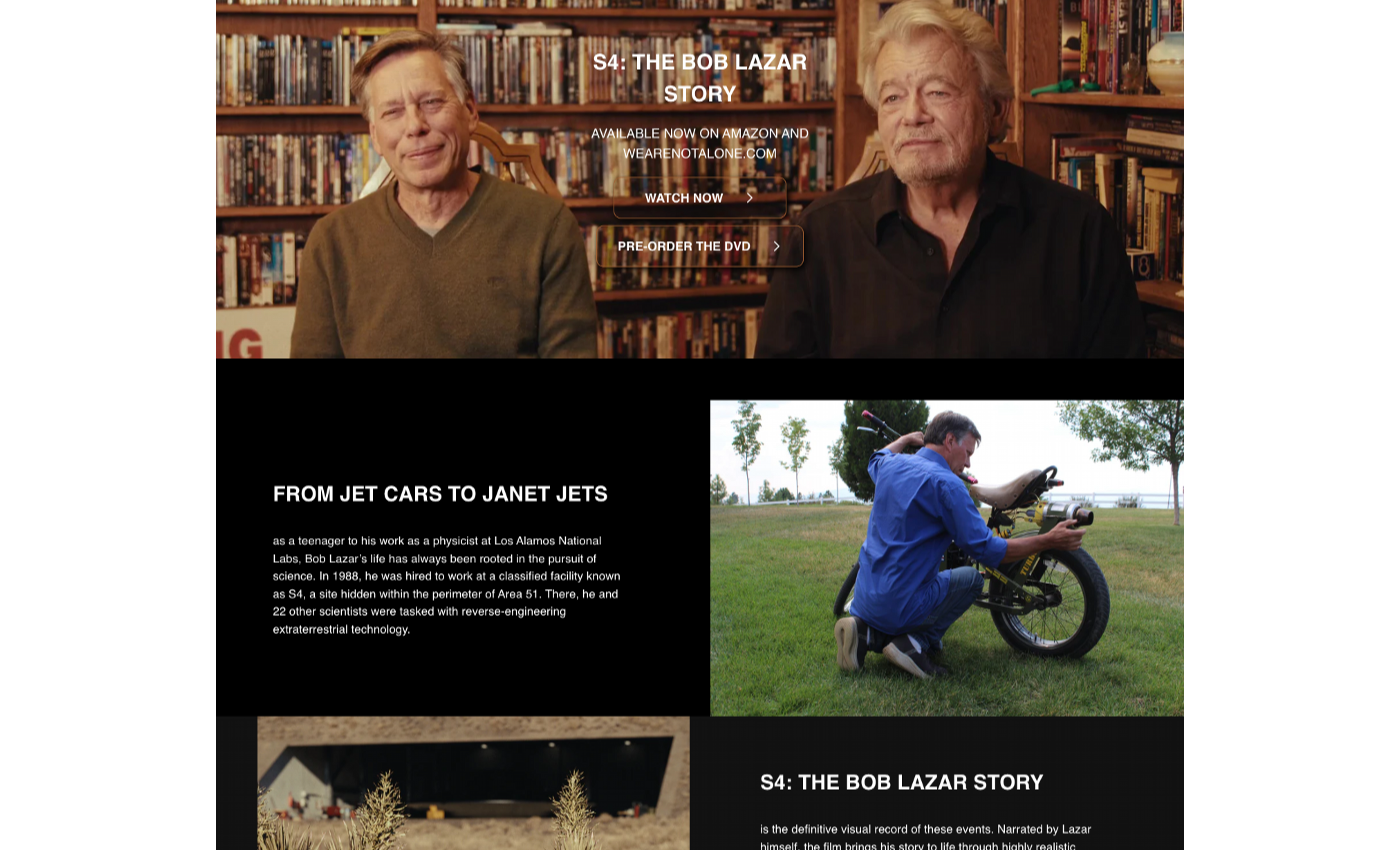
The new product is called S4: The Bob Lazar Story. It is a 1-hour-54-minute documentary, directed by Luigi Vendittelli and Christopher Matteau, narrated by Lazar, released on Amazon Prime Video on 3 April 2026. On Rotten Tomatoes the critic score is empty — zero reviews — and the Popcornmeter sits at 96% across 250-plus audience ratings. The film is also sold through the producers' own WANA Channel at wearenotalone.com for $8.88 a month or $88.89 a year after a 3-day free trial.
It is not the first film about Lazar. Jeremy Corbell's 2018 documentary Bob Lazar: Area 51 & Flying Saucers already exists. What is new is the pipeline around it. The 2026 release is the visible part of a five-stage product that started as a die-cast model in a Canadian marketer's garage and ended with a Joe Rogan Instagram post to a global audience.
The man behind the film is a marketer, not a journalist
Luigi Vendittelli is Canadian. He is not a filmmaker. In his own description, he spent the COVID shutdown "taking a deep dive into the Bob Lazar story" and decided to build a die-cast replica of the craft Lazar has described since 1989 as the "Sport Model" — the disc-shaped object Lazar says he was hired to reverse-engineer at a facility called S-4, near Area 51, alongside 22 other physicists.
From a die-cast model, the project moved to a virtual recreation. Vendittelli told investigative reporter George Knapp, in a 9 April 2026 Mystery Wire piece for KLAS Las Vegas: "It's like a car company making a car. We had a book to how to make a sport model. And it was about all the specifics." The "book" was Lazar's own memory — three decades of recollections, sketches, and walkthroughs of the hangars, the bench layout, the colour of the paint in the hallway.
Then the project expanded again. "One of the guys I was working with said, you could do a VR experience doing this. And I said, okay, well, now, now we're talking. At least there's a way to monetize it because it's a lot of money to invest."
The four-and-a-half-year collaboration produced a film, a VR environment, a die-cast model, an official soundtrack on Apple Music, a Project Gravitaur merch shop with posters, DVDs, mugs, and clothing, and a streaming platform — WANA Channel — that sells bonus episodes such as Bob Lazar: Unfiltered Episode 1 and George Knapp & Bob Lazar: Unfiltered Episode 1 for individual purchase.
What the film shows — and what it does not
According to the Project Gravitaur site, the film is "the definitive visual record of these events," built around "highly realistic and accurate recreations of exactly what he witnessed inside the S-4 facility." It is supported, the site says, by "never-before-seen tangible evidence, humanizing footage of Lazar's personal life, and exclusive interviews with Gene Huff, George Knapp, Mario Santa Cruz, and Joy Lazar."
The people in the film are the same circle Lazar has lived inside since 1989: Huff, a friend and key witness; Knapp, the Emmy-winning KLAS investigative reporter who first put Lazar's story on television; Santa Cruz, a friend "before, during and after S-4"; and Joy Lazar, his wife.
What is missing from that list is anyone outside the Lazar circle. There is no interview with an academic physicist evaluating the propulsion claims, no documentary record of Edward Knapp's brief November 1990 confirmation that he had seen "letters of recommendation" for Lazar at Sandia — and the equally quick retraction. There is no confrontation with the missing Caltech and MIT transcripts. There is no footage from the 2017 FBI search of United Nuclear.
Lazar himself, in Knapp's KLAS write-up, gives the film the central defence it will need: "No matter how many times you tell a story, you can tell a story to 100 people, even a detailed explanation of what you're trying to get across, and you will still come out with 40 or 50 different, you know, images in their mind or versions of it."
That sentence is also the strongest argument for the pipeline's existence. If a single viewer ends up with 40 to 50 versions of an unwitnessed scene, a film that shows only one version is doing something more than reporting. It is doing the visual work that the missing physical evidence cannot.
Lazar did not want to be in another documentary
Knapp's piece is unusually candid about Lazar's resistance to the project.
"Lazar did not want to be part of another documentary, and didn't welcome the idea of doing interviews to promote it," Knapp wrote. "Every time he has raised his head out of the foxhole over nearly four decades, he gets pummeled as a liar, conman, criminal or worse, who covets attention."
Lazar's own quote to Knapp: "But yeah. Attention. You, if you make a claim like that, you clearly have, you know nothing about me."
The thing that broke the resistance was the VR rebuild. Vendittelli's team worked from Lazar's older sketches and decades-old graphics, asking at each step about "the color of paint in a hallway or the location of a door or workbench." When the VR environment was finished, Lazar said it "really made the hair stand up on my arms. That, that, that he reached that level of reality to me."
That reaction matters. The reconstruction is the only artifact in the project that has been confirmed as accurate by the man whose memory is being reconstructed. It is not a confirmation of the underlying claim. It is a confirmation that the visual reconstruction matches his memory. The two are different things, and the project's marketing does not always separate them.
The other economy around Lazar
The product pipeline did not start in 2020, and it does not end with Vendittelli.
Knapp, in the same article, lists what already surrounds Lazar's name in the United States: "bus tours, TV shows, movies, an E.T. Highway, a baseball team, songs, trinkets, jokes, and an army of people devoted to debunking Lazar over the decades." That is the description of an industry, not of a witness.
The new film slots into the existing machine. The Project Gravitaur site sells its merch through the same kinds of checkout pages United Nuclear already uses. United Nuclear itself sells a hand-signed S-4 base sketch — the same drawing reproduced and commercialised in Vendittelli's VR environment and on Project Gravitaur posters. Joe Rogan launched the film to his audience on 3 April 2026.
The pipeline is not a single product. It is a circle. Lazar's memory becomes a VR reconstruction. The VR reconstruction becomes a film. The film feeds a streaming channel. The streaming channel feeds a merch shop. The merch shop feeds back into the public image of Lazar the storyteller. Every stage adds a revenue layer. None of the stages add a new piece of public-record evidence.
What the 1989 claim still looks like in 2026
The underlying story has not changed since Lazar's first on-camera interview with Knapp, in May 1989. Lazar says he was hired at S-4 in 1988 to reverse-engineer recovered alien craft, that the craft is a disc he calls the "Sport Model", and that the reactor runs on element 115 — moscovium, its periodic-table name — which was synthesised in a Russian-American laboratory in 2003 and confirmed by IUPAC in 2016.
The supporting evidence in 2026 is still the same evidence available in 1989: Lazar's own testimony, his then-wife's confirmation, a video of the disc being test-flown over the Nevada desert that he says was recorded by Gene Huff and Gene's brother, the brief and quickly retracted confirmation from Sandia's Edward Knapp, the missing Caltech and MIT transcripts, and the United Nuclear business record that includes a 2017 FBI search related to a Michigan homicide investigation, not to element 115.
None of that has been added to by the new film. The film adds visual recreation. It adds Joseph Rogan's audience. It adds a checkout page.
The most honest summary comes from Lazar's own words, recorded by Knapp in April 2026: the story, told a hundred times, still produces forty or fifty versions. A film that picks one version and renders it in VR is now for sale on Amazon.
Related UAP Logbook notes
- Bob Lazar has a checkout page — the United Nuclear store, the 2017 FBI search, and the commerce lane.
- Area 51 is not one mystery. It is a machine. — the geography and the restricted airspace around S-4.
- Disclosure Day was not science fiction to Spielberg — how the 2026 disclosure-adjacent media cycle feeds the same audiences.
Sources
- George Knapp, KLAS Mystery Wire, "Reconstructing the world of Bob Lazar: 'S4' collaboration brings original story to life," 9 April 2026 — the central source for the pipeline, the Vendittelli quotes, and Lazar's own resistance.
- Project Gravitaur, "About S4: The Bob Lazar Story" — production company page, cast list, and product framing.
- WANA Channel (wearenotalone.com) homepage — subscription streaming platform, pricing, and bonus-episode catalog.
- Rotten Tomatoes, "S4: The Bob Lazar Story" (2026) — 1h 54m runtime, 0% Tomatometer / 96% Popcornmeter, distributors Motivo.
- IMDb, "S4: The Bob Lazar Story" (2026, tt37605896) — release date 3 April 2026 (streaming), full cast and crew.
- Amazon Prime Video listing for "S4: The Bob Lazar Story" — official distribution and current availability.
- Joe Rogan, Instagram post, 3 April 2026 — the launch audience for the film.
- Wikipedia, "Bob Lazar" — for the 1989 timeline, the Edward Knapp November 1990 confirmation, and the 2017 FBI search of United Nuclear.
- Jeremy Kenyon Lockyer Corbell, dir., Bob Lazar: Area 51 & Flying Saucers (2018 documentary, 97 min) — the prior film in the pipeline.
- George Knapp, Dreamland: An Autobiography (2001, with contributions from Ryan S. Wood) — for the 1989–1990 first-interview timeline and the S-4 layout Lazar described.