News / Jun 15, 2026
The Pokhara disc in the CIA's Himalayan UFO file
A 1968 CIA UFO file in PURSUE Release 03 lists bright objects over Ladakh, Nepal, Sikkim, and Bhutan. The sharpest line comes from Nepal: a metallic disc-shaped object reportedly found in a crater near Pokhara. Later Nepali reporting points to a colder possibility: space debris.
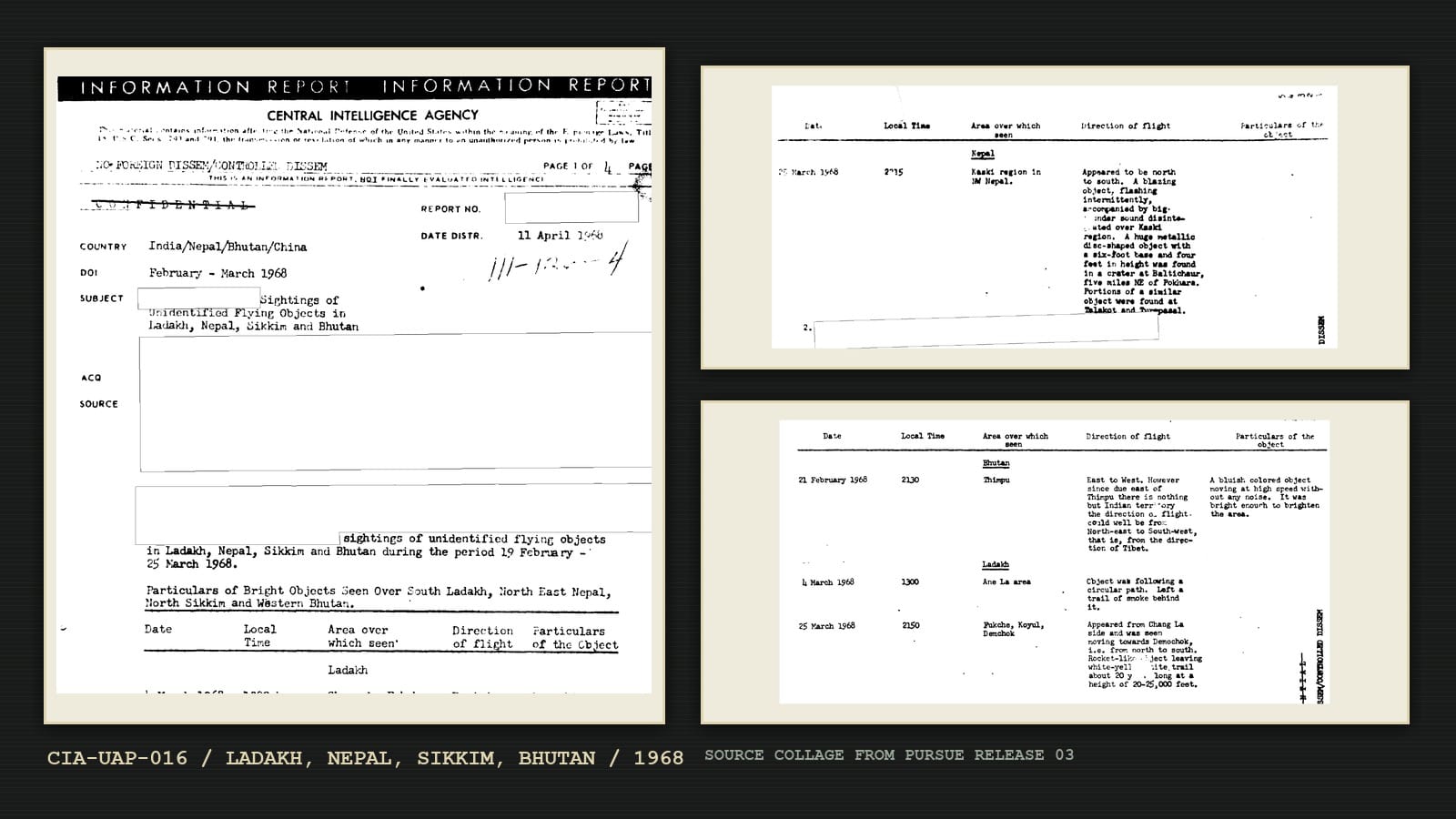
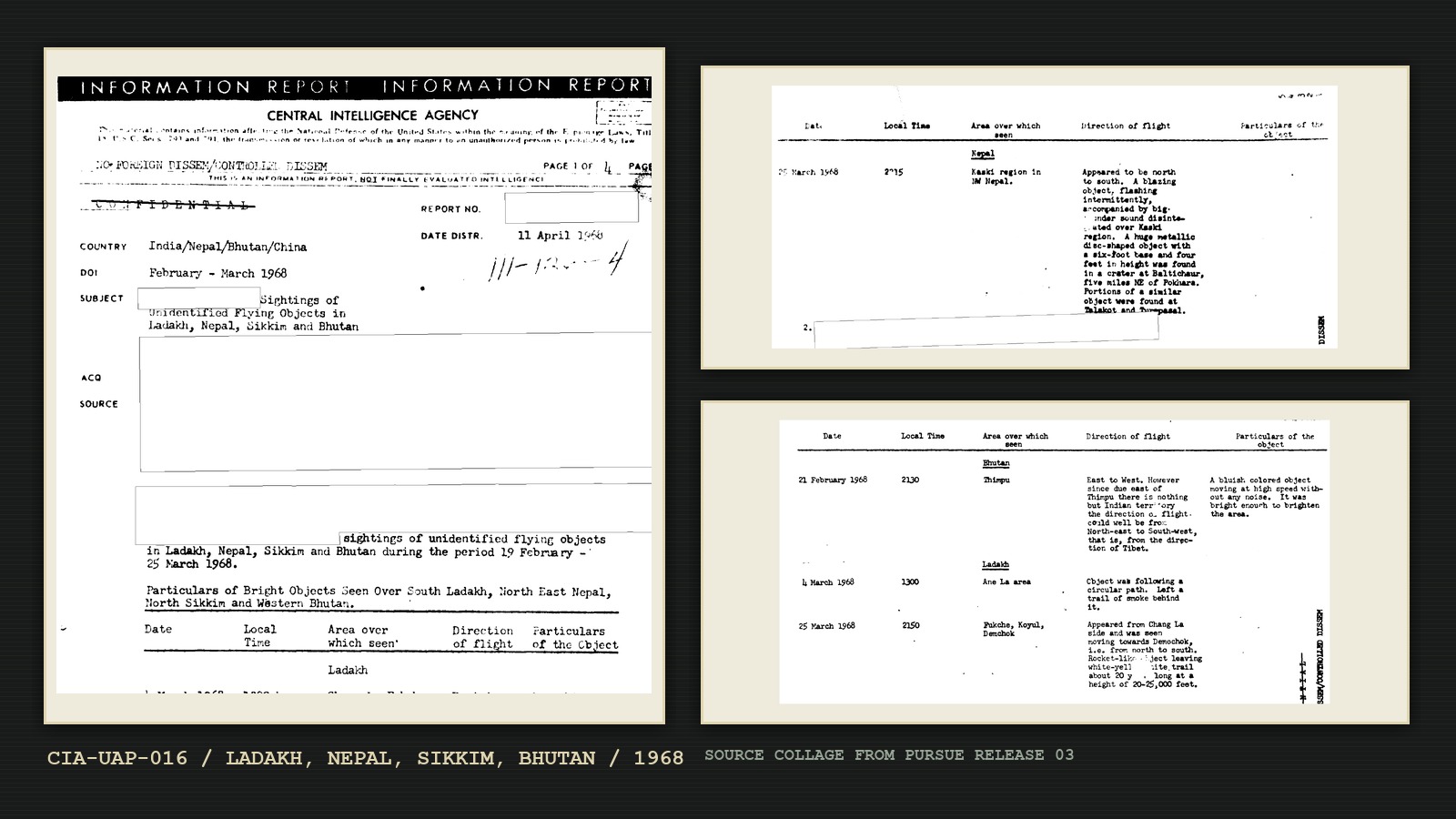
A 1968 CIA intelligence report released in PURSUE Release 03 describes seven UFO sightings across the Himalayan borderlands — and one claim that stands apart from the rest.
A "huge metallic disc-shaped object," the file says, was found in a crater near Pokhara, Nepal.
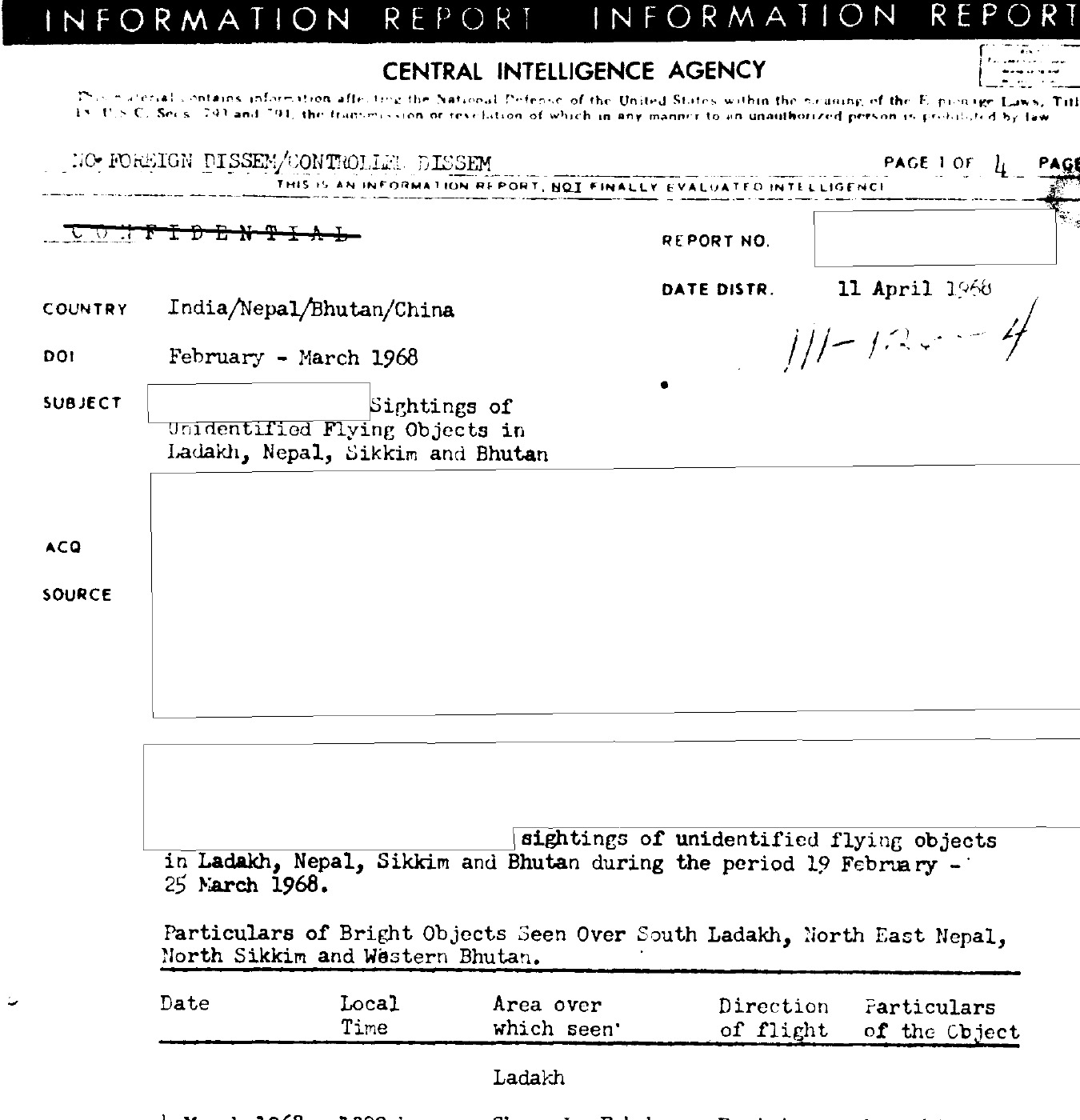
The file is CIA-UAP-016, dated April 11, 1968. It covers sightings across Ladakh, Nepal, Sikkim, and Bhutan between Feb. 19 and March 25, 1968. The Department of War published it June 12, 2026, as part of the third PURSUE release.
What CIA-UAP-016 says
The report's country line reads "India/Nepal/Bhutan/China." Its subject is sightings of unidentified flying objects in Ladakh, Nepal, Sikkim, and Bhutan.
The source line is redacted. The document carries a standard warning: it is an information report, not finally evaluated intelligence.
The scan is thin on evidence. There are no photographs, debris images, witness names, radar plots, or lab results in the release.
Why this region
The sightings stretch along a Cold War frontier: Ladakh, Nepal, Sikkim, and Bhutan, all near or facing the Chinese borderlands.
The geography is the first clue. The 1962 Sino-Indian War had ended only six years earlier. China was testing nuclear weapons at Lop Nur. U.S. interest in Nepal and the Himalayan border region was already tied to China, Tibet, Soviet influence, and high-altitude intelligence work.
The file leaves out who collected the information and what prompted the report. The pattern is still clear: seven entries in a five-week window, all along the Himalayan arc.
Seven sightings across the Himalayas
The report is built as a table of "bright objects" seen over South Ladakh, northeast Nepal, north Sikkim, and western Bhutan.
On Feb. 19, over northeast Nepal, the file describes a fast-moving object, long and thin, emitting red and green light. The scan says it was bright enough to create daylight, with a thunder sound heard after a few seconds.
The same date appears in Sikkim. The table's scan is rough, but it describes an object giving light from its tail, bright enough to brighten the area, with thunder heard after the sighting. The direction line is confused in the source; the report itself notes that the Nepal direction may be the more correct one because the date and time coincide.
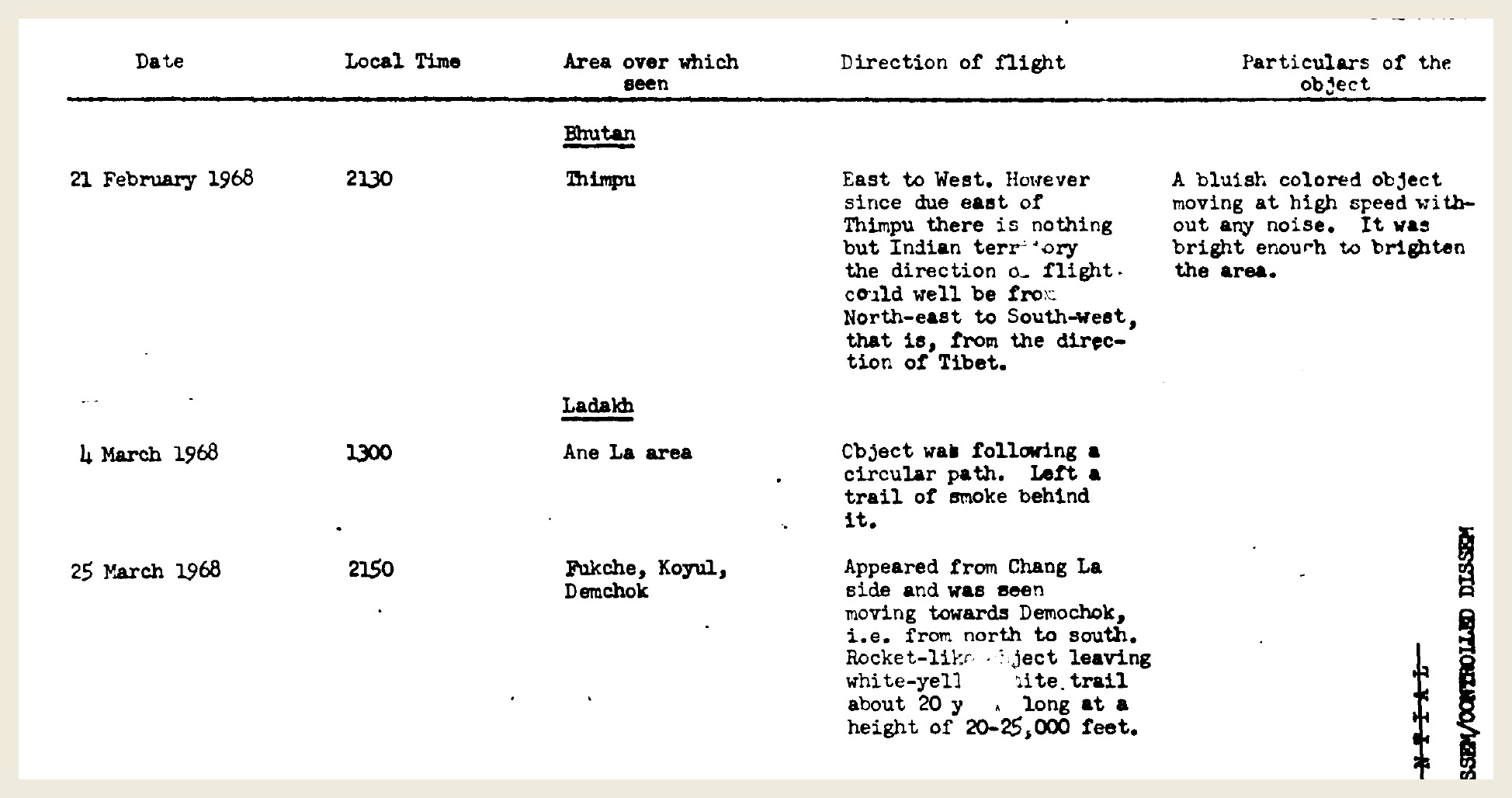
On Feb. 21, the file lists Thimphu, Bhutan: a bluish object moving at high speed, without noise, bright enough to brighten the area.
On March 4, over Chang La, Fukche, and Koyul in Ladakh, the table says one white light moved east to west. Two blasting sounds were heard. A reddish light followed by white smoke was also reported.
Then Ladakh appears again. On March 4, at Ane La, an object reportedly followed a circular path and left a smoke trail. On March 25, over Fukche, Koyul, and Demchok, a rocket-like object reportedly moved from the Chang La side toward Demchok, leaving a white-yellow trail at an estimated 20,000 to 25,000 feet.
The Pokhara line
The final Nepal entry is the clearest hook in the file.
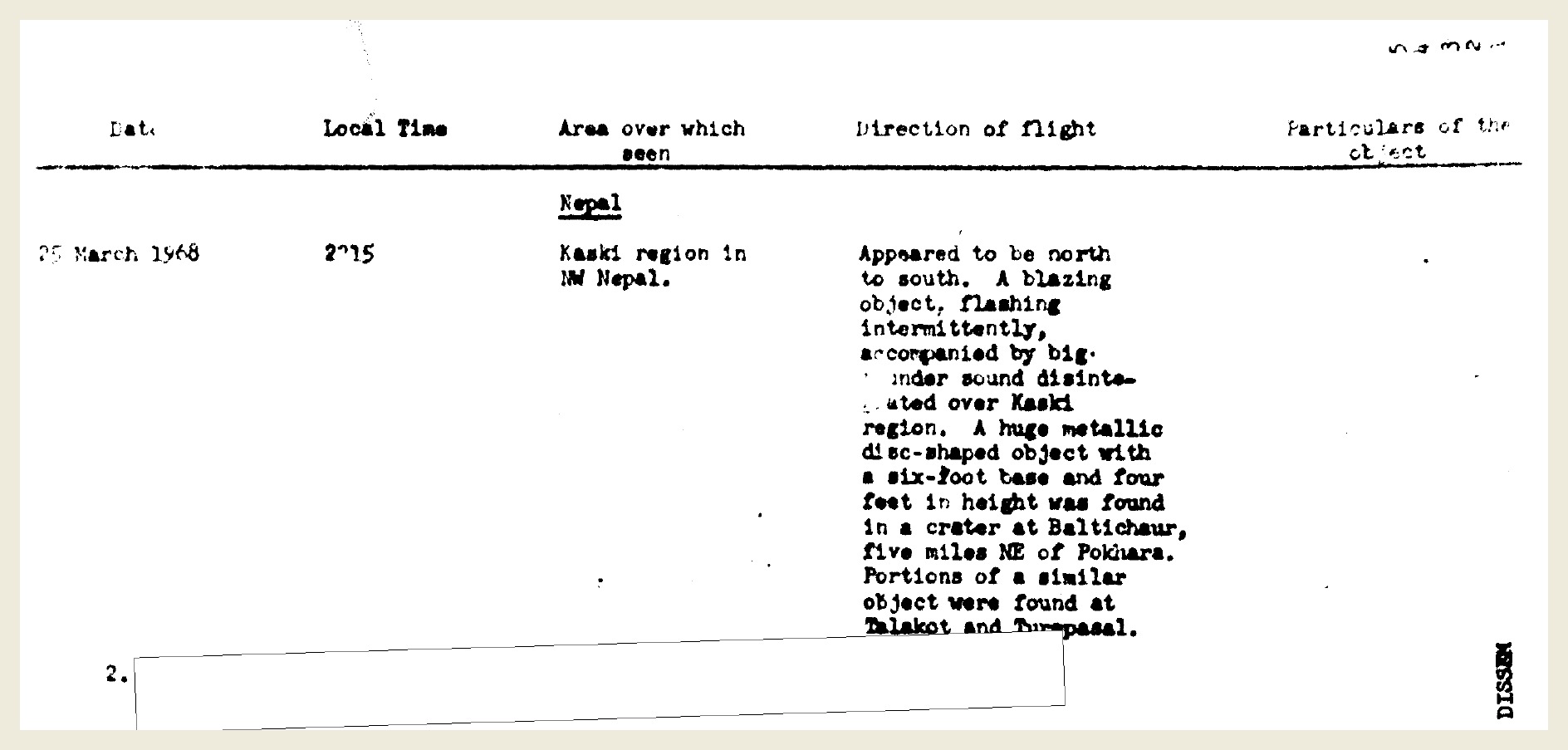
At 2215 on March 25, 1968, over the Kaski region in northwest Nepal, the report describes a blazing object moving north to south, flashing intermittently, accompanied by a loud thunder sound, and disintegrating over the region.
Then the file adds the ground claim. A huge metallic disc-shaped object with a six-foot base and four feet in height was found in a crater at Baltichaur, five miles northeast of Pokhara, according to the report. The final line says portions of a similar object were found at two other named locations, though the scan is hard to read at that point.
"Baltichaur" appears to be a variant spelling of Batulechaur, a locality in Pokhara. A 2019 Kathmandu Post column by Amish Raj Mulmi cited the same CIA document and placed the incident in Batulechaur, on the way to Mahendra Gufa. Mulmi noted that Pokhara was a much smaller town in 1968, and asked how information from such remote areas reached U.S. authorities at all.
What local reporting added
Later Nepali reporting adds the part the CIA table leaves out.
In 2020, Mulmi returned to the case for The Kathmandu Post after local photo archivist Sunil Ulak tracked down a witness account. The witness was Kul Prasad Timilsina, who said he saw the sky light up, found a metal disc in his field the next morning, and used it around a buffalo shed before officials took it away.
The same column cited two U.S. State Department documents from 1968 that treated the metal as foreign space debris. One preliminary report said some pieces could be Soviet, possibly Cosmos 208, a Soviet military photo-surveillance satellite that re-entered on the night of March 25, 1968.
Nepali Times followed the story in 2024 with more local reporting. It described witnesses in Batulechaur, conflicting versions of where the metal sheet went, and a 1972 State Department and Defense telegram tagged "MOON DUST / Space Fragments" that referred to a restored space fragment being shipped back to Kathmandu.
Put those pieces together and the Pokhara line becomes more than a strange UFO entry. It becomes a Cold War space-debris trail: something fell, local people noticed it, U.S. officials got interested, and the object moved into the machinery of foreign-technology collection.
What changed with PURSUE
The official Release 03 data says a more redacted version of the same report had already been available on the CIA's public website. The new release gives the file a fresh route into the UAP conversation, now under a modern PURSUE label and a CIA-UAP file number.
The UFO label is what made CIA-UAP-016 travel. The metal is what keeps it interesting.
The missing piece is still simple: the identification. The trail points to a space fragment. The final lab answer is still not on the page.
CIA-UAP-016 now has a sharper shape: seven sightings across the Himalayas in early 1968, one ground-recovery claim near Pokhara, and a Cold War space-fragment trail running underneath the UFO label.
Related UAP Logbook notes
- PURSUE Release 03: CIA files, FBI orbs, and a 1949 flying saucer study
- CIA-UAP-017: The Harare airport UFO that put Zimbabwe on high alert
- The 1998 UFO mailbag inside PURSUE Release 03
- "Orbs Launching Orbs": The unresolved AARO case from PURSUE Release 03
Sources
- CIA-UAP-016: Sightings of Unidentified Flying Objects in Ladakh, Nepal, Sikkim and Bhutan, released in PURSUE Release 03.
- PURSUE Release 03 data CSV.
- Amish Raj Mulmi, "How the US kept tabs on UFO sightings and Yeti hunting in Nepal," The Kathmandu Post, Feb. 8, 2019.
- Amish Raj Mulmi, "Close encounters, of the terrestrial kind," The Kathmandu Post, Oct. 15, 2020.
- Durga Rana Magar, "UFO over Pokhara," Nepali Times, Dec. 7, 2024.