
Short Note / Jun 30, 2026
Council Bluffs sat on 35 pounds of molten metal for 44 years. Then a Stanford lab looked at it.
Council Bluffs got a fire call about a glowing red-orange mass in Big Lake Park on a December night in 1977. Eleven witnesses saw something fall. Two saw a round object with red lights. NASA and the Air Force took a look and gave up. Jacques Vallée kept a sample. Forty-four years later, a Stanford team analyzed it in a peer-reviewed journal.
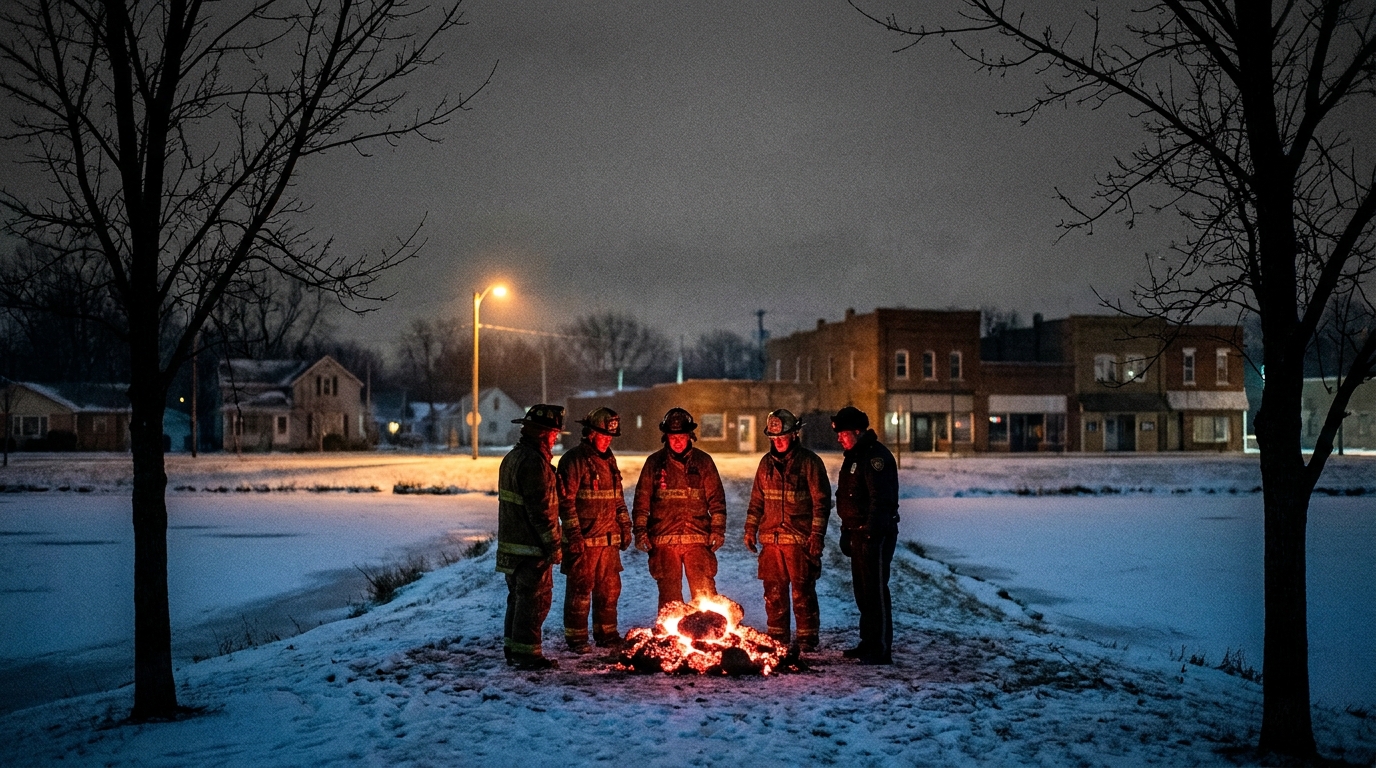
Council Bluffs got a fire call about 8 p.m. on Saturday, December 17, 1977.
By the time Assistant Fire Chief Jack Moore reached Big Lake Park on the north side of the city, the thing was still molten. About thirty-five to fifty-five pounds of metal sat in a six-by-four-foot patch on a grassy dike sixteen feet from the road, glowing red-orange, hot enough to ignite the grass. Lava-like strands ran down the dike and slowed as they cooled. A bluish, crystalline substance sat at the center of the mass. One witness told the local historical society it "looked like a great big sparkler."
Eleven witnesses saw something that night, according to the local account. Most of them called in to report what looked like a plane crash. Two of them described a round object hovering below the treetops. The fire department and the Council Bluffs police both showed up within fifteen minutes. They saw the same mass. It was still too hot to touch.
What investigators ruled out
Whatever had happened, three obvious explanations were on the table from the start.
Eppley Airfield and Offutt Air Force Base were both contacted. Neither knew of any aircraft crash in the area, and no plane or helicopter had reported a malfunction or a dropped load. A meteorite was the second candidate and the easiest to dismiss. A meteor of that size would have left a crater, and there was none. It also would have left stone, not molten iron.
The third candidate was the hardest to rule out from a fire chief's truck. Council Bluffs had two foundries in 1977. The first wave of analysis on the residue came back as "a simple high-carbon steel of a type common in manufacturing," which is exactly the kind of finding that closes a fire investigation and not much else. The melted metal was a perfect match for what a local foundry could have produced.
Three things kept the case open. The fire department found no signs of transport, no scorch marks away from the park, no empty crucible, and no trace of a foundry making an off-the-books pour on a Saturday evening. Two witnesses put a hovering object with red blinking lights in the sky. And a police photographer had shot Polaroids at the scene that night, the kind of evidence a metallurgy lab could do something with.
What a peer-reviewed paper did with it
Jacques Vallée, a French computer scientist whose case-file archive on UAP physical traces dates to the 1960s and includes hundreds of named incidents, kept one of the samples. In a 2021 paper in Progress in Aerospace Sciences — written with the Stanford immunologist Garry Nolan, the radiobiologist Sizun Jiang, and the aerospace-medicine researcher Larry Lemke — Vallée put a piece of the Council Bluffs material through a Multiplexed Ion Beam Imaging instrument designed for cell biology.
The paper does not say the metal is from off the planet. It says three things that fit the local record. One, all the isotopes lined up with terrestrial origin except for a small deviation in iron-57, and the authors suggested a conventional explanation for that. Two, the metallic residue, the slag and the white inclusions in the slag did not form naturally by any ordinary process the lab could identify. Three, the case is "perfect" for building a pipeline of material analysis on alleged UFO residues — meaning well-collected, well-witnessed, well-preserved, and still unexplained.
That last line is the part of the paper journalists usually skip. A peer-reviewed journal in January 2022 ran an analysis of a sample that fire crews pulled off a frozen park dike in Council Bluffs forty-four years earlier and the best the authors could say is that the sample is real, the origin is not, and the methodology now exists to keep working on cases like it.
What is and is not in the public file
In the public file. The local history. The 2021 peer-reviewed paper. The 2025 arXiv preprint. Two magazine profiles of the researchers. The television episode that put Vallée and Nolan on camera together. Full source list below.
Not in the public file. The Council Bluffs police Polaroids. The full three-component sample layout. Eppley Airfield and Offutt AFB aircraft logs for that December weekend. Any Iowa foundry shift log covering a Saturday-night pour. Any second wave of isotopic analysis on a fresh Council Bluffs sample since 2021.
Council Bluffs is what a physical-trace case looks like when the trace outlasts the witnesses by four decades and the analysis still sits at "consistent with terrestrial, but the inhomogeneity is real, and the original sample is no longer at the scene."
What stays open
- Did any other UAP sample ever reach a peer-reviewed aerospace-science journal on a story like Council Bluffs? Nolan and Vallée have both said no. The 2022 paper remains the named reference.
- Has a second Council Bluffs sample been analyzed since the 2021 paper? The public record does not say so.
- Have the Council Bluffs police Polaroids been published anywhere outside Vallée's own files? No published version has surfaced.
Related UAP Logbook notes
- Garry Nolan says UFO metals need lab work. Oak Ridge tested one famous sample
- Colm Kelleher carried Skinwalker out of the ranch and into the UAP era
- Vallee as computer-science and database figure: UFOCAT, GEIPAN and the information-infrastructure problem
- The UFO hoaxes that still haunt disclosure
Sources
- Nolan, Vallée, Jiang, Lemke: "Improved instrumental techniques, including isotopic analysis, applicable to the characterization of unusual materials with potential relevance to aerospace forensics," Progress in Aerospace Sciences Volume 128, online December 9, 2021 (cited as the primary publication venue; full journal issue January 2022).
- Richard Warner: "Close Encounter at Big Lake Park," Historical & Preservation Society of Pottawattamie County.
- Knuth et al. (2025): "The New Science of Unidentified Aerospace-Undersea Phenomena (UAP)," arXiv:2502.06794 (Council Bluffs is section 5.3.2 — UAP Deposits).
- Sam Scott: "First Contact," Stanford Magazine, July 2023.
- "Jacques Vallée Still Doesn't Know What UFOs Are," Wired.
- National Geographic, "UFOs: Investigating the Unknown MEGA Episode: UFO Truths Exposed".
- Keith Basterfield: "Vallee-Nolan et al, peer reviewed analysis of unusual materials paper published," December 11, 2021 (closest open-access summary of the paper's Section 3 Council Bluffs case study).