
News / Jun 17, 2026
Jacques Vallee helped turn UFO stories into data
Jacques Vallee is often treated as the theorist of the strange. The sharper trail starts with the database: UFOCAT, case catalogs, computer work, and the question of what UFO reports become once someone tries to sort them.
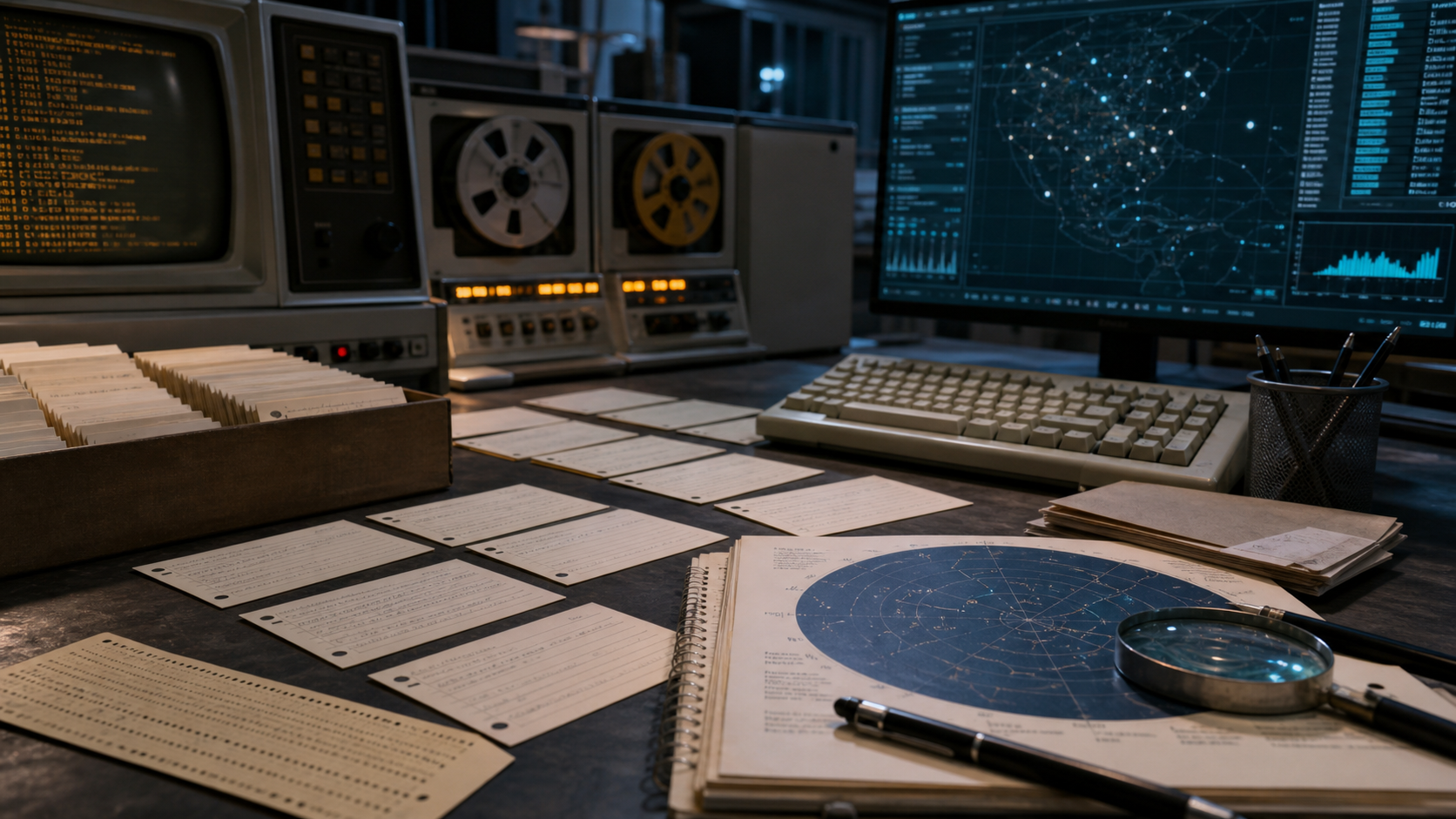
Jacques Vallee is often remembered for the strange theories.
Passport to Magonia. Folklore echoes. The control-system idea. The theory that UFOs may not fit a simple visitors-from-space model.
But his sharper contribution was more practical.
Vallee brought computer science into the UFO problem. Instead of asking only whether one witness saw one strange thing, he asked what happens when thousands of reports are stored, coded, compared, and searched.
That question is back in 2026.
AARO pages, DVIDS videos, PURSUE file labels, FBI letters, CIA clippings, NASA audio, congressional clips, and social-media frames are now moving through the same public conversation. The mystery is not only what people saw. It is how the reports are sorted.

The computer scientist in the UFO room
Vallee's biography does not read like a normal UFO biography.
The Sol Foundation profile describes him as a former Paris Observatory astronomer who co-developed the first computerized map of Mars for NASA in 1963, then worked at Stanford Research Institute's Augmentation Research Center under Douglas Engelbart, in the ARPANET world that helped lead to the internet.
His own professional bibliography is heavy with information systems, message systems, retrieval languages, computer conferencing, and database work. The UFO shelf sits next to a computer-science shelf.
That matters because Vallee did not only treat UFOs as a belief question. He treated them as an information problem.
UFOCAT and the sorting problem
UFOCAT shows the older version of that problem.
The Center for UFO Studies says UFOCAT began during the Air Force-sponsored Colorado UFO project, also known as the Condon Committee. CUFOS describes the latest UFOCAT-2023 version as a database with more than 300,000 entries, including more than 192,000 primary UFO reports.
Vallee's early part is specific. CUFOS says he contributed a large computer catalog of approximately 6,000 cases at the project's inception.
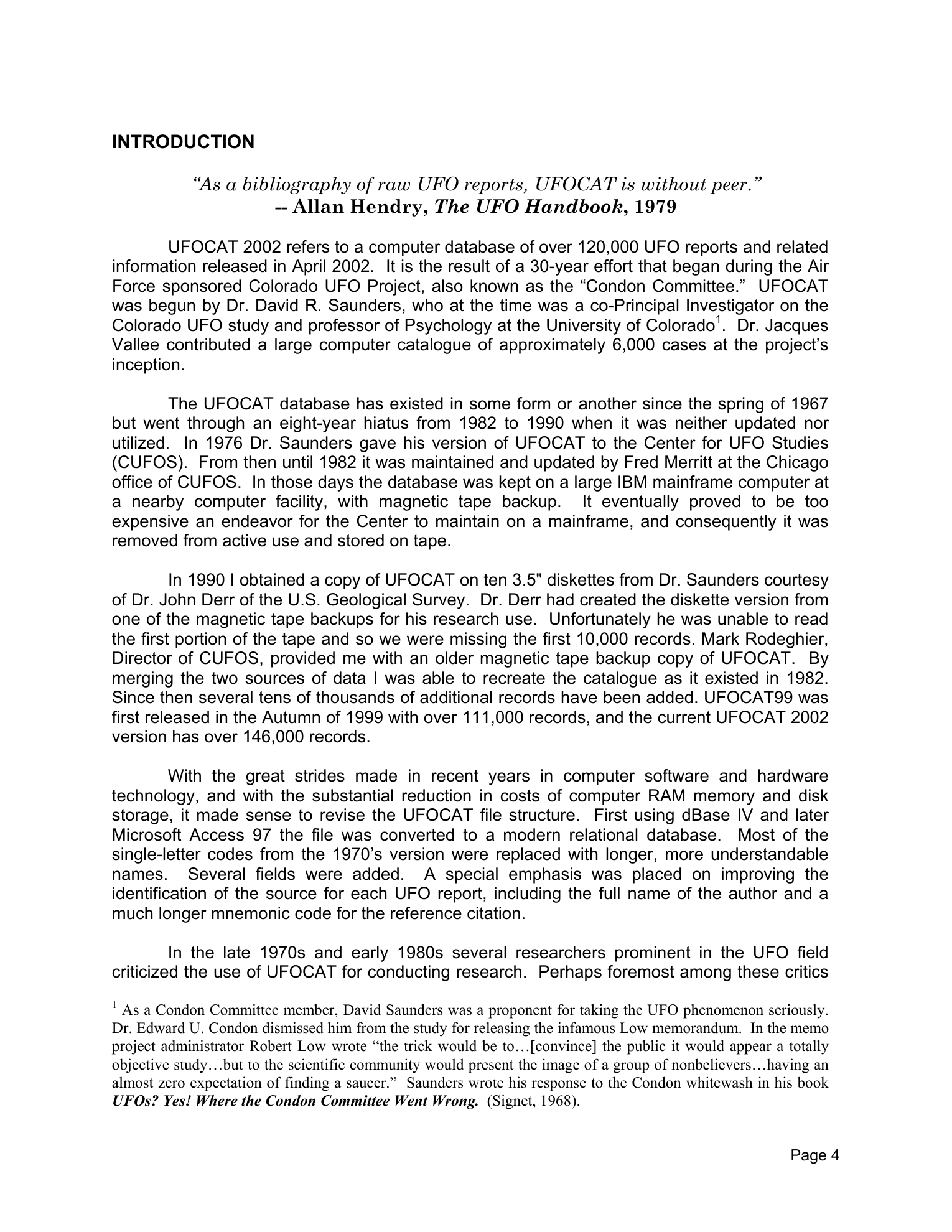
That sounds ordinary now. It was not ordinary when UFO reporting lived across books, card files, newsletters, local newspapers, private collections, letters, and official files. A database changes the question. Instead of asking only whether one witness saw one thing, it asks what the whole pile looks like when sorted by time, place, shape, behavior, witness type, duration, setting, and source.
The database does not solve the phenomenon. It does something more practical: it keeps the reports from becoming only anecdotes.
The theory came after the pile
Vallee is famous for ideas that pull UFOs away from a simple extraterrestrial-hardware model. He wrote about folklore echoes, social effects, deception, control systems, and cases that looked modern and old at the same time.
That theory can get slippery when it is detached from the file work underneath it. The stronger way into Vallee is to start with the pile.
He had cases from different eras. Reports that did not fit one tidy technical bucket. Witness stories with physical details, cultural details, and bad data mixed together. Once the pile gets large enough, a single explanation starts to look cramped.
The database side does not make every strange report true. It does explain why Vallee kept resisting easy answers.
The Capella problem
Vallee was still making the database argument decades later.
In a 2014 paper for a CNES/GEIPAN workshop in Paris, he described the history of UAP catalogues and the obstacles that keep them from becoming a serious research base. The paper is blunt about the problem: many groups collect reports, but standards, validation, source tracking, and long-term maintenance vary widely.
The paper also describes Capella, a proposed data warehouse made from multiple databases. Its diagram is not glamorous. That is the point. It places photographs, recordings, videos, maps, satellite views, radar data, web links, and internal databases into one structure.
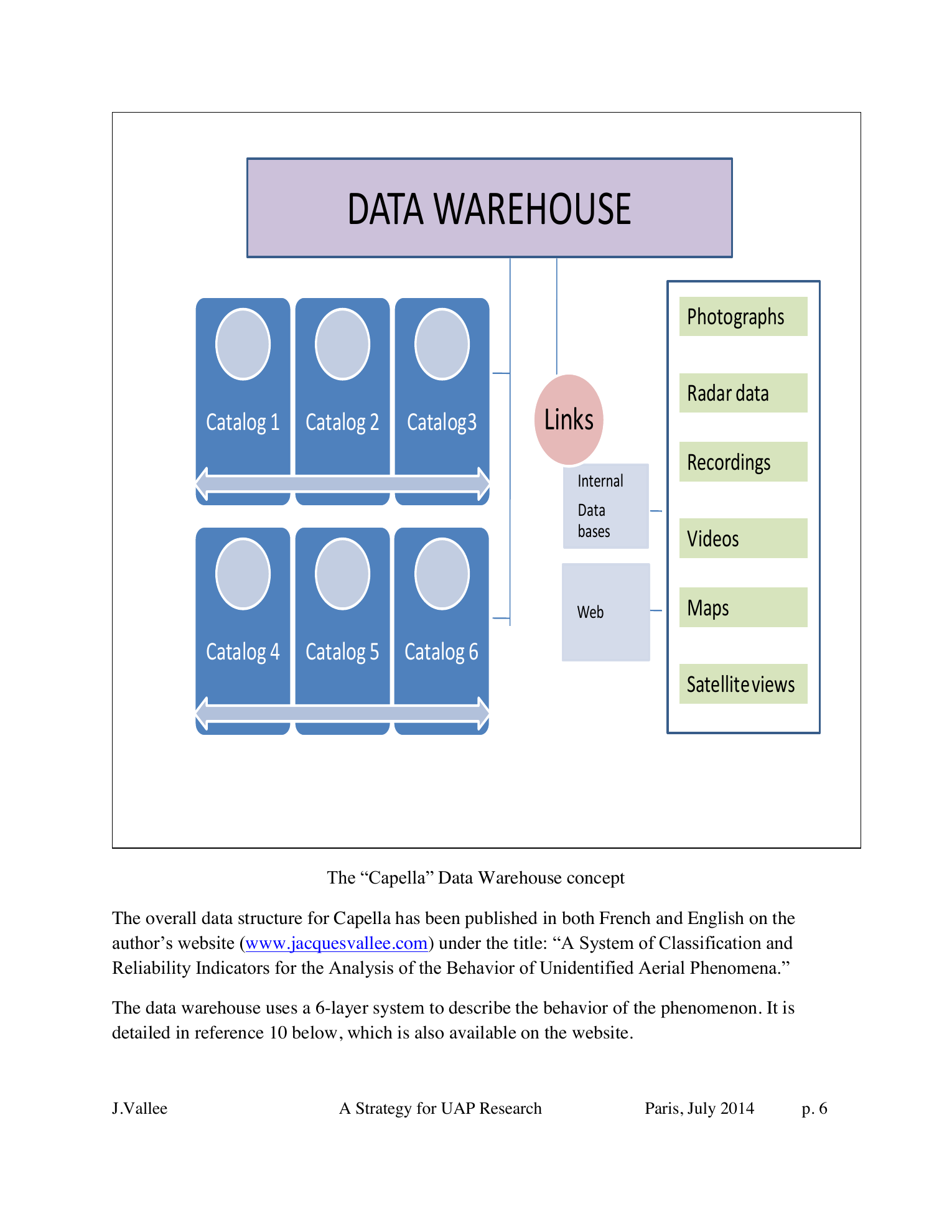
That is very close to the UAP problem now. The public sees a clip. A file has a title. A witness has a description. A news segment has a headline. A government page has a PDF. A social post has a cropped frame. The hard work is making those layers talk to each other without pretending they are the same thing.
Why Vallee still fits 2026
The modern UAP era is full of releases that look official but arrive in pieces.
AARO pages. DVIDS videos. PURSUE file labels. FBI correspondence. CIA clippings. NASA audio. Congressional clips. International offices. Old newspaper stories coming back through new search terms.
That is why Vallee still fits. He is not only a theorist of high strangeness. He is one of the early figures who treated UFO reports as information infrastructure.
The current fight is not only over belief. It is over fields: date, place, source, sensor, witness, file number, chain of custody, duplicate status, explanation status, confidence level, and what the report actually contains.
That may sound less dramatic than a crashed-saucer story.
It is also where the real work begins.
Related UAP Logbook reading
- France has had a UFO office since 1977
- What is PURSUE? The UAP records release program explained
- PURSUE Release 03 is out: CIA files, FBI orbs, and a 1949 flying saucer study
- The 1561 Nuremberg sky battle still has a job
- The CIA's UFO fringe file starts with psychoweapons panic