Main Article / Jul 16, 2026
A new DMT preprint asks whether the entities are real
A May 2026 PsyArXiv preprint asks whether recurring DMT entity encounters could be perceptions of other minds. Its authors propose tests; they do not report a positive result.
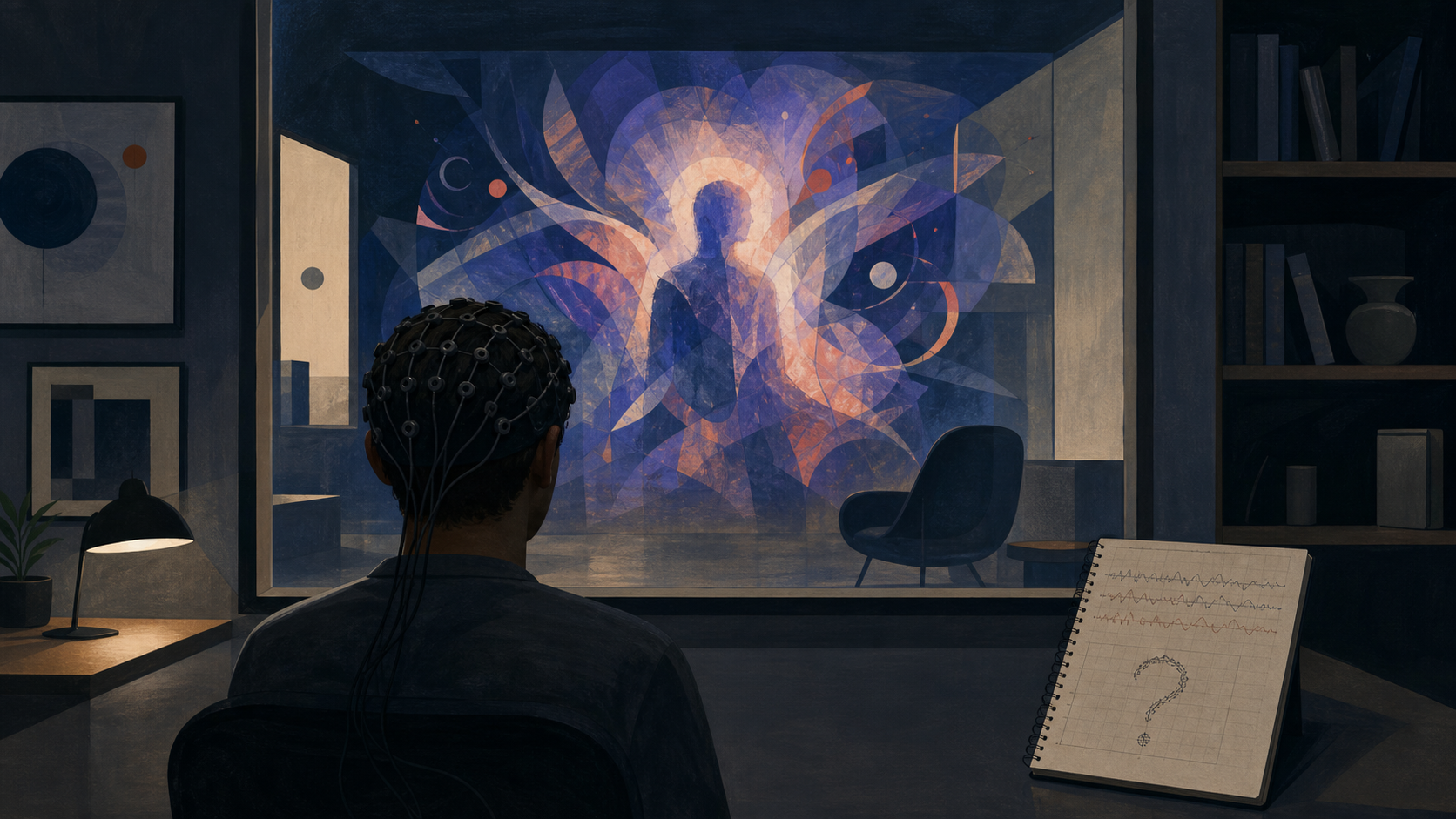
In thousands of public DMT accounts, the same report keeps appearing: somebody is there.
A 2022 analysis of Reddit posts counted entity encounters in 1,719 of 3,778 first-hand reports. The descriptions did not settle into one shared character. Some writers described a feminine presence, others gods, aliens, creatures, jesters or the “machine elves” popularised by psychedelic writer Terence McKenna. What did recur was the feeling that the encounter was with an autonomous intelligence.
That pattern is now the starting point for a more ambitious claim. A PsyArXiv preprint posted on 27 May 2026 asks whether some DMT entity encounters might be perceptions of other consciousnesses rather than experiences generated wholly within the brain. The authors are Andrew R. Gallimore, Niffe Hermansson and Donald D. Hoffman. Their paper, Traces of the Other – Are DMT Entities Real?, does not report a successful experiment. It proposes a framework and says what a test might look like.
The distinction matters. The recurring reports are a research subject. The proposed explanation is a much bigger claim.
A theory moves from philosophy into an experiment
Hoffman is a professor of cognitive sciences at the University of California, Irvine, known for arguing that perception functions more like a user interface than a transparent window onto reality. Gallimore, who runs the DMT-focused Noonautics project, describes himself as a computational neurobiologist, chemist and pharmacologist. Hermansson is the paper's second author. Their collaboration joins Hoffman's “conscious realism” to Gallimore's work on DMT pharmacology and sustained laboratory protocols.
The central proposal is simple to state and difficult to support: DMT could disrupt the ordinary perceptual interface enough that normally inaccessible conscious agents leave detectable “traces” in experience. The paper says it aims to distinguish ordinary hallucination from experiences that show stable structure, external constraint or non-trivial correlations between people.
The authors frame the work as an open test. They say they aim to “derive testable predictions and propose experimental paradigms.” The preprint was posted to PsyArXiv on 27 May; its DOI is 10.31234/osf.io/8qvgy_v2. It has not been peer reviewed.
The Trace Institute and Noonautics say their planned work will use an extended-state protocol intended to hold a DMT state for minutes to hours, rather than treating it as a brief, one-off report. That is methodologically relevant because a sustained, controlled setting could allow repeated observations, predefined targets and time-stamped reports. The announcement is still a programme description, not evidence that such a result has been obtained.
What the existing data actually contain
The 2022 Scientific Reports paper is the strongest numerical anchor in this story. David Wyndham Lawrence, Robin Carhart-Harris, Roland Griffiths and Christopher Timmermann reviewed posts in Reddit's r/DMT community from 2009 through 2018. They screened 30,652 posts and included 3,778 self-reported inhaled-DMT experiences in a qualitative analysis.
Entity encounters appeared in 45.5 percent of the included reports. Within that group, the authors coded a feminine phenotype in 24.2 percent, deities in 17.0 percent, aliens in 16.3 percent, creature-based entities in 9.2 percent, mythological beings including machine elves in 8.4 percent, and jesters in 6.5 percent.
Those figures describe a body of testimony, not a representative sample of all DMT users. It is a public, self-selected archive of English-language Reddit posts. Age was reported in 3.1 percent of the accounts and gender in 6.3 percent. The study is useful because it records the shape and recurrence of the experience. It cannot tell a reader whether the perceived agent was a brain-generated presence, a culturally supplied image, or an outside mind.
The phrase “machine elves” deserves a similar distinction. It is not a clinical category. McKenna used it for his own DMT accounts, and the phrase became part of the culture through books, recordings and online communities. Its appearance in later reports may describe a shared experience, a shared vocabulary, or both.
The competing explanation has names too
Another 2026 paper, published in Neuroscience of Consciousness, approaches the same material from the other direction. Its lead author is Jonas Mago of McGill University; the large author group includes George Deane, Christopher Timmermann, Robin Carhart-Harris and Michael Lifshitz. Their paper, “Computational spirits: a neuroscientific account of psychedelic entity encounters,” argues from active inference: brains continually use incomplete sensory material to infer the causes around them.
Under altered states, the authors argue, that inference can become more liable to assign agency to ambiguous material. Their paper puts the mechanism plainly: when expectations are strong and sensory precision is low, the brain may generate “false positives” about whether an agent is present and about what it is like.
The account also makes room for culture. The authors cite evidence that recent media exposure, ritual settings and learned expectations can shape psychedelic imagery. That is a serious challenge for the idea that recurring figures alone point outward. People can share stories, images and names before an experience; they can also reach for the same images afterwards when a difficult experience needs words.
This is not an argument that an encounter is unimportant or insincere. It is an argument about causal inference. A vivid report of an autonomous presence tells us something happened to the reporter. It does not, without an independent check, identify what caused it.
The experiment that would matter
Gallimore, Hermansson and Hoffman put the right issue on the table when they call for testable predictions. A persuasive study would need to be built before anyone knows the result: blinded targets, preregistered criteria, records made during the session, and an independent team able to repeat the work.
The strongest version would be information. If participants repeatedly recovered concealed details unavailable through ordinary channels, at rates that survived the controls, that would create a problem for an account based only on expectation and internally generated experience. Shared imagery alone would not do it. The same cultural archive and the same drug state can produce overlap without a common external source.
That is also why comparisons with LSD or psilocybin should be handled carefully. Entity encounters are reported with several psychedelics and in non-drug contexts. The new neuroscience paper describes DMT as one of the more reliable routes to such reports, but the present evidence does not provide a clean, like-for-like league table of entity rates across drugs, settings and cultures.
Why this is relevant to UAP readers
The DMT story is not evidence that UAP and psychedelic encounters concern the same phenomenon. The link is methodological. Both invite a jump from an intense report to an explanation about reality. In both cases, the important question is what could be measured independently of the witness's conviction.
For now, the paper's value is narrower and more interesting than its title. It makes an extraordinary interpretation explicit, and it accepts that the interpretation should be vulnerable to a result. Until that test exists and survives replication, “DMT entities are real” remains a question posed by a preprint, not a scientific finding.
Related UAP Logbook notes
- Donald Hoffman says perception is an interface. Then UFOs enter the room
- David Grusch's sentient plasmoid claim, separated from the physics
- The CIA's UFO and psi archive: what the released files do and do not show
Sources
- Andrew R. Gallimore, Niffe Hermansson and Donald D. Hoffman, “Traces of the Other – Are DMT Entities Real?”, PsyArXiv, version 2, posted 27 May 2026; DOI: 10.31234/osf.io/8qvgy_v2. Preprint, not peer reviewed.
- Trace Institute × Noonautics: “Traces of the Other”. The collaboration's description of its hypothesis and planned extended-state research programme.
- University of California, Irvine: Donald D. Hoffman profile.
- Noonautics: Andrew Gallimore profile.
- Lawrence et al., “Phenomenology and content of the inhaled N,N-dimethyltryptamine experience”, Scientific Reports, 2022; DOI: 10.1038/s41598-022-11999-8.
- Mago et al., “Computational spirits: a neuroscientific account of psychedelic entity encounters”, Neuroscience of Consciousness, 2026; DOI: 10.1093/nc/niaf069.
- Terence McKenna, “The DMT Experience,” excerpt from Food of the Gods. Historical source for the “machine elves” phrase; this is an author's account, not scientific evidence.
- Sabine Hossenfelder, “A 10/10 Bullshit Claim About DMT Entities”. The supplied video that prompted this reporting note; used as a lead, not as primary evidence.