Main Article / Jul 17, 2026
Puthoff and Davis Detail UAP Briefing Lists — and a Split Over NDA Waivers
An email exchange published by researcher Joe Murgia reveals new details on the specific congressional and corporate briefings delivered by Dr. Eric Davis and Dr. Hal Puthoff, highlighting their differing positions on potential presidential disclosure waivers.
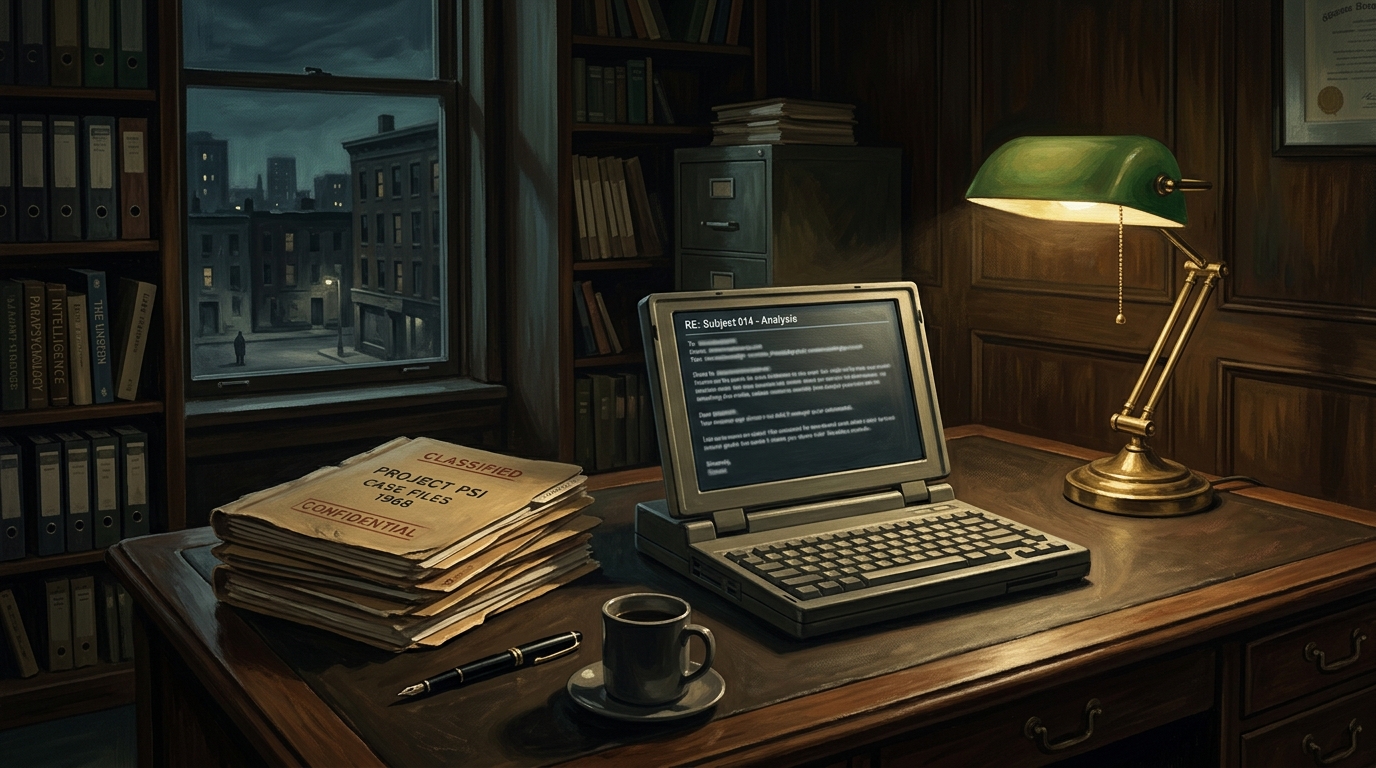
On July 14, 2026, UAP researcher Joe Murgia published a brief email exchange with physicist Dr. Hal Puthoff on X.com detailing which congressional and corporate committees he and his longtime collaborator, physicist Dr. Eric Davis, briefed on anomalous aerospace phenomena. The exchange also surfaces a clear divide in how the two men would respond if a presidential executive order waived their non-disclosure agreements.
The Congressional and Corporate Briefing Record
According to the exchange, Davis delivered briefings at several restricted venues: a Pentagon SCIF for Senate Armed Services Committee staff in October 2019, a controlled-access Senate office building room for Senate Select Committee on Intelligence staff that same month, a private defense contractor's facility in June 2021, and a House SCIF for the committee led by Rep. Anna Paulina Luna in May 2025. Davis also confirmed briefing Dr. Sean Kirkpatrick during his tenure as director of the All-domain Anomaly Resolution Office (AARO).
When Murgia asked Puthoff which committees he personally briefed in recent years, Puthoff listed the Senate Armed Services Committee, the Senate Select Committee on Intelligence, and AARO — a shorter list than Davis's, though the two men have worked together closely for decades, including on earlier government-funded research into phenomena like ball lightning.
Where Puthoff and Davis Diverge on Disclosure
Both physicists say their active security oaths and NDAs are the boundary keeping them from speaking publicly. But their stated conditions for crossing that boundary differ sharply. Davis has said repeatedly — to Murgia and in James Fox's documentary Moment of Contact — that a presidential waiver would settle the matter for him: "If the President of the United States issued an executive order that absolves me of all of my TS/SCI NDAs... I would go and tell them everything I know." He has claimed under oath to have seen photographs, reports, and evidence of crash retrievals, including non-human bodies.
Puthoff's answer to the same question was narrower. Asked whether he would share everything under a presidential waiver, he replied only: "Depends on language, security restraints." The gap extends to what each man says he has actually reviewed. While Davis has sworn on his children's lives that he personally saw photographs of recovered craft and bodies, Puthoff told Murgia plainly: "Reports yes, photos no" — a distinction that separates secondhand documentation from direct visual evidence.
AAWSAP's Origins and the Reverse-Engineering Question
The exchange also addressed how earlier research connects to today's claims. Puthoff said the 2002 meeting between Davis and Admiral Thomas Wilson — the basis for the widely circulated and disputed Davis-Wilson memo — was "never considered as official background" when the Defense Intelligence Agency's Advanced Aerospace Weapon System Applications Program (AAWSAP) was established around 2007–2008. The memo has remained a point of contention in UAP research circles partly because other figures connected to early disclosure efforts, including former CIA officer Jim Semivan, have declined to comment on it publicly.
Puthoff and Davis also responded to comments by former AAWSAP program manager James Lacatski, who said on the podcast Weaponized that the U.S. government had achieved reverse-engineering success with anomalous craft, but "not to its full extent." Puthoff drew a sharp line between theory and hardware: "Partial success at figuring out the likely physics is not the same as partial success in reverse engineering." Davis separately noted that Lacatski's remarks had been cleared by the Defense Office of Prepublication and Security Review (DOPSR) — the Pentagon's prepublication review body — which would mean the comments were approved for release rather than an unauthorized leak, consistent with DOPSR's documented pattern of clearing other Lacatski manuscripts.
A Small Circle, A Wide Gap
The exchange underscores how much of the UAP disclosure debate still runs through a handful of insiders whose briefings have reached the highest levels of congressional oversight, yet whose underlying evidence remains locked behind classification. Puthoff's and Davis's diverging answers to the same hypothetical — one open to a full accounting under the right legal cover, one conditional on undefined "language" — show that even among close collaborators, there is no shared standard for what a safe or complete disclosure would actually look like.
Sources
- Joe Murgia (@TheUfoJoe): "EXCLUSIVE: Hal Puthoff Opens the Door to Sharing All of His UFO Knowledge," email exchange published on X.com, July 14, 2026.
- James Fox (director): Moment of Contact: New Revelations of Alien Encounters, documentary interview transcript referencing Eric Davis, 2022.
- Jeremy Corbell and George Knapp: Weaponized podcast interview with James Lacatski, late 2025.
- Defense Intelligence Agency: Advanced Aerospace Weapon System Applications Program (AAWSAP) contract and timeline records, 2007-2008.
- Defense Office of Prepublication and Security Review (DOPSR): Clearance records for Lacatski, Kelleher, and Knapp manuscripts, 2021-2025.