Science / Jun 03, 2026
Donald Hoffman says perception is an interface. Then UFOs enter the room
The title promises aliens. The conversation mostly delivers something better: Donald Hoffman's interface argument, then a late UFO turn.
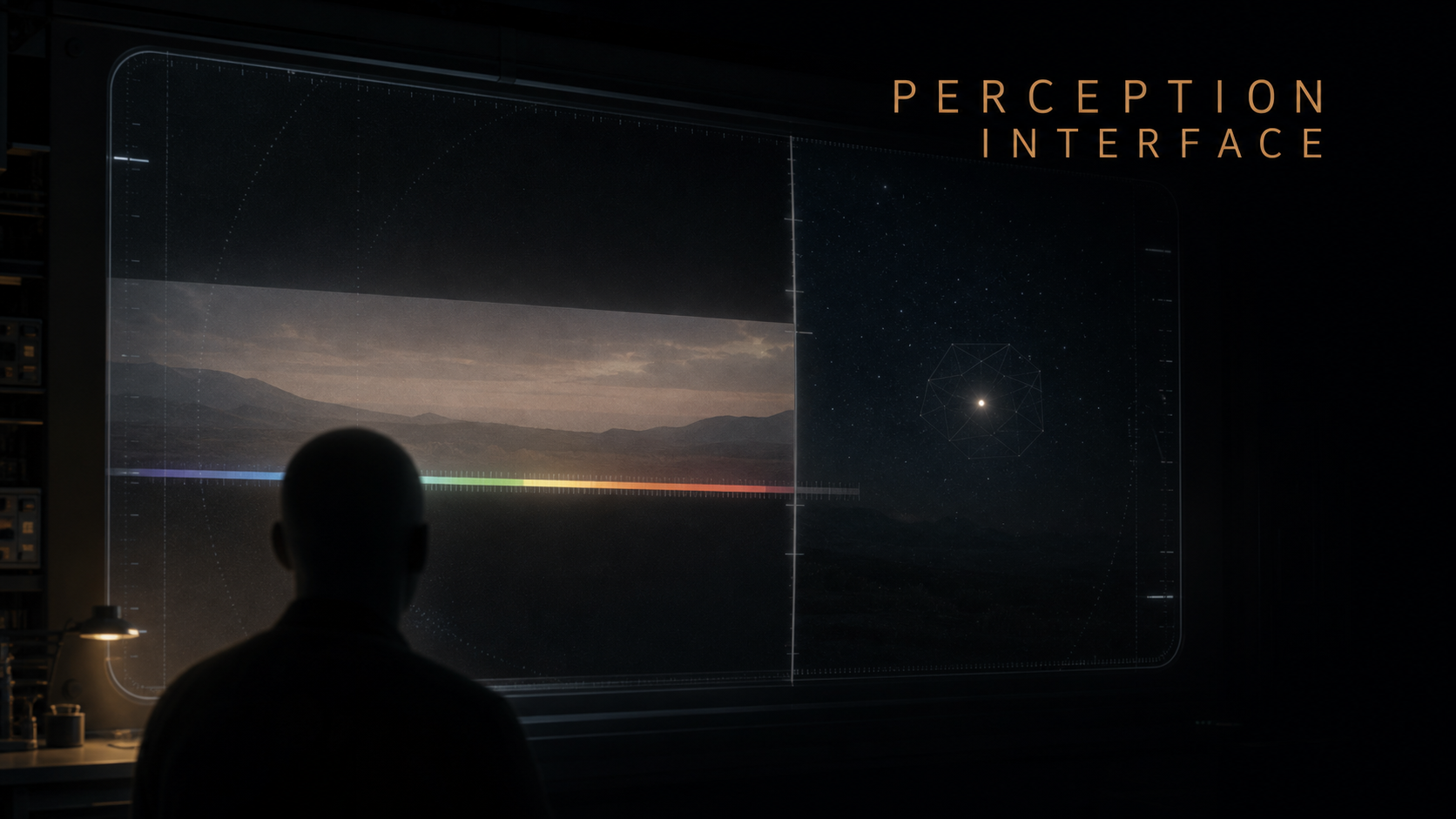
The title is doing a lot of work.
"MIT Scientist: Your Brain Evolved To Ignore Aliens - They're Everywhere!" is the YouTube hook Jesse Michels used for his new American Alchemy episode with Donald Hoffman. The click is understandable. The actual three-hour conversation is more interesting than the title, and the UFO part is only one late turn in it.
The interface idea
Hoffman is a cognitive scientist at the University of California, Irvine, and he has been making the same argument in public for years: perception is not a window. It is a desktop.
We do not see reality directly, in Hoffman's framing. We see icons our nervous system pushes onto a screen because those icons helped our ancestors survive. The folder on your computer screen is not the file. The blue color is not a wavelength. A tree, in this argument, is not reality shown naked. It is a compressed symbol a mammal can act on quickly.
Most of the interview is this. Michels pushes, Hoffman rebuilds it. Evolution, fitness over truth, Markov matrices, the math that has to hold. Hoffman keeps saying his conjectures have to work or break. That is the part of the episode worth staying with.
The UFO question
Near the end, Michels turns to UFOs.
He asks Hoffman if he believes in them. Hoffman gives the careful answer: he had not really thought about it until the congressional testimony, and after that he had "no reason to disbelieve" the witnesses. No grand claim, no finished theory. Just: possibly, and worth looking at.
He says there may be "an infinite number of alien intelligences." The human headset, in his language, shows only a thin slice. Other intelligences could be operating with different or richer interfaces, not necessarily bound by the space-time picture humans treat as final.
That line explains the title. It also marks the point where the interview gets less sharp.
What Michels adds
Michels does one useful thing with the alien language: he pulls it back toward sensors.
Humans see a sliver of the electromagnetic spectrum. We do not see electric fields. We need instruments for electrons, radar returns, infrared signatures, and most of the things that make a modern UAP report more than a campfire story.
That gives Michels a narrower question than the headline. A phenomenon could be partly outside what humans natively detect and partly inside what instruments catch. A pilot's eye, an IR camera, a radar track, a witness report: the interesting cases usually arrive as a stack, not as one clean view.
Hoffman's model gives Michels a vocabulary for that. Whether the vocabulary gets you anywhere with a specific UAP case is a separate problem.
Where the jump happens
The interview moves fast once UFOs enter.
Perception, consciousness, space-time, UAP testimony, higher intelligences: it is a large jump. Without the mathematics, it would dissolve into mysticism quickly. With the mathematics, it is at least a wager Hoffman is willing to test.
He brings up recursive trace logic, Markov matrices, contextuality, relativity, and quantum field theory. Not as decoration, but as the part where the argument has to survive contact with something harder than a metaphor.
The UFO passage sits one layer below that.
The interview does not test a specific UAP case. No sensor file is analyzed. No released video is walked frame by frame. Michels is asking whether Hoffman's theory leaves room for a stranger reading of the clips and testimony already moving in public.
The strongest version is not "aliens are everywhere." It is the older Hoffman question with a UFO edge: what if perception is a narrow tool, not the whole room?
The door it leaves open
The episode is not a UAP case file. It works more like a passageway between Hoffman's normal subject and the current UFO conversation.
Hoffman gives Michels a way to talk about sensor limits, observer limits, and the old problem of mistaking the display for the thing underneath. The UFO material then becomes a question applied to that argument, not the foundation of it.
Read it in that order and it works better. The headline promises aliens. The conversation mostly delivers a better question.
Related UAP Logbook notes
- The UFO claims hiding inside physics words
- Project Rubik's Cube: Corbell, Borland, and the phrase that will not settle
- Richard Dolan sorts Release 02 into a shorter list
- NewsNation revisits Apollo 17, STS-48, and NASA anomaly claims
Sources
- Jesse Michels / American Alchemy: "MIT Scientist: Your Brain Evolved To Ignore Aliens - They're Everywhere!", published June 2, 2026. Local transcript saved from YouTube auto-captions.
- University of California, Irvine: Donald Hoffman faculty profile.
- UC Irvine News: "The case against reality", July 22, 2019.