News / May 28, 2026
NewsNation revisits Apollo 17's "triangle" and the STS-48 shuttle video
Ross Coulthart and Max Derakhshani returned to two NASA-linked records: an Apollo 17 lunar-sky image with three blue points, and the STS-48 shuttle video long disputed as ice/debris and thruster effects.
What was discussed
NewsNation's Reality Check returned to two NASA-linked anomaly claims: an Apollo 17 lunar-sky image and the STS-48 shuttle video.
Ross Coulthart's guest was theoretical physicist Maaneli "Max" Derakhshani. The hook was the current UAP file-release cycle; the material itself comes from public NASA imagery, archive scans, and a shuttle-video dispute that has been argued over for years.
The split is simple: Apollo 17 is an image-and-archive question. STS-48 is a video-interpretation question.
Apollo 17: three blue points
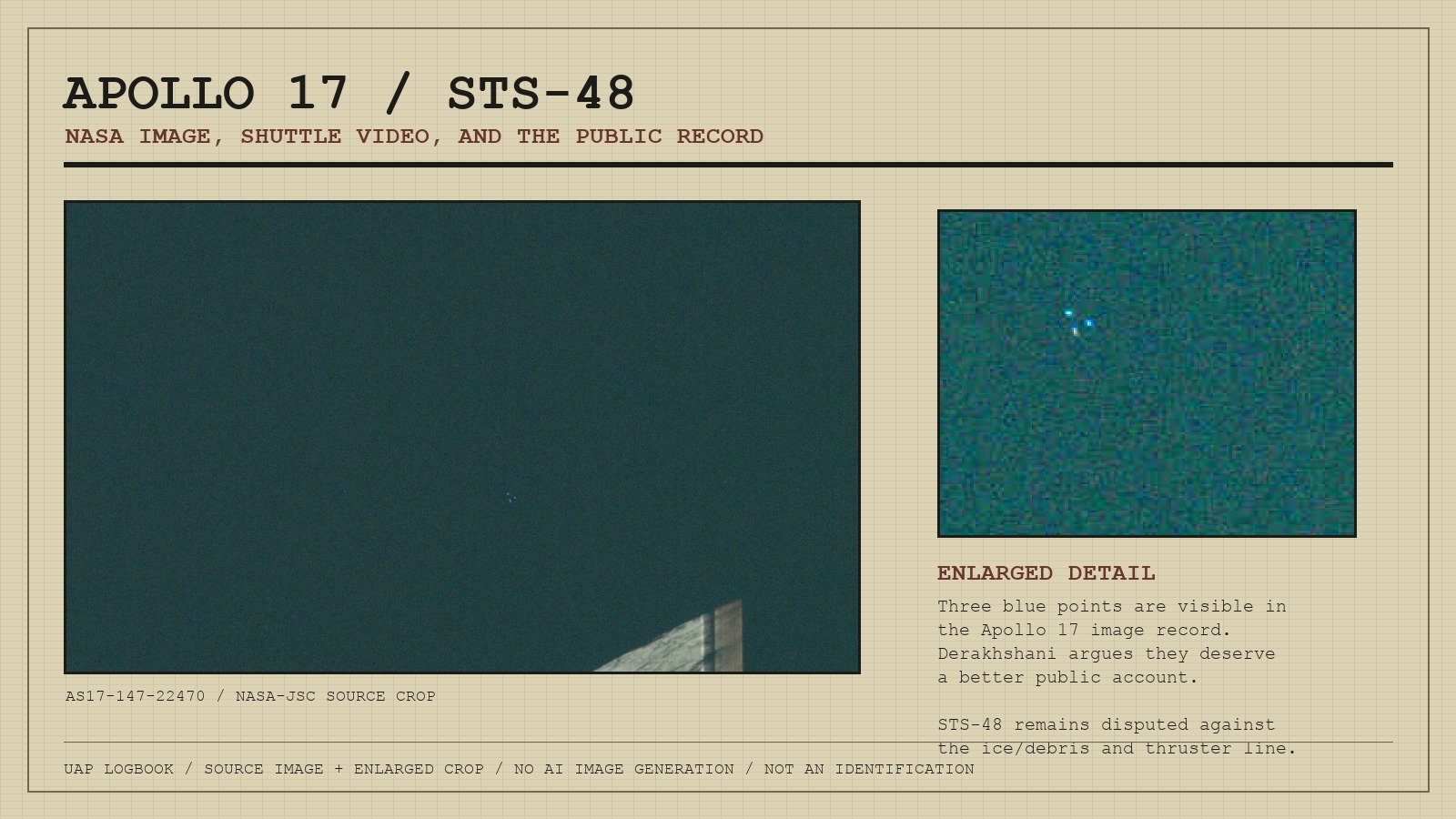
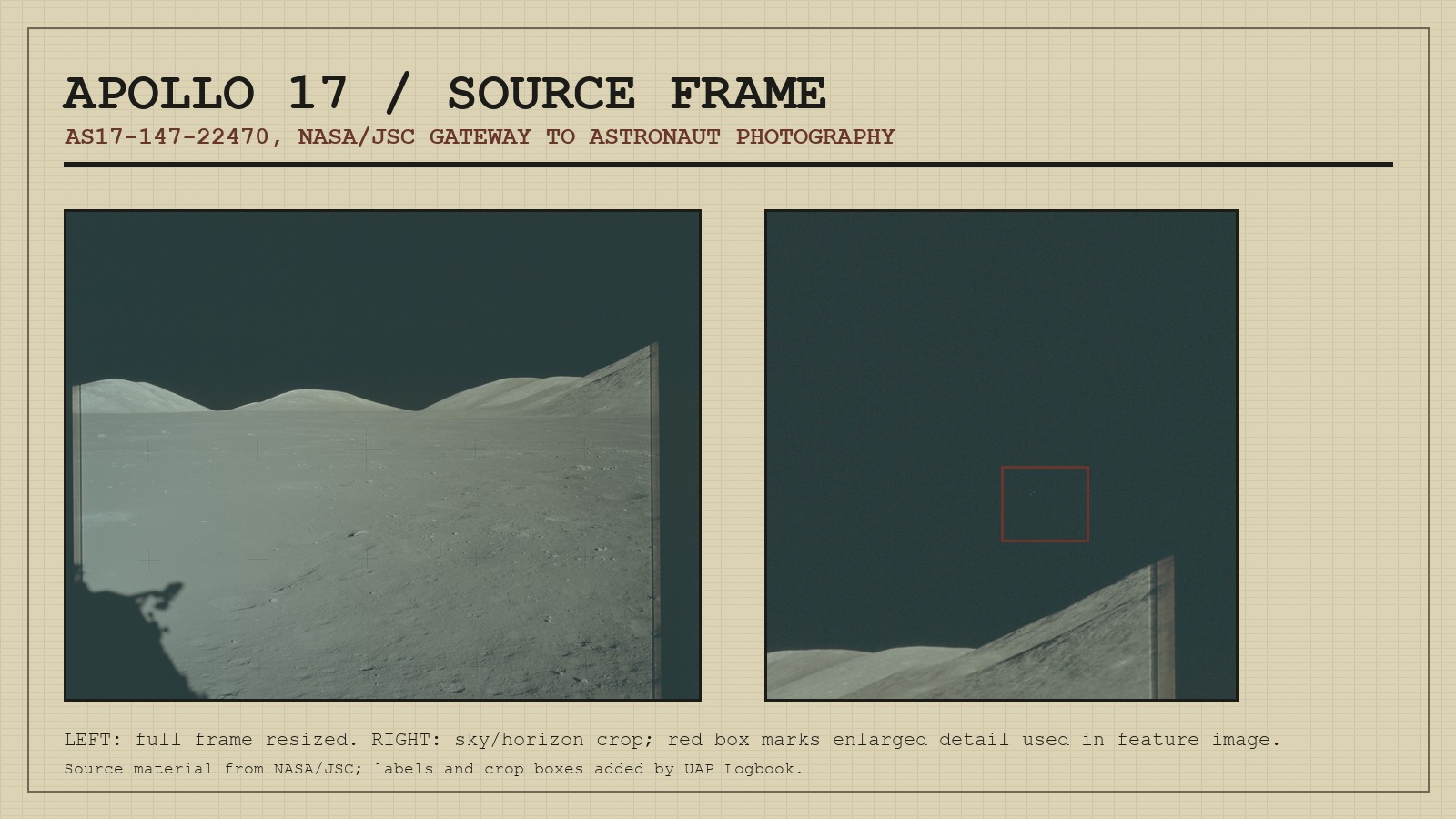
The Apollo 17 part centers on image AS17-147-22470, available through NASA/JSC's Gateway to Astronaut Photography of Earth. The image shows the lunar surface and black sky. In the right side of the sky, three small blue points are visible on magnification.
Derakhshani said the Department of War release used a lower-resolution version, while NASA/JSC also hosts a higher-resolution scan. He argued that the higher-resolution image makes the blue points easier to inspect.
He also said the points appear in the same location across multiple scans, which, in his view, weighs against a simple scanning artifact. Coulthart pressed the archive question: if a sharper scan exists, why was a lower-quality image used in the public release?
The public record currently gets this far: the image exists, the blue points are visible, and CBS reported that the Defense Department caption described three dots in a triangular formation. CBS also reported that there was no consensus about the anomaly's nature, while a preliminary analysis indicated it could be a physical object.
STS-48: the shuttle dispute
The second part turns to STS-48, the 1991 Space Shuttle Discovery mission. NASA's mission page describes STS-48 as the deployment mission for the Upper Atmosphere Research Satellite.
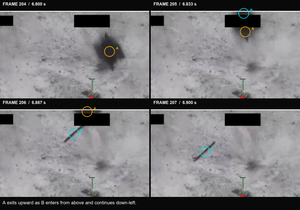
The clip discussed by Coulthart and Derakhshani is the familiar STS-48 night/limb video: bright points move in the frame, a flash appears, and one point seems to change direction sharply. Derakhshani presented it as one of the stronger shuttle anomalies.
The counter-reading is also part of the record. NASA's old explanation, quoted during the exchange, treated the objects as orbiter-generated debris illuminated by the sun, with abrupt motions caused by attitude-thruster firings. James Oberg has long argued along similar lines: nearby small debris, lighting, thrusters, and ordinary shuttle context can produce a misleading appearance.
Derakhshani's reply is distance. If the point is close to the shuttle, the debris explanation carries more weight. If it is far from the shuttle or near the horizon, the apparent acceleration becomes harder to fit. That distance question takes up much of the STS-48 discussion.
What is on the table
On Apollo 17, the discussion points back to a specific image ID and to a quality question: which scan is being used, and what does the higher-resolution source show?
On STS-48, it points back to a dispute that never really left the UAP archive: ice/debris and thruster effects on one side, distance and apparent motion on the other.
The piece does not include a new NASA statement, shuttle telemetry, or Apollo film analysis. The public trail remains image, transcript, shuttle video, and argument.
Where the trail stops
The Apollo 17 trail can be checked against NASA/JSC image AS17-147-22470 and the Department of War/CBS reporting on the May 2026 UAP file release.
The STS-48 trail can be checked against NASA's mission record, the old shuttle-video debate, and Oberg's rebuttal. The open record does not settle the distance of the object in the clip.
The next public-record check is whether NASA, AARO, or Congress releases a specific analysis of the Apollo 17 frame or a telemetry-backed review of the STS-48 video.