News / May 21, 2026
DOW-UAP-PR28: Greece January 2024 and the SWIR-only diamond
DOW-UAP-PR28 is the sensor-dependence case in the Greece Release 01 cluster: a diamond-shaped object reported visible in SWIR, lost in visible spectrum, and not reacquired.
DOW-UAP-PR28 is the third useful Greece case in the first PURSUE release.
It is stronger than PR35 because the file makes a more specific sensor claim.
It is different from PR34 because the public description is not about sharp turns. It is about visibility: the object is reported as detectable in short-wave infrared, lost in visible spectrum, and not reacquired when the operator switches back.
That is a clean thing to track.
What the file says
The case appears in the Department of War's first public PURSUE release, published on May 8, 2026.
The unresolved report is labeled DOW-UAP-PR28. The paired mission report is DOW-UAP-D25.
According to the public PR28 description, United States Central Command submitted a report to AARO consisting of one minute and five seconds of video captured through multiple sensor modalities aboard a U.S. military platform in 2024.
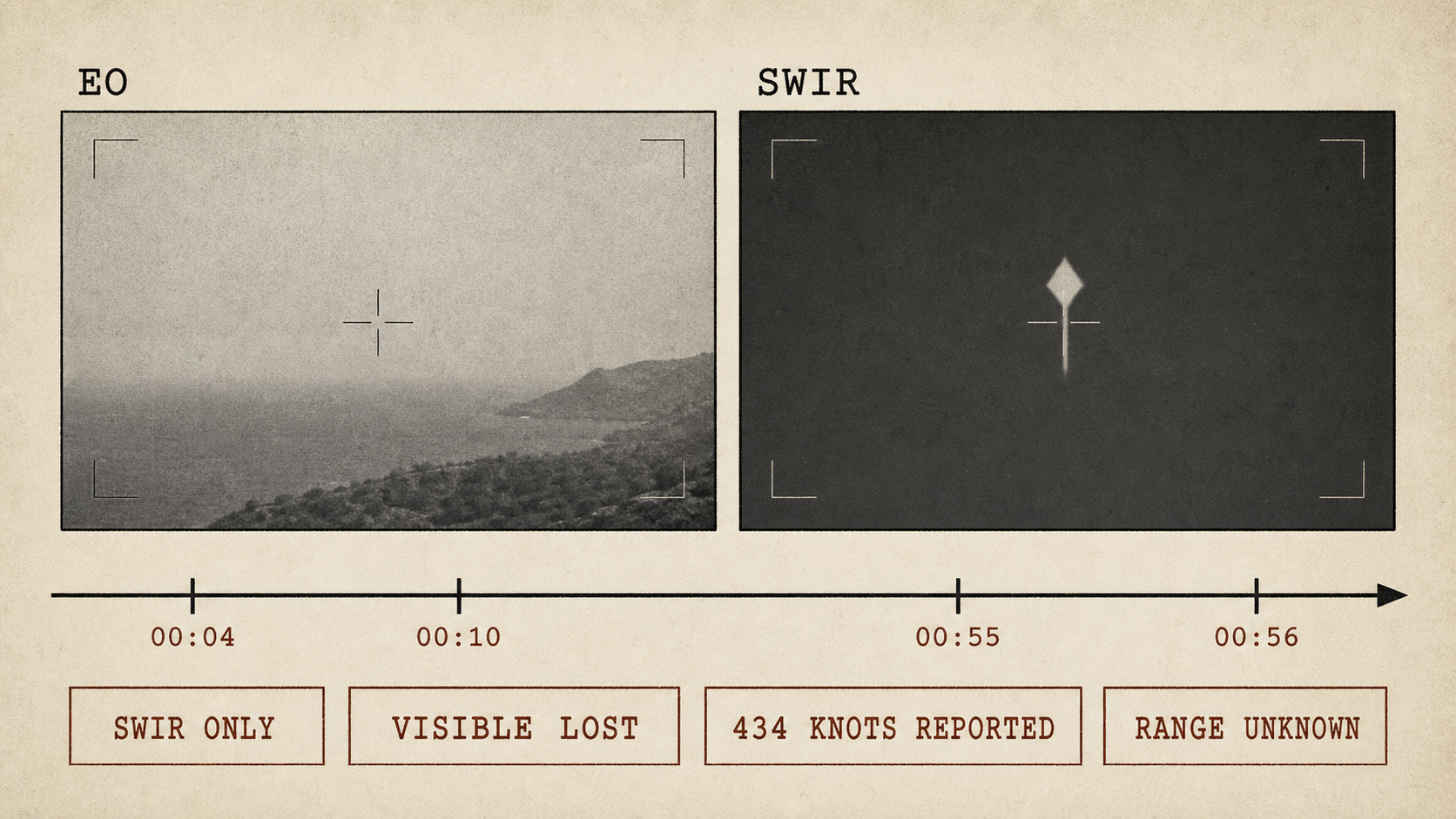
The accompanying D25 mission report describes the object as diamond-shaped, moving at approximately 434 knots, and visible only through onboard short-wave infrared, or SWIR.
Those are the headline facts. They are also the limits of what the public record can support.
What the video description says
The public video description gives a short timeline:
- during the first ten seconds, the display is split between electro-optical footage and SWIR footage;
- at 00:04, an area of contrast becomes distinguishable against the background;
- at 00:10, the display shifts to full-screen SWIR;
- at 00:55, the area of contrast remains generally centered and is described as resembling an inverted teardrop with a vertical trailing mass;
- at 00:56, the operator switches to visible spectrum and loses the subject against the background;
- from 00:57 to 01:05, the operator switches back to SWIR black-hot but does not reacquire the area of contrast.
That sequence is the useful part.
The object is not just described as hard to see. It is described as sensor-dependent.
What D25 adds
D25 gives the mission-report language behind the public video entry.
The report says the event occurred over the Mediterranean Sea on January 25, 2024. It describes one UAP, a duration of approximately two minutes, and an estimated speed of approximately 434 knots.
The shape description is also more specific than PR35. The object is described as diamond-shaped, with what the report calls a non-maneuvering probe at the bottom.
The report also carries its own caution. Its descriptive and estimative language reflects the reporter's subjective interpretation at the time. It should not be read as a conclusive statement about the object's nature.
That caveat is not decoration. It is doing real work.
Why SWIR-only matters
SWIR can see contrast that ordinary visible-spectrum imaging may not show. That can be useful. It can also create interpretation problems if the public does not know range, background, sensor settings, atmospheric conditions, platform motion, and the processing chain.
In PR28, the switch from SWIR to visible spectrum matters because the subject is lost. The later switch back to SWIR matters because the subject is not reacquired.
That does not prove the object was extraordinary.
It does make the sensor context central.
If an object is only visible in one mode, the public needs to know what that mode was doing.
What this does not prove
PR28 does not publicly prove a non-human craft, exotic propulsion, or an impossible object.
It also does not prove a simple explanation.
The public record leaves room for ordinary possibilities: a distant aircraft, balloon, drone, bird, debris, atmospheric contrast, tracking artifact, processing artifact, or geometry problem. The reported speed may depend heavily on range and assumptions about motion.
That is why the 434-knot figure should be logged, not worshipped.
It is a reported estimate inside an incomplete public packet.
What would make it stronger
The useful next release would include:
- original video rather than a public copy;
- full sensor metadata;
- range estimate;
- platform position and motion;
- line of sight;
- weather and atmospheric context;
- full mission timeline around the event;
- any radar, visual, SIGINT, or Link 16 correlation;
- the analytic path used to keep the case unresolved.
Those items would not make the case less interesting.
They would make it testable.
Greece cluster
PR28 now sits next to two other Greece cases in Release 01.
PR34 is the sharper performance claim: a Greece 2023 case described with sharp 90-degree turns.
PR35 is the quieter comparison case: a small circular object over water, no reported maneuvering, and a public description that fades into background ambiguity.
PR28 is the sensor-dependence case: a diamond-shaped object reported in January 2024, visible in SWIR, lost in visible spectrum, and not reacquired.
Together, the three cases show why Release 01 is useful. Not because it answers the UAP question. Because it gives specific public records that can be compared.
The strongest question is still boring:
What exactly did the sensor see, and what context is still missing?