Main Article / Jul 15, 2026
Elizondo compares UAP whistleblowers to Operation Paperclip and calls for amnesty
On a 13 July 2026 Ask the Squares interview, Luis Elizondo compared UAP whistleblowers to Operation Paperclip scientists and called for amnesty. Rep. Eric Burlison's UAP Disclosure Act amendment is the actual legislative track on UAP records; the reported 60-day whistleblower window is a separate, weaker-attested proposal. The $22 trillion figure Elizondo uses is a rhetorical round-up, not a DoD finding. Neither AARO nor the Pentagon has responded publicly.
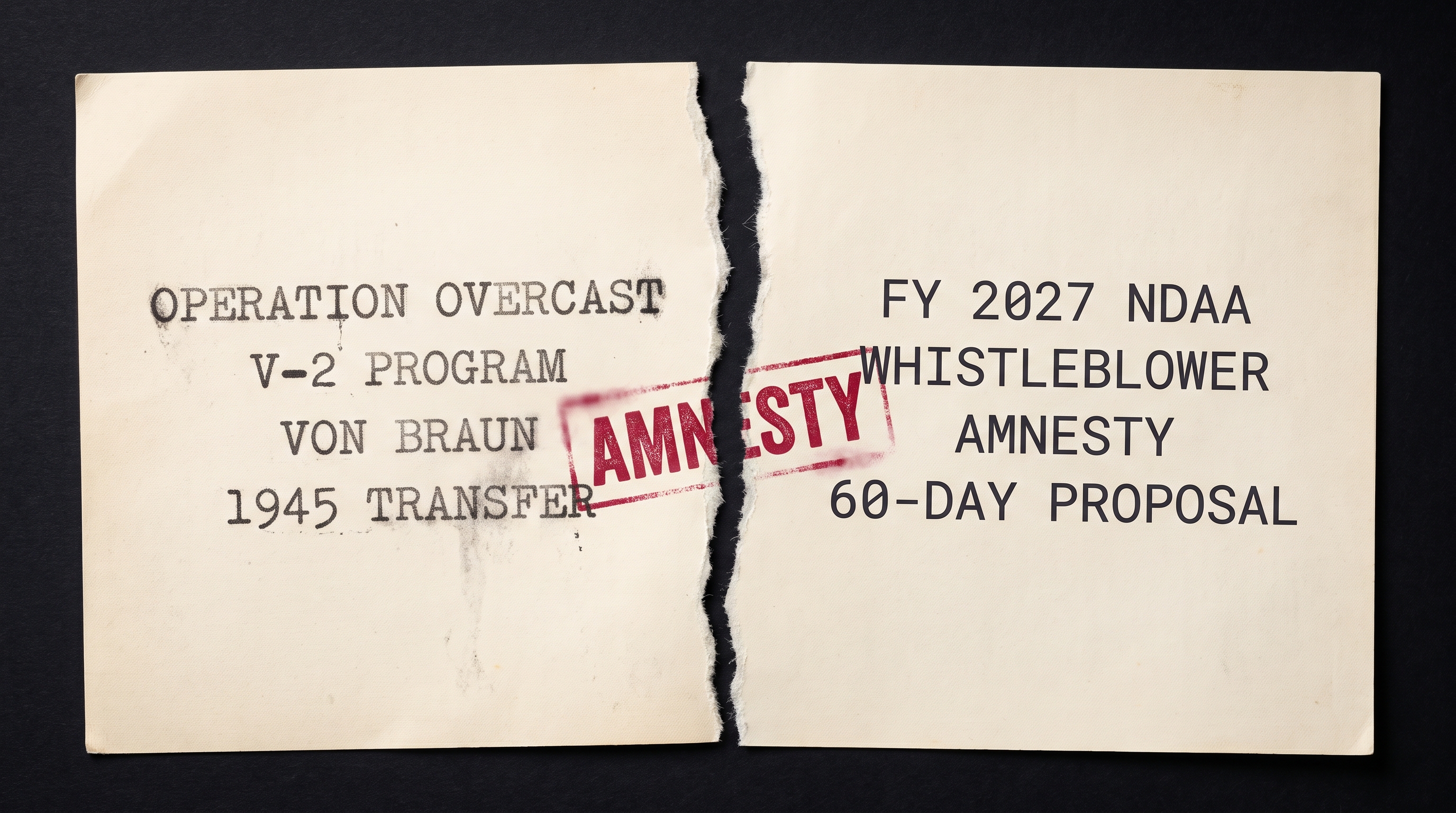
On a 13 July 2026 episode of Ask the Squares — a long-form consciousness-and-experiencer podcast that does not normally cover UAP policy — Luis "Lue" Elizondo, the former head of the Pentagon's Advanced Aerospace Threat Identification Program, made a sharper argument than the one he had taken to Capitol Hill in November 2024.
He didn't just want the truth out. He wanted the people sitting on it to be able to come out safely. He said it in one word: amnesty.
"I think we need to incentivize them to come out. I think we need to give them amnesty," Elizondo said. "Think about the most evil empire we've had this last century… and yet, right at the end of the war, we had a program called Operation Paperclip where we brought Nazi scientists, part of the war machine… Dr. Von Braun, who we brought over as part of Operation Paperclip, was the godfather of the V-2 rocket which reigned hell and fire on the innocent people of London. Right, 20-some years later he helped design the Saturn 5 rocket that put an American on the moon. So there is a precedent for this — this truth and reconciliation, so to speak — and we've seen other nations like Rwanda and South Africa. So it can be done."
Elizondo has gestured at the Paperclip analogy before, but this is the first time he has stretched it into a full argument — naming the V-2-to-Saturn-V pivot and folding in the South Africa and Rwanda comparisons in the same breath. The argument now sits next to a real legislative track: Rep. Eric Burlison of Missouri has spent much of 2026 pushing a UAP records and whistleblower framework through the NDAA process, with a reported White House Deputy Chief of Staff also engaged on the subject.
What he actually said, and when
The interview was recorded shortly before it posted to YouTube on 14 July 2026. Two passages carry the argument. Around the 33-minute mark, the host asks what the historical secrecy has cost. Elizondo answers with a dramatized exchange — speaking as an imagined senator confronting an official — invoking a figure of "$22 trillion" in disappeared black-budget money and accusing that official of lying to the president, to Congress, and to the "Gang of Six" oversight group. Two minutes later comes the amnesty pitch quoted above. The two passages work as a pair: the cost is what makes amnesty urgent, and the Paperclip precedent is what makes it sound achievable.
The $22 trillion number, and what the public record actually shows
The "$22 trillion" figure isn't a new Pentagon finding, and it isn't what the public DoD Inspector General audits have actually reported.
In July 2016, the DoD Office of Inspector General released Army General Fund Adjustments Not Adequately Documented or Supported (FY 2015), which documented $6.5 trillion in unsupported journal-voucher adjustments in the Army's fiscal year 2015 general fund. The "unsupported" entries lacked the underlying transaction-level documentation needed to verify them, not that money had vanished. The DoD OIG later stated, in comments supplied to Michigan Public and Forbes, that the figure was not cumulative, not an estimate of missing funds, and not a transfer out of the U.S. Treasury. It was an artifact of a fragmented multi-system accounting process.
In December 2017, Forbes contributor Laurence Kotlikoff and Michigan State University economist Mark Skidmore aggregated similar DoD OIG and Housing and Urban Development OIG reports and concluded that $21 trillion in unsupported adjustments could be documented across 1998–2015. Skidmore has continued to update the analysis. The figure has been disputed by accounting researchers and by Mick West on Metabunk: the "unsupported" entries are largely intra-government balance-sheet transfers that reverse and reoccur from year to year, and adding them up produces a number many times the U.S. government's annual revenue. The number is not, in the strict sense, "missing."
Elizondo's "$22 trillion" is a rounded echo of the disputed 2017 figure, delivered inside a dramatized skit rather than cited as a document. It's worth being clear about what that means: the number doesn't have to be accurate for his underlying argument — that decades of secrecy carry a real cost — to be worth taking seriously. Presented without context, it reads as a sourced fact. It isn't one.
What Operation Paperclip actually was — and what the analogy leaves out
Operation Paperclip was the U.S. program, running roughly 1945 to 1959, that brought about 1,600 German scientists, engineers, and technicians — many confirmed or suspected members of the Nazi Party, the SS, or the SA — into U.S. government employment after the war. It began as Operation Overcast, approved by the Joint Chiefs of Staff on 20 July 1945, and was renamed for the paper clips physically attached to recruits' personnel files.
Wernher von Braun, who led the V-2 program at Peenemünde as an SS officer, was its most prominent recruit. He and roughly 125 colleagues arrived at Fort Bliss, Texas, in 1946, moved to Redstone Arsenal in Huntsville, Alabama, in 1950, and transferred to NASA in 1960, where von Braun became the first director of the Marshall Space Flight Center and chief architect of the Saturn V. The V-2 first crossed the edge of space on 20 June 1944; the first crewed lunar landing came on 20 July 1969 — 24 years to the day after Overcast was approved.
Historians have never treated Paperclip as a clean success story. The V-2s that hit London and Antwerp killed thousands of civilians and were built using forced labor from the Mittelbau-Dora concentration camp, where an estimated 20,000 prisoners died during production. The U.S. government actively sanitized recruits' Nazi affiliations to clear them for entry. Wikipedia, the Smithsonian's Air and Space Museum, and the Army's own official histories describe Paperclip as a pragmatic trade — technical value judged to outweigh moral cost — not a vindication of the people involved.
Elizondo's version of the analogy leans entirely on the outcome — Paperclip produced the Saturn V — without addressing what the U.S. government actually forgave to get there. That's a real gap, not a minor one, since it's the exact question an amnesty proposal for alleged UAP insiders would also have to answer: what, specifically, is being forgiven, and for whom. The ask is sharper when it is the asker who names the price.
The "Top Gun ace" is a composite, not a named person
In the same monologue, Elizondo describes a "Top Gun ace" who lost flight status, left the military, went through a divorce, and had a "crisis of conscience" after being told by his own government that he was imagining things.
The description fits David Fravor more closely than anyone else on the public record. Fravor, former commander of Strike Fighter Squadron 41 and a Topgun graduate, led the flight during the 14 November 2004 USS Nimitz "Tic Tac" encounter — still the most-cited UAP pilot account on the public record. He left active service in 2006 and has said in multiple interviews, including a 2021 CBS 60 Minutes segment, that the encounter brought unwanted institutional pressure. Elizondo has never named Fravor directly in this context, and Fravor has never confirmed the specific personal details Elizondo lists. The description functions as a composite meant to make an abstract cost concrete, not a biography of one identified person.
The actual legislative track: Burlison's UAP Disclosure Act, with a weaker 60-day thread alongside it
Elizondo isn't the only person using the word "amnesty" this year. Rep. Eric Burlison has spent much of 2026 building support for what his own office calls the UAP Disclosure Act — an amendment to the FY2027 NDAA, modeled on the JFK Records Release Act. The amendment, as Burlison described it in his 29 June 2026 testimony before the House Rules Committee, would create a nine-member independent UAP Records Review Board appointed by the president and confirmed by the Senate, with subpoena power and access to all relevant records and facilities; require every federal office to identify, organise, and transmit UAP records to the National Archives within 300 days; prohibit the destruction or reclassification of previously disclosed UAP records; and explicitly cover contractor-held materials. Burlison submitted the same package as an amendment to the FY2026 NDAA on 29 August 2025. The framework is records-preservation and oversight first, and the bill text does not, on the record, propose a whistleblower amnesty mechanism.
Alongside that, secondary reporting has described a separate proposal: a 60-day safe-passage window for UAP insiders to come forward with classified information about legacy programs, in exchange for protection from prosecution under statutes like the Espionage Act. The window was raised at a Dallas event Burlison held with Elizondo on or around 30 May 2026; coverage from ufouap.com, Coulthart's Reality Check, and Reddit cites a follow-up call from a White House Deputy Chief of Staff — most reporting refers to Stephen Miller, on the strength of the published follow-up coverage, although the White House has not confirmed his name in the call on the record. Rep. Anna Paulina Luna is separately reported to have raised the idea of a UAP whistleblower executive order with the White House in early June.
None of these three threads — the UAP Disclosure Act amendment text, the reported 60-day safe-passage proposal, and Luna's reported executive-order push — are the same document. None of them amount to the blanket "truth and reconciliation" process Elizondo described on Ask the Squares. The word "amnesty" is doing a lot of work across several different proposals in different stages of attestation, and the public record does not yet show them converging into a single vehicle.
Elizondo's own November 2024 written testimony to the House Oversight Committee did not use the word "amnesty" at all. It asked for a single point of contact for UAP issues government-wide, a national UAP strategy, and "a protected environment so whistleblowers, desperate to do the right thing, can come forward without fear." That is a narrower ask than what he is making publicly now. The shift — from whistleblower protection to a Rwanda-style reconciliation process — is itself a development worth tracking, not least because it lands the same month his reported Dallas event with Burlison.
AARO and the Pentagon have not responded on the record
Neither AARO nor the Office of the Secretary of Defense has issued any public statement addressing Elizondo's amnesty proposal specifically, despite his repeated public claims about the existence of "legacy program" insiders who might be eligible for it. That silence is not, on its own, evidence either for or against the claim that such insiders exist. But it does mean the public amnesty conversation is currently a one-sided one: Elizondo, a handful of sympathetic members of Congress, and reported but unconfirmed White House interest on one side; no institutional response on the other.
The closest institutional record is still the November 2024 House Oversight hearing, where Elizondo's own testimony framed the ask in narrower terms. Since then, the public record has grown around the ask — but it has grown in claims, not in counter-claims or in documents.
What's still missing
Nothing in the Ask the Squares interview produces a document. The Paperclip precedent is real, but incompletely applied; the $22 trillion figure is a dramatized echo of a disputed accounting dispute, not a citation; the "Top Gun ace" is unnamed by design; the Rwanda/South Africa comparison is an analogy, not a process map anyone has published; the 60-day safe-passage proposal is reported but not on the public record in legislative form; and the institutional response to the ask is, so far, silence.
Five things would change the public record if they appeared attached to a name and a document: a public draft of Burlison's or Luna's proposal with amnesty terms spelled out; an on-record statement from a senior White House official confirming what the reported Miller–Burlison conversation actually covered; a named list of anyone who has come forward under any amnesty-style mechanism to date; a clear line separating the amnesty ask from existing protections under the Intelligence Community Whistleblower Protection Act; and documentation of what program, specifically, anyone would be seeking amnesty from having worked on.
Until then, the argument runs on analogy and urgency rather than evidence. That doesn't make it wrong — it does mean the public record hasn't caught up to how the argument is being told.
Sources
- Ask the Squares — Lue Elizondo interview, recorded c. 13 July 2026, posted 14 July 2026 (YouTube)
- Written Testimony of Luis Elizondo, House Oversight Committee, November 2024 (PDF)
- Rep. Eric Burlison testimony before the House Rules Committee, UAP Disclosure Act amendment to the FY2027 NDAA, 29 June 2026 (YouTube, 2:57)
- Rep. Burlison press release: UAP Disclosure Act of 2025 as amendment to FY2026 NDAA, 29 August 2025
- Burlison Brief, 7: UAP Disclosure Act amendment testimony summary
- Rep. Burlison, "The American People Deserve the Truth," 9 June 2026 (YouTube, 6:16) — immunity and NDA-waiver ask
- ufouap.com: A Missouri Congressman Is Touring America's Secret UFO Bases (May 30 / June 5, 2026 update notes on the Miller–Burlison and Luna calls)
- UFO News: "Voices Say UFO Disclosure Cannot Be Stopped Now" (Burlison 60-day window, Dallas event)
- CBS 60 Minutes: "UFOs regularly spotted in restricted U.S. airspace, report on the phenomena due next month," 16 May 2021 (Fravor / Dietrich Nimitz encounter)
- Wikipedia: Operation Paperclip
- Wikipedia: Wernher von Braun (V-2 / SS / Peenemünde / Redstone / Marshall / Saturn V chronology)
- Smithsonian Air and Space Museum: Project Paperclip and American Rocketry after World War II
- National Geographic: "How Operation Paperclip brought Nazi scientists to the U.S."
- Forbes / Laurence Kotlikoff: "Has Our Government Spent $21 Trillion Of Our Money Without Telling Us?", 8 December 2017
- Michigan Public: "Did the federal government spend $21 trillion that wasn't authorized by Congress?", 20 December 2017 (includes DoD OIG response statement)
- Metabunk: Debunked — Missing $21 Trillion / $6.5 Trillion / $2.3 Trillion (Journal Vouchers)