Main Article / Jul 08, 2026
Why UFO claims keep ending at private contractors
The latest UAP cycle keeps pointing away from agencies and toward private contractors. That does not prove a hidden retrieval program. It shows where public-record tools, congressional letters, and FOIA requests start to hit walls.
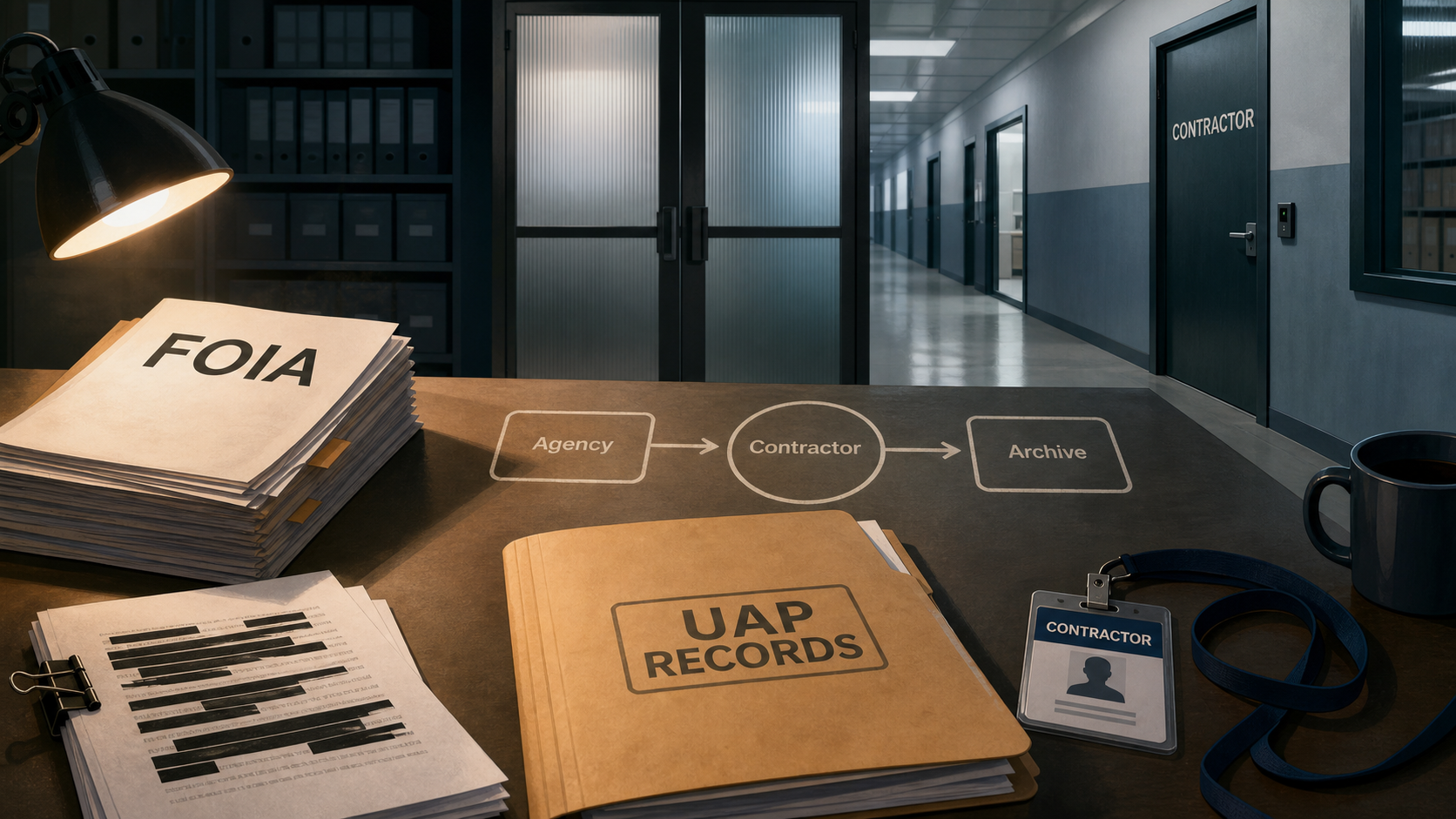
Every few months, a UFO story starts inside a federal agency and ends at a contractor's front door.
Avi Loeb's new science advisory council is asking the Pentagon for files. Rep. Eric Burlison is pressing MITRE and MIT Lincoln Laboratory for records. Luis Elizondo told a Japanese livestream audience that FOIA reaches government agencies far more easily than it reaches private organizations. And AARO says it already investigated claims that private companies hold off-world technology, and found nothing.
Put those threads together and a pattern emerges, though it is quieter than the "corporations are hiding crashed craft" version that circulates online. The U.S. national-security system routes an enormous amount of technical work through contractors, laboratories, federally funded research centers, and sponsor-controlled programs. If UAP-related records sit anywhere inside that architecture, a standard agency FOIA request may only ever see part of the room.
That does not confirm the hidden-hardware claim. It does explain why the claim survives in a place ordinary readers cannot inspect.
The new claim cycle
The latest push came from Loeb's UAP Science Advisory Council, a panel he describes as created to advise the U.S. government on unresolved UAP cases. The Associated Press reported on July 1, 2026, that the committee had asked the Pentagon for dozens of videos, images, and documents. The Guardian's version of the same story noted that Loeb approaches the objects assuming they are human-made, viewed through a national-security lens rather than an extraterrestrial one.
That framing makes the council a file-access story as much as a UFO story. Christopher Sharp of Liberation Times reported on June 16 that an ODNI official confirmed a new UAP Governance Board, set up by ODNI alongside the FBI and Department of War to coordinate UAP investigations, data collection, and declassification. Sharp also reported that Loeb's council is one of several outside advisory groups feeding into that board.
The current structure has layers: a government board, outside advisory groups, agency files, and a public that only sees what eventually gets released. Loeb's council may help shape which questions get asked. On the current public record, though, it does not have an open door to classified evidence. The public-facing trail should also make the council's mandate, access, and funding legible, because advisory bodies can shape attention even when they cannot compel disclosure.
The contractor wall
Elizondo laid out the same problem more plainly during his July 7 interview with Niconico News in Japan. Asked why his book Imminent could name specific companies and laboratories after pre-publication review, he said the fact that the government hires private organizations to do work is not always classified, even when the results of that work are. When the hosts brought up FOIA, he pointed out that the law applies to government bodies, not to private companies in the same way.
It is a careful answer, almost dull, which is exactly why it holds up. The public can request agency records: emails, reports, contracts, task orders, meeting minutes, classification decisions. But once a government office contracts out analysis, or work sits at a federally funded research center under sponsor control, the paper trail splits. The agency might hold one copy. A contractor might hold another. A sponsor might control release entirely. Some of it may sit behind procurement or proprietary barriers that have nothing to do with UFOs and everything to do with how defense contracting normally works.
This is not unique to the UAP subject. It only becomes explosive here because crash-retrieval claims tend to point at the wall itself, rather than at any specific file behind it. Critics of the modern disclosure loop have made the same broader point in other terms: an unreachable repository can keep a claim alive without making the claim stronger.
What AARO says it checked
AARO's 2024 historical report remains the strongest official counterweight to the contractor narrative.
It states that AARO found no empirical evidence that the U.S. government or private companies have reverse-engineered extraterrestrial technology. Investigators located the programs, officials, companies, and documents named by interviewees. Aerospace executives and technical officers denied, on the record, ever recovering, possessing, or reverse-engineering anything extraterrestrial.
The report adds a telling detail: many interviewees seemed to have mistaken genuinely classified national-security programs for evidence of alien activity. One case, KONA BLUE, was a proposed UAP recovery and reverse-engineering program. It was proposed, never approved, and never tied to empirical evidence.
That is a real finding, not something to wave away. It also leaves a procedural question the public cannot resolve just by reading the report. AARO says it had broad access and found nothing. Critics and some witnesses argue the most sensitive material sits in contractor or waived-access channels that ordinary investigators cannot reach, or that people with direct knowledge will not speak outside protected legal processes.
Readers cannot settle that dispute by picking a side. They can only ask for the next document that would actually test it.
Burlison turned the claim into a records test
That is what makes Burlison's letters to MITRE and MIT Lincoln more interesting than their headlines suggest. In May 2026, he asked MITRE for UAP-related records, assets, contracts, metadata, search certifications, and sponsor-control information dating back to 1930. MITRE told DefenseScoop it was reviewing its archives. Separately, Burlison asked MIT Lincoln Laboratory to account for a 1952 reel-to-reel item labeled "flying saucer talk."
Whether either organization turns out to hold anything unusual is almost beside the point. The value is in the search map it forces into existence. If MITRE finds records, follow-up questions become concrete: what are they, who sponsored them, what classification or proprietary limits apply, who has authority to release them? If MITRE finds nothing, Burlison's request still demands a methodology: which repositories were searched, which custodians were contacted, what search terms were used, and who signed off on the result.
A denial without that search map is just another wall. A denial that comes with one is at least a record other people can check.
Where the public record actually points
The grounded contractor story is not one claim. It is a stack of public facts that can sit together without resolving the bigger question.
AARO's reporting channel explicitly accepts submissions from current or former contractor personnel with direct knowledge of U.S. government UAP programs or activities. Defense and intelligence work genuinely does route through contractors, FFRDCs, and sponsor-controlled channels as a matter of routine. Congressional pressure has moved from agencies alone toward named outside organizations like MITRE and MIT Lincoln. And AARO says it specifically investigated named-company claims and found no evidence that any private company held or reverse-engineered extraterrestrial technology.
None of that proves a company is sitting on a crashed UFO. It does confirm that the contractor layer has become a real battleground in the public UAP-records fight, which is narrower and more useful than the version that usually makes headlines.
What would change the story
The next useful piece of evidence will not be another anonymous claim that a contractor has something. It would look more like a contract number, a task order, a program element, a named custodian, a search certification, a records schedule, a sponsor's response, a declassification decision, or a chain-of-custody document that can be checked against a real workplace and a real date range.
The public does not need the entire classified archive to move the story forward by one step. It needs a path showing where a specific record is supposed to live.
Until someone produces that path, the contractor gap stays exactly what it is: a gap large enough for the boldest UFO claims to hide inside, and not, on its own, evidence that any of them are true.
Related UAP Logbook notes
- AARO's UAP reporting channel includes contractor personnel
- Burlison asked MITRE what it knows. MITRE says it is searching.
- Loeb's UAP council asked the Pentagon for 50 files. It has no clearance to see classified evidence.
- Lue Elizondo says blue orbs led two dogs into a Utah field
- Burlison asks MIT Lincoln Laboratory to find a 1952 "flying saucer" recording
Sources
- Associated Press: New government UFO panel led by polarizing Harvard professor, July 1, 2026.
- The Guardian / AP: The Harvard astronomer dubbed Trump's chief alien hunter starts by assuming UFOs human-made, July 1, 2026.
- Liberation Times: U.S. Government Establishes New Interagency UAP Governance Board, June 16, 2026.
- AARO Historical Record Report, Volume I, February 2024.
- AARO: Submit a Report / Government UAP-Related Program or Activity Reporting.
- Rep. Eric Burlison: Burlison Presses MITRE for Answers on UAP Records, May 26, 2026.
- Burlison legislative interrogatories to MITRE, dated May 22, 2026.
- Burlison letter to MIT Lincoln Laboratory, May 7, 2026.
- Niconico News: Luis Elizondo interview, YouTube, July 7, 2026.