Main Article / Jul 14, 2026
SCU's 1945-1975 study finds a sustained UAP pattern around U.S. atomic warfare sites
A volunteer research coalition has spent five years analysing Project Blue Book's "unknown" cases against the map of the U.S. atomic warfare complex. The result is a multi-decade correlation that survives three independent methodologies. The paper's own abstract goes further than that, and treats non-human intelligence as a "working analytic hypothesis."
On 20 April 2026 the Scientific Coalition for UAP Studies (SCU) — a volunteer research coalition of scientists, engineers, and former military and law-enforcement personnel — published its fifth and largest multi-decade study on Unidentified Anomalous Phenomena. The paper, "UAP Operational Presence, 1945–1975," integrates findings from four prior SCU analyses into the group's first single thirty-year assessment. Its headline finding is a sustained, disproportionate pattern of UAP reports around the U.S. atomic warfare complex, with activity surges in 1949–51, 1952, and October–November 1975. The pattern survives three complementary analytic approaches. What the pattern means is a separate question, and one the study's own abstract answers more assertively than its earlier entries in the series did.
That distinction matters. The paper's abstract goes further than a simple correlation claim. It treats non-human intelligence (NHI) as "a working analytic hypothesis" and states that the cumulative evidence "supports, but does not definitively establish, the interpretation of a persistent, intelligence-driven actor." That is a stronger interpretive claim than SCU's 2023 and 2025 predecessor papers made, and it deserves to be read on its own terms rather than assumed to mirror the more cautious framing of the earlier work. The same abstract describes the observed behaviour as consistent with "a small, mobile 'reconnaissance force' operating under tight resource constraints," notes that "UAP behavior is observed to transition from highly visible daylight maneuvers to a predominantly nocturnal, lower-visibility, profile," and reads the repeated reports of UAP avoiding contact with approaching interceptors as "consistent with adaptive tactics responsive to human aggressive tactics." None of those formulations appear in the earlier papers' abstracts. They are new in the 2026 synthesis, and they are the part of the paper most likely to be either over-read or under-read by readers who came in expecting a correlation-only document.
The data
The study's working dataset is Brad Sparks' "Comprehensive Catalog of Project Blue Book UFO Unknowns" — the closest thing the public has to a complete list of cases the U.S. Air Force left classified as Unidentified when it shut down Project Blue Book in 1969. Sparks, a UAP researcher, has spent decades re-evaluating the original Blue Book microfilm case files at the National Archives, reassigning cases he argues the Air Force explained away using unsupported categories. The 2026 paper uses Sparks' database as its base layer.
NICAP's archive — case files from the National Investigations Committee on Aerial Phenomena, a civilian group active in the 1950s and 1960s — supplements Sparks' catalog. Together the two sources give SCU its dataset, and also its central limitation: Sparks' catalog is a curated re-evaluation, not the Air Force's own list, and NICAP's intake was shaped by which witnesses chose to call in. The sample is the best public record of "unknown" UAP activity over thirty years. It is not a random sample of UAP activity over thirty years.
Three predecessor studies, not two
The 2026 paper sits on top of three earlier SCU papers, each applying a different method to the same underlying question.
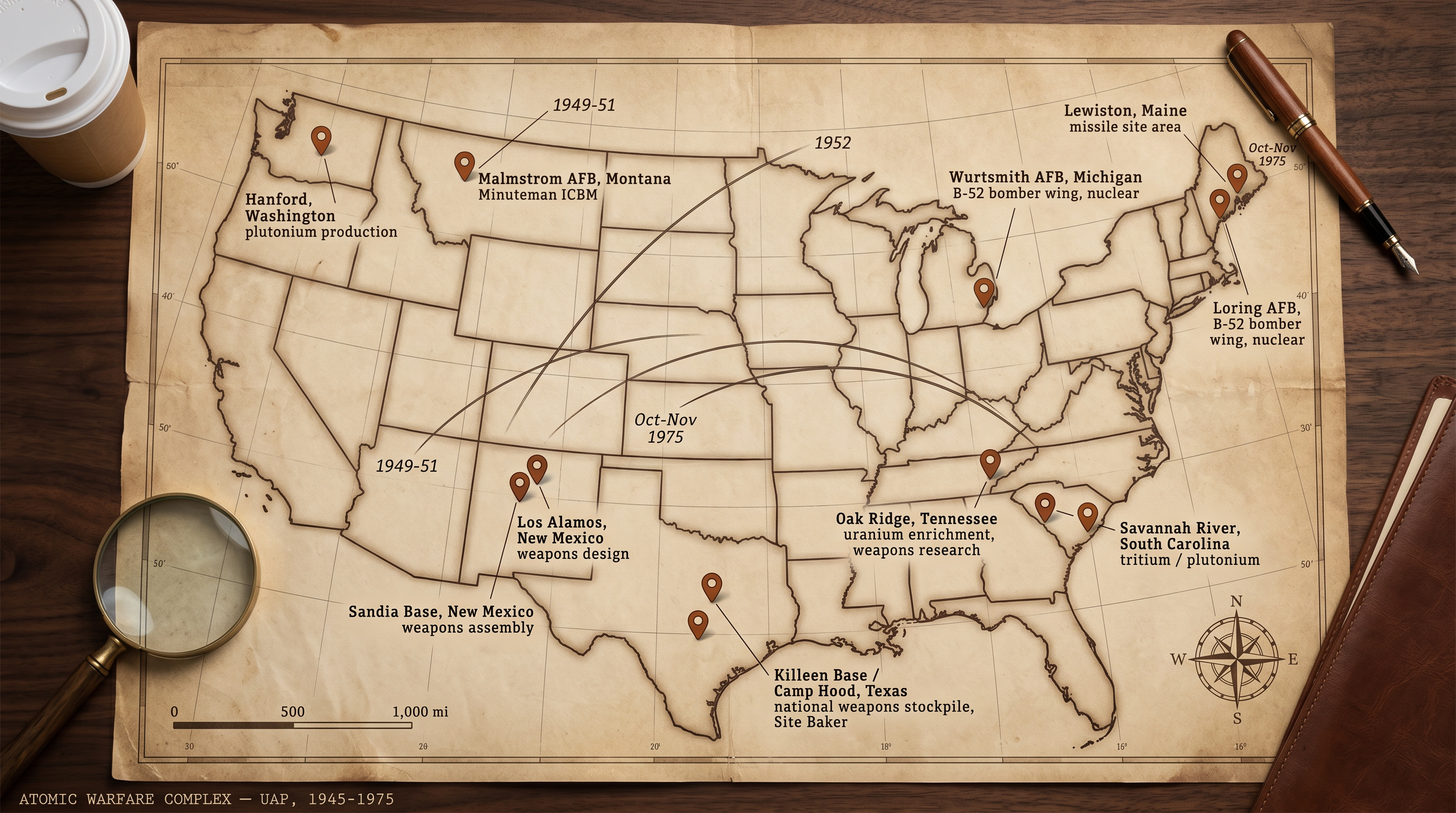
Larry J. Hancock, Ian M. Porritt, and Sean Grosvenor, with Larry Cates and Ike Okafor as project members, published "UAP Pattern Recognition Study 1945–1975: US Military/Atomic Warfare Complex" in April 2023 — a Zenodo-hosted journal article that has sometimes been informally dated to 2022 in the secondary literature. The paper used a set of 590 comprehensively documented UAP reports drawn from Project Blue Book and other sources, mapped them against the geographic footprint of the U.S. Atomic Warfare Complex — Oak Ridge, Hanford, Los Alamos, Sandia, the National Stockpile Sites, the Minuteman ICBM wings, and the B-52 nuclear-capable bomber wings — and compared them against civilian population centres and high-security, non-atomic military bases as controls. Elevated UAP activity was found at all three atomic site classes and was most noticeable at the earliest facility in each class, with activity in many cases beginning during the construction phase and escalating once the site became operational. Elevated activity at study sites clustered in a 1948–1951 window that continued through the national spike in UAP reporting in 1952, then "dramatically decreased, never to repeat the 'window' levels during the remainder of the study period." Notably, this initial paper was itself described by SCU as peer-reviewed on publication.
Hancock, Porritt, and Grosvenor followed with "UAP Indications Analysis 1945–1975 United States Atomic Warfare Complex" in July 2023, an indications analysis that scored the same 590 reports plus a further 284 cases of either engaged aircraft, active radar jamming, radio or radar interference, directed radar frequency transmissions mimicking pilot frequencies, IFF-coded transmissions, or sightings over missile, rocket, and high-altitude balloon tests and over military installations. The paper ranked four intention scenarios — general military survey, atomic weapons survey, atomic warfare prevention, and military aggression — and concluded that an atomic weapons survey was the most likely scenario, general military survey the next most likely, and atomic warfare prevention and military aggression the least likely. "We found little evidence to support prevention or aggression as primary intentions," the paper concluded.
Sean Grosvenor joined Hancock and Porritt, with Larry Cates, for the "UAP Activity Pattern Study 1945–1975 Military and Public Activities" published in March 2024. That paper used a separate set of 505 UAP incidents drawn from Project Blue Book, NICAP, Clear Intent (Fawcett and Greenwood, 1984), and Faded Giant (Salas and Klotz, 2005), and looked at nine specific types of UAP activity — interactive flight, radical flight, electronic transmissions, interference with military weapons systems, intrusions at military installations, loitering, close approaches, observed occupants, and encounters with occupants. It found that during the early study period 1945–1960, most reports involved UAP being observed at a distance, during the daytime, and with both the military and public. From 1960 onwards, the reports shifted to close approaches during the nighttime and with the public. "UAP occupant reports and reported messaging indicate intelligence; however, there are limited data with which to establish strong patterns and trends and further study is required." The military-domain activity, which focused on the locations of deployed atomic weapons, continued throughout the study period.
A separate 2025 paper, Sean Grosvenor and colleagues' "UAP Indications Analysis 1945–1975: United States Atomic Warfare Complex" published in Limina, an open-access peer-reviewed UAP journal, refined the per-facility intensity scoring from the 2023 Indications work, controlled more rigorously for military-airspace and base-aviation effects, and added a temporal correlation against major weapons-development milestones. The strongest single-site signal sat at Oak Ridge over 1948–1952, with Hanford a close second and Malmstrom Air Force Base producing the strongest ICBM-era signal over 1966–1968. The Limina paper was explicit about its interpretive ceiling — a statistically significant correlation does not, by itself, specify a mechanism.
What the 2026 synthesis adds
The April 2026 paper, authored by Porritt, Hancock, and Grosvenor, is the first to place the three predecessor methodologies — case-density mapping, indications analysis, and activity-pattern analysis — on the same page as a single thirty-year assessment. It identifies three clear activity surges: 1949–51 (expansion of atomic weapons facilities), 1952 (the national UAP-reporting spike, coinciding with early ICBM-era developments), and October–November 1975. A fourth possible peak around 1957 appears in some supplementary material but is treated far less firmly than the other three, and the paper does not offer a developed explanation for it — a gap worth flagging rather than glossing over, since 1957 is also the year of Sputnik's launch, a plausible contextual link the study itself does not explore.
Across all three surges, the paper reports no evidence of simultaneous UAP operations at multiple sites. Instead, activity moves in a staggered, region-to-region pattern — a finding the authors read as consistent with a small, mobile force operating under resource constraints, rather than a large-scale, multi-site presence. "Structured sequencing and tightly bounded clusters observed across multiple datasets are difficult to reconcile with a high-density presence," the abstract concludes.
The 1975 Northern Tier sequence
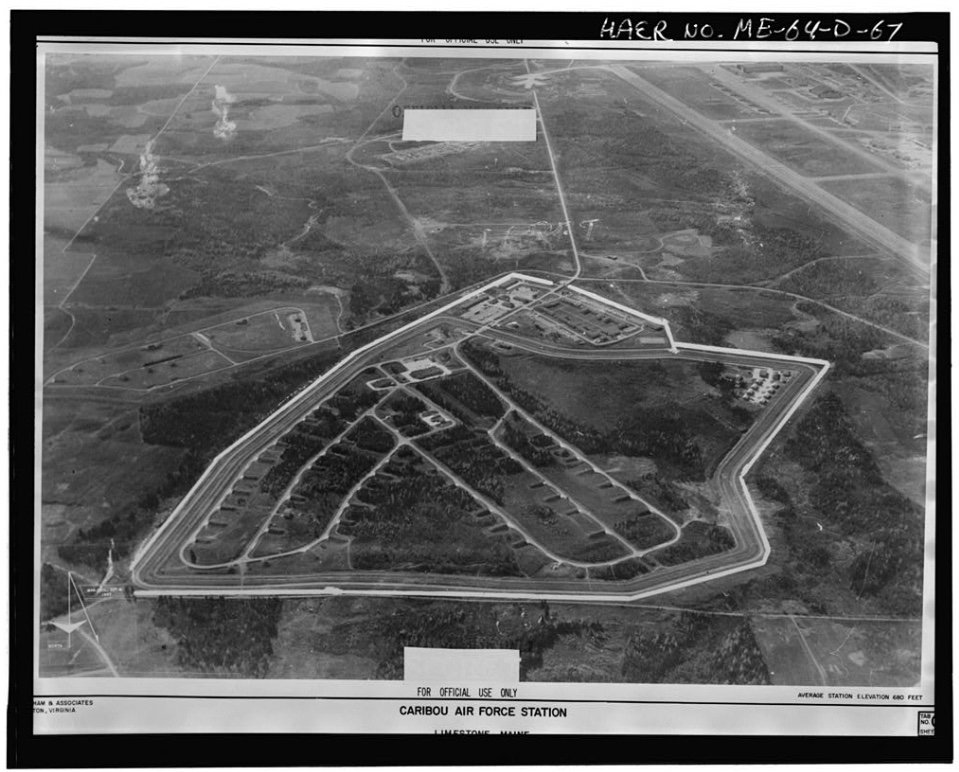
The clearest illustration in the 2026 paper is the October–November 1975 sequence. Between October 27 and November 12, four atomic-warfare facilities — Loring Air Force Base in Maine, Wurtsmith Air Force Base in Michigan, Malmstrom Air Force Base in Montana, and a missile-site area near Lewiston, Montana, sat within Malmstrom's Minuteman ICBM field — recorded UAP activity in a staggered, non-concurrent pattern. Loring and Wurtsmith hosted B-52 nuclear-capable bomber wings; Malmstrom was a Minuteman ICBM wing; the Lewiston missile site was a launch control facility in the field surrounding Malmstrom.
None of the four 1975 incidents is documented with the same density of case files and witness triangulation as the 1949–51 Killeen Base (Camp Hood, Texas) wave earlier in the study period. The 1975 sequence rests more heavily on SCU's aggregate case-density work than on individually corroborated file sets. It is also the most recent of the study's surges, meaning more underlying case material should, in principle, remain retrievable through FOIA requests than for the 1940s cases. Whether the Loring, Wurtsmith, Malmstrom, and Lewiston files for late 1975 have been independently re-examined by any researcher outside SCU is not clear from the public record.
The methodological limit — and the interpretive leap
Three complementary methodologies is the strongest technical claim SCU can make for the 2026 synthesis, and the paper is careful about how it makes it. That care is also the study's central limitation: all three methods draw on the same underlying Blue Book and NICAP material, refined by an overlapping set of SCU researchers across a decade of related papers. Sparks' catalog is itself a curated re-evaluation. NICAP's archive is a non-random intake. Even the more rigorous controls in the 2025 Limina paper cannot fully rule out that the observed pattern reflects how the Air Force, NICAP, and later Sparks chose to log, retain, and reclassify cases — rather than what was actually in the air over Oak Ridge, Hanford, and Killeen Base.
Where the 2026 paper departs from its predecessors is in how it frames the implications of that pattern. The 2025 Limina paper stopped at "a statistically significant correlation does not specify a mechanism." The 2026 synthesis's own abstract goes further, describing the evidence as supporting an inference of "a persistent, intelligence-driven actor" operating with resource constraints and adaptive tactics. That is an interpretive claim built on top of the correlation, not a restatement of it, and readers evaluating the paper should treat those as two distinct claims with two different evidentiary standards. Lead author Ian Porritt, in the SCU press release accompanying the paper, framed the same finding as: "These resources, not benign intentions. This limited footprint may be restricting their operational scope. An increase in presence could reveal a broader behavioral profile."
No academic statistician outside SCU's own research pipeline has, to date, published an independent replication of these findings using an independently curated sample. AARO's 2024 historical-records report did not run a comparable analysis of Blue Book's unknown-cases file against the atomic-warfare-complex footprint. Until an outside group attempts that replication, SCU's is the most data-grounded public claim in the field on this specific question — and it is also, by its own abstract's language, a claim that has moved from describing a pattern to interpreting an actor behind it.
Open question
The throughline across SCU's five-paper, five-year effort is a strengthening correlation and a widening interpretive claim, arriving in the same document. The refined methodology and the three-method cross-check have moved the field from "Blue Book Unknowns and atomic sites probably overlap" to "the overlap survives available controls, tracks the weapons-development timeline, and — per the study's own framing — points toward a coordinated, resource-constrained actor." Whether that last step is warranted by the data, or represents the interpretive reach the paper's own methodological caveats should caution against, is the question an independent replication would need to settle. Until one appears, SCU's synthesis remains the strongest available claim on the record — and also the one furthest from external verification.
Sources
- Porritt, I. M., Hancock, L. J., Grosvenor, S. "UAP Operational Presence 1945–1975," Scientific Coalition for UAP Studies, Zenodo record 16299623, 20 April 2026. https://doi.org/10.5281/zenodo.16299623.
- Solve Advocacy / Scientific Coalition for UAP Studies, "SCU Publishes Comprehensive Analysis of UAP Operational Presence, 1945–1975," EIN Presswire via National Law Review, 20 April 2026.
- Hancock, L. J., Porritt, I. M., S. Grosvenor (Cates, L., Okafor, I., project members), "UAP Pattern Recognition Study 1945–1975: US Military Atomic Warfare Complex," SCU journal article, Zenodo record 7295958, published 3 April 2023. https://doi.org/10.5281/zenodo.7295958.
- Hancock, L. J., Porritt, I. M., S. Grosvenor, "UAP Indications Analysis 1945–1975 United States Atomic Warfare Complex," SCU journal article, Zenodo record 7758498, published 20 July 2023. https://doi.org/10.5281/zenodo.7758498.
- Hancock, L. J., Porritt, I. M., S. Grosvenor, Cates, L., "UAP Activity Pattern Study 1945–1975 Military and Public Activities," SCU peer-review publication, Zenodo record 8213330, 25 March 2024. https://doi.org/10.5281/zenodo.8213330.
- Grosvenor, S., et al., "UAP Indications Analysis 1945–1975: United States Atomic Warfare Complex," Limina, 2025.
- UAP Investigations, "Northern Tier 1975 Nuclear Base Incursions," uapinvestigations.com, case file (FOIA-derived documentation; identifies Loring AFB, Wurtsmith AFB, Malmstrom AFB, Minot AFB, and the Lewiston missile site area as the principal 1975 incursion sites).
- Sparks, Brad, "Comprehensive Catalog of Project Blue Book UFO Unknowns," working data behind the SCU analysis; available as supplementary data on Zenodo record 7758498.
- NICAP, "1975 UFO Chronology," nicap.org (7 November 1975 entry references the Lewiston missile site, MT).
- The Warzone, "The Bizarre Mystery of Unexplained Aerial Incursions Over Loring Air Force Base," twz.com.
- SCU Publications page, explorescu.org/publications, accessed July 2026.
Image credits and licensing
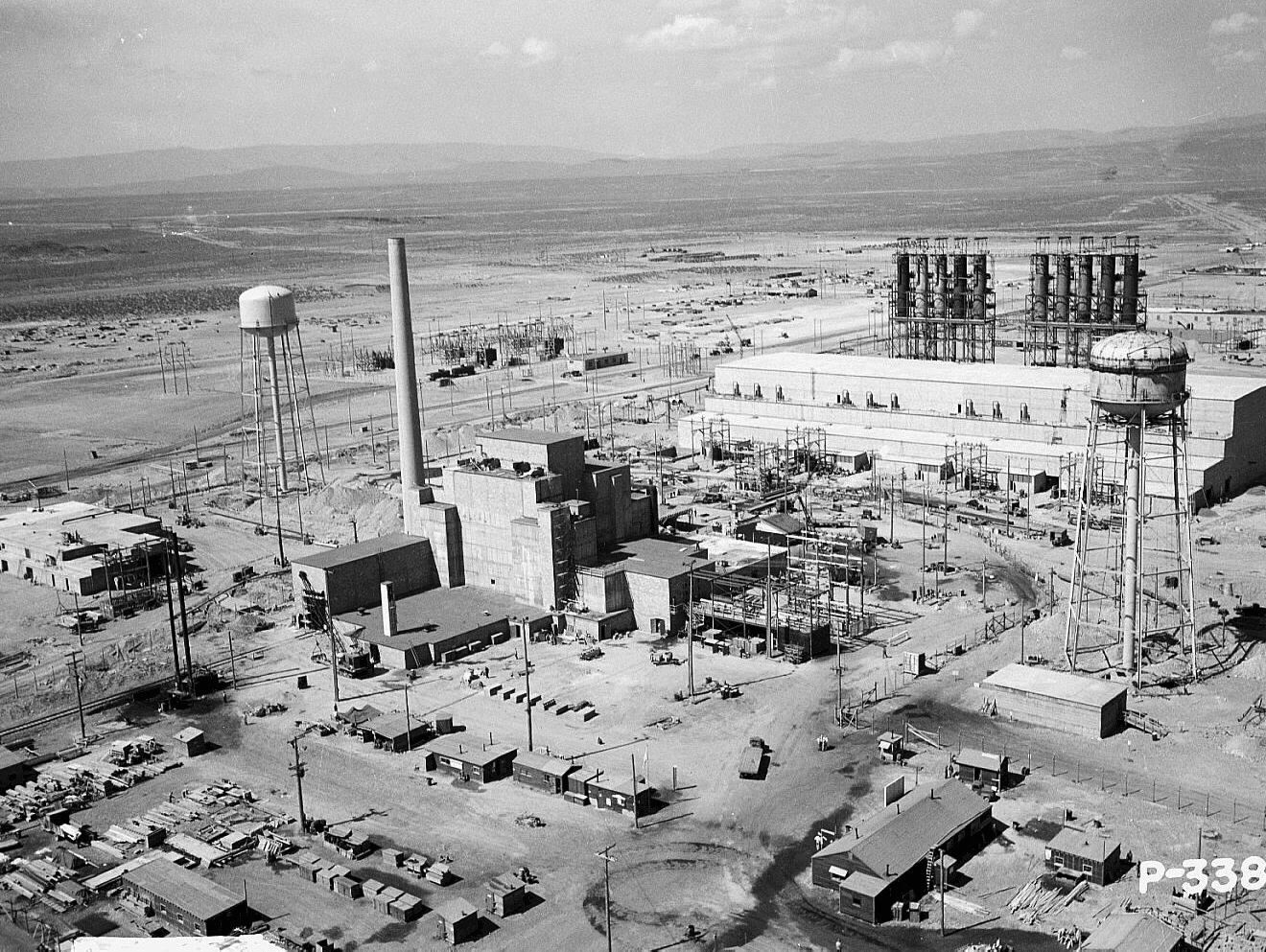
- Feature image — Hanford B Reactor, Washington State. Photograph by the U.S. Department of Energy, image #N1D0029049 from the Hanford Declassified Document Retrieval System, transferred to Wikimedia Commons by the uploader "Cacophony" in 2008. Wikimedia Commons file page. Public domain (PD US DOE) — a work of the U.S. federal government.
- Inline image — AWC site map. Editorial illustration by UAP Logbook, in the Vintage-Investigator-Desk visual style. Site positions and peak dates are derived from the SCU study, Zenodo record 16299623; the desk context (parchment, magnifying glass, fountain pen, paper coffee cup, compass rose, scale bar) is illustrative.
- Inline image — Loring Air Force Base, weapons-storage area (1967). Official U.S. Air Force aerial photograph, deposited with the Library of Congress Historic American Engineering Record as HAER No. ME-64-D-67. Wikimedia Commons file page. Public domain (PD-USGov-NPS-HAER) — a work of the U.S. federal government.