Main Article / Jul 14, 2026
A Würzburg university office runs Germany's only state UAP lab
A small camera cluster sits on a 2,650 m research terrace in the German Alps. It is run from a Würzburg office that, since January 2022, has been the only state university in Germany to put UAP in its research canon. Pilots can now report sightings straight to it.

For about nine months, a small camera cluster has been watching the sky from the concrete research terrace of the Schneefernerhaus, at 2,650 meters just below the Zugspitze summit on the German-Austrian border. The hardware belongs to a project the University of Würzburg has run since 2016. Since January 26, 2022, that same project has also been the only research office at a German state university with the study of Unidentified Anomalous Phenomena formally written into its statute.
The office is called IFEX, the Interdisciplinary Research Center for Extraterrestrial Studies. It sits inside the Faculty of Mathematics and Computer Science at Würzburg, led by space-technology professor Hakan Kayal, and it has spent nine years quietly assembling a German counterpart to the kind of scientific UAP research that, until recently, lived almost entirely in the United States.
The German counterpart looks nothing like the American one. There is no Pentagon office behind it, no defense-intelligence budget, no Congressional hearing room. What exists instead is a university lab: a page, a list of cameras, a pilot-reporting form, one peer-reviewed paper, and an annual conference.
A camera cluster on Germany's highest research roof
The Zugspitze hardware is the latest in a line called SkyCAM. Würzburg installed the first version, SkyCAM-5, on a university rooftop at the Hubland campus in December 2021. In 2024 the team added SkyCAM-6, a double-camera unit, at the Blue Box instrument station in Hessdalen, the Norwegian valley where luminous phenomena have been reported since the 1980s and where IFEX has run a KI-based camera since 2021. SkyCAM-7 went up on the lower research terrace of the Schneefernerhaus at the end of September 2025, just before the first snow closed the mountain road.
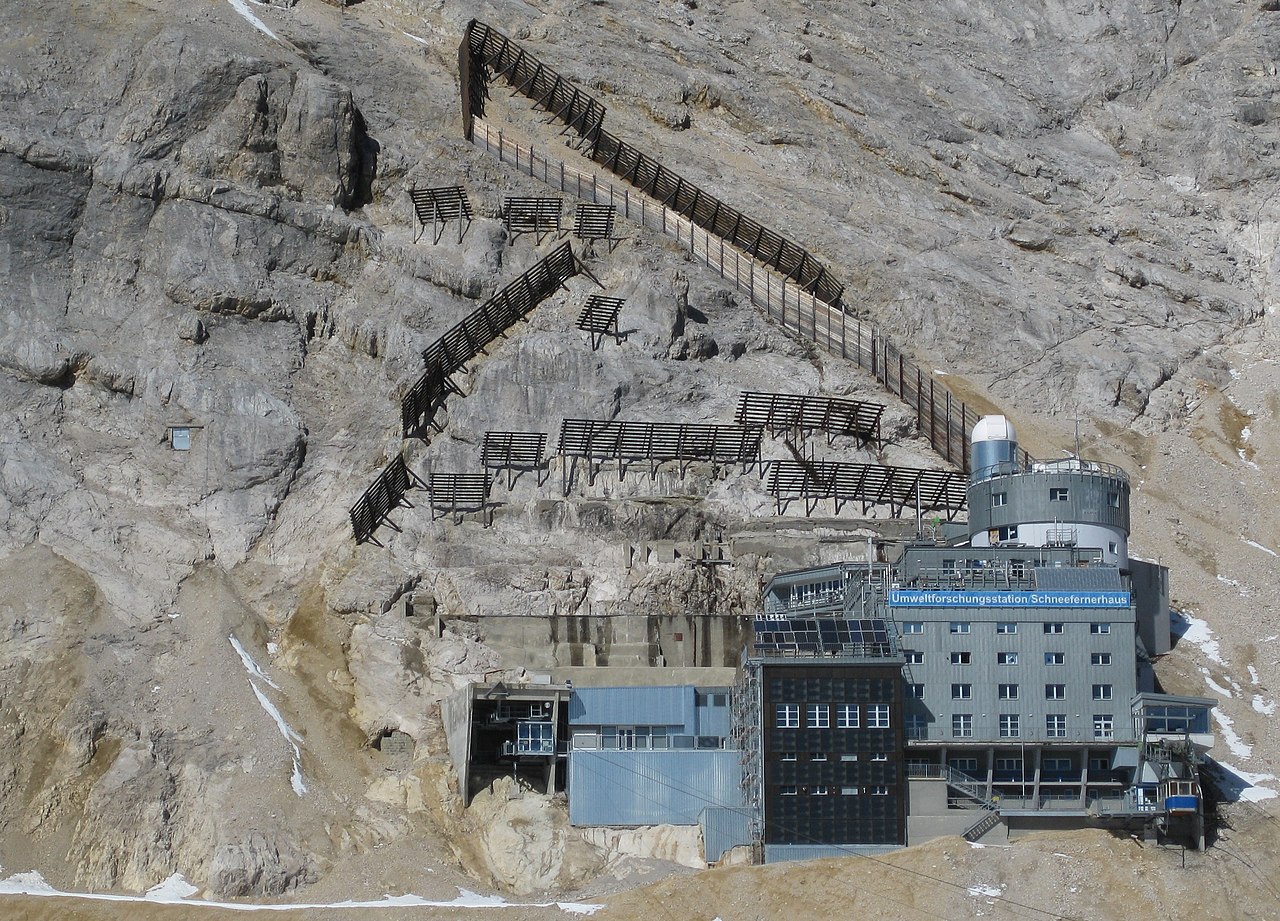
The Schneefernerhaus sits 2,650 meters above sea level, just below the 2,962-meter Zugspitze summit, making it Germany's highest environmental research station. The AllSkyCAM unit is a compact ring of cameras that together cover the full visible sky. Machine-learning software inside the unit has been trained to separate ordinary movers — insects, birds, aircraft, satellites, meteors — from anything that doesn't fit the catalogue.
"The SkyCAM-7 is a test version that is deliberately being trialed on the Zugspitze," Kayal said when the system went live. "In continuous operation, it helps in the exploration of known objects such as clouds or meteors in the atmosphere, as well as the possible discovery of new phenomena such as Unidentified Anomalous Phenomena."
The first image IFEX released from the system showed the cameras correctly tagging a bird against the mountain sky — an unremarkable result, and the one that actually matters. A system that flags a passing bird as anomalous produces noise, not data. One that lets the bird pass and flags only what's left is the version worth testing at 2,650 meters.
The hardware and the Mars test
The Zugspitze installation belongs to a larger DLR-funded project called VaMEx3-MarsSymphony, aimed at preparing sensor technology for a future German Mars mission targeting Valles Marineris. The AllSkyCAM is being run at altitude and in extreme cold to see whether it can function as a general-purpose anomaly detector under conditions that approximate a Martian environment.
The project runs through Germany's Federal Ministry for Economic Affairs and Energy under grant number 50RK2451A, started August 1, 2024, with an end date of December 31, 2026. Public project pages do not list the total funding amount for the Würzburg component, so the actual budget behind the Zugspitze installation remains unclear from the available record.
That funding line is a useful contrast to the U.S. picture. Almost every prior public conversation about state-funded UAP research has run through the American system — AARO, its 2024 historical-records report, the Navy and Air Force task forces that preceded it, and the Congressional hearings that followed. The DLR line funds a camera meant for another planet; the UAP application is a use case for that camera, not the reason it exists.
IFEX, Würzburg, and a research remit
IFEX was founded in September 2016. Its statute covers space exploration, the search for life in the solar system, SETI, UAP research, interdisciplinary coordination, and public outreach on extraterrestrial science. The 2022 addition of UAP to that statute is the moment the office stopped being a general space-research center that also followed UAP and became a state-university body with UAP written into its founding document.
IFEX runs four working groups. One builds the technology — sensors, camera systems, time synchronization, automatic event detection, and matching against exclusion data such as flight traffic and satellite positions. A second develops the concepts — observation strategies, evidence criteria, and classification standards. A third handles the social dimension — stigma, reporting behavior, legal and data-protection questions, and disinformation. A fourth investigates specific cases, including pilot reports and, in a separately bounded and explicitly cautious lane, contact and abduction claims.
That fourth group's scope is unusual for European state-funded UAP work, which typically excludes the more exotic claim categories outright. IFEX has carved out a narrow space for them instead, with an explicit warning that the goal is critical analysis, not validation.
The team itself is small. Public listings name Kayal as chair, with staff including Julian Mutter, Tobias Herbst, Andreas Maurer, Clemens Riegler, Joshua Stadler, Niklas Johne, and Julian Junker — a research group, not a national program.
The LBA pilot pipeline
IFEX's online UAP reporting form for pilots has been live since July 2025. In September 2025 the German civil aviation authority, the Luftfahrt-Bundesamt (LBA), agreed to link to it from its general occurrence-reporting area. A pilot who sees something unidentifiable can now follow that link and send a report to a university research group rather than a hobbyist UFO database.
The form collects standard incident data plus optional image and video uploads. IFEX has said it plans to add database integration so reports can be checked against flight routes, satellite passes, weather, and astronomical events. Publicly available figures on how many reports have actually come through the LBA link since July 2025 have not been released, so it is not yet possible to say whether the pipeline is generating meaningful volume or remains largely theoretical.
This is a small, careful change to the German reporting system, and it's worth being precise about what it is and isn't. It is not a UAP office. It is a link from one government agency to a university form. The LBA still treats these reports as ordinary aviation occurrences that may need a safety follow-up; IFEX treats them as research data. Neither side has promised a disclosure event — what the pipeline offers is simply somewhere to send an observation that doesn't force it into either a "nothing happened" or "this is unexplained" frame.
The academic frame: arXiv, conferences, public television
In February 2025 a 194-page review, "The New Science of Unidentified Aerospace-Undersea Phenomena (UAP)," was posted to arXiv by a multi-author group led by Kevin H. Knuth of the State University of New York at Albany. The paper surveys roughly 20 historical government UAP studies dating to 1933, plus a range of private and current scientific efforts. Kayal is a co-author, listed under his Würzburg IFEX affiliation. The paper has since been published in the peer-reviewed journal Progress in Aerospace Sciences, volume 156, article 101097.
The review explicitly argues against treating UAP as an American phenomenon, listing Germany, Ireland, Norway, and Sweden alongside the U.S., France, and the U.K. as countries with active scientific UAP efforts. It functions as the academic anchor for the rest of the Würzburg story — the same researchers building the cameras are also the ones writing the global literature reviews, which gives the project a rare degree of internal consistency, even if it also means the field's most visible cheerleaders and its primary reviewers substantially overlap.
In September 2025 IFEX held its third annual SETI & UAP conference in Würzburg, September 17–19, in the Turing lecture hall on the Hubland campus. Speakers included Andreas Müller of GreWi on German UFO reports, Baptiste Friscourt of the Sentinel Center on citizen-science observatories, Ryan Graves of Americans for Safe Aerospace on aviation-safety risk, Massimo Szydagis of the University at Albany, IFEX's own Clemens Riegler on the MarsSymphony UAP component, and Robert Haseitl of Project Hessdalen on the 2024 Hessdalen campaign. ESA representatives Philipp Ailleris and Kai-Uwe Schrogl presented the agency's current UAP position. Talks from the conference were published on IFEX's YouTube channel in November 2025.
On October 31, 2025, German public broadcaster ZDF posted a 20-minute interview between Kayal and Harald Lesch for the science series Terra X Lesch & Co. A shortened version aired in the Terra X episode "The Truth About UFOs" on November 4, 2025. It is the most-watched German-language mainstream-media treatment of scientific UAP research to date.
"What I propose is that we iteratively try to characterize the phenomenon a little better than has been the case so far," Kayal told Lesch. "To do a kind of inventory." That line summarizes what the camera network, the pilot form, the conference, and the peer-reviewed paper are all built to do — describe the problem carefully enough that the next steps become visible, without claiming to have solved it.
Earlier in 2025, Parliamentary State Secretary Dr. Silke Launert, of the Federal Ministry for Research, Technology and Spaceflight, visited the IFEX control room in Würzburg. In a press statement released afterward by IFEX itself, Launert was quoted saying the federal government had identified a clear research need on UAP and that the goal was to investigate the phenomena in a scientifically sound way, using existing sensor data more effectively and developing new analytical approaches. IFEX's own account is currently the only public record of that visit and its framing.
There is no defense-intelligence office behind IFEX, no cleared program, no crashed-material claim, and no German AARO equivalent. There is no equivalent of David Grusch or Lue Elizondo testifying to a legislature. Würzburg's UAP work is not the American story retold with a German accent — it is a university research office with a DLR grant, an aviation-authority link, one peer-reviewed review paper, a small camera network, and an annual conference.
What's still missing from the record
Independent scientific reaction to IFEX's work — from astronomers, physicists, or research bodies outside the Würzburg group itself — is largely absent from the public record so far. Nearly all available coverage originates either from IFEX's own releases or from GreWi, a UFO-focused outlet sympathetic to the project. Whether Kayal's approach carries weight with the broader German physics and astronomy community remains an open question the current record doesn't answer.
Nine months into SkyCAM-7's operation, including a full Alpine winter, IFEX has not publicly announced any resolved UAP detections. Whether that winter data set gets published, whether the LBA pipeline produces a meaningful report volume, and whether the 2026 SETI & UAP conference shows the camera work, the pilot form, and the peer-reviewed research still functioning as one coherent program — those are the concrete tests the next year of the record will need to answer.
Sources
- IFEX – UAP & SETI Forschung, Julius-Maximilians-Universität Würzburg, accessed July 2026.
- AllSkyCAM installed on the Zugspitze, Professorship for Space Technology, University of Würzburg, 26 September 2025.
- Umweltforschungsstation Schneefernerhaus (UFS), DLR, project page confirming altitude of 2,650 m.
- Würzburger Forscher erproben Observatorium zur Detektion von UAP/UFOs auf der Zugspitze, GreWi, 23 October 2025.
- Knuth, K. H. et al., "The New Science of Unidentified Aerospace-Undersea Phenomena (UAP)," arXiv:2502.06794, submitted 27 January 2025; published in Progress in Aerospace Sciences 156 (2025) 101097.
- IFEX SETI & UAP Konferenz 2025 – Programm, Julius-Maximilians-Universität Würzburg, 17–19 September 2025.
- Scientific research on UAPs: Interview with Professor Hakan Kayal for the German TV series Terra X – Harald Lesch, University of Würzburg, 10 November 2025.
- VaMEx3-MarsSymphony, IFEX, project start 1 August 2024, end 31 December 2026, grant 50RK2451A.
- UAP-Meldestelle für Piloten, IFEX.
- IFEX Statut, Stand 25.01.2022, Julius-Maximilians-Universität Würzburg.