News / May 20, 2026
The FAA's UAP reporting rule is boring. That is why it matters.
The FAA did not confirm aliens. It did something more useful: it turned UAP reports into a checklist and a reporting route inside air traffic operations.
The FAA did not confirm aliens.
It did something more useful for anyone trying to track the subject: it wrote UAP into air traffic reporting procedure.
That is not a disclosure event. It is not a statement about what UAP are. It is also not just internet vocabulary anymore.
It is a normal aviation system telling air traffic personnel what to do when pilots or controllers report unidentified anomalous phenomena.
What changed
FAA Notice N 7110.800 took effect on October 26, 2025. It updated FAA Order JO 7110.65 by replacing the older abbreviation UFO with UAP and retitling the relevant section as “Unidentified Anomalous Phenomena (UAP) Reports.”
The same notice added a requirement: air traffic personnel should inform the operations supervisor or CIC of any reported or observed UAP activity.
The notice also points to FAA Order JO 7210.3, paragraph 4-7-4, where the actual reporting route is laid out.
That paragraph is the useful part.
The reporting route
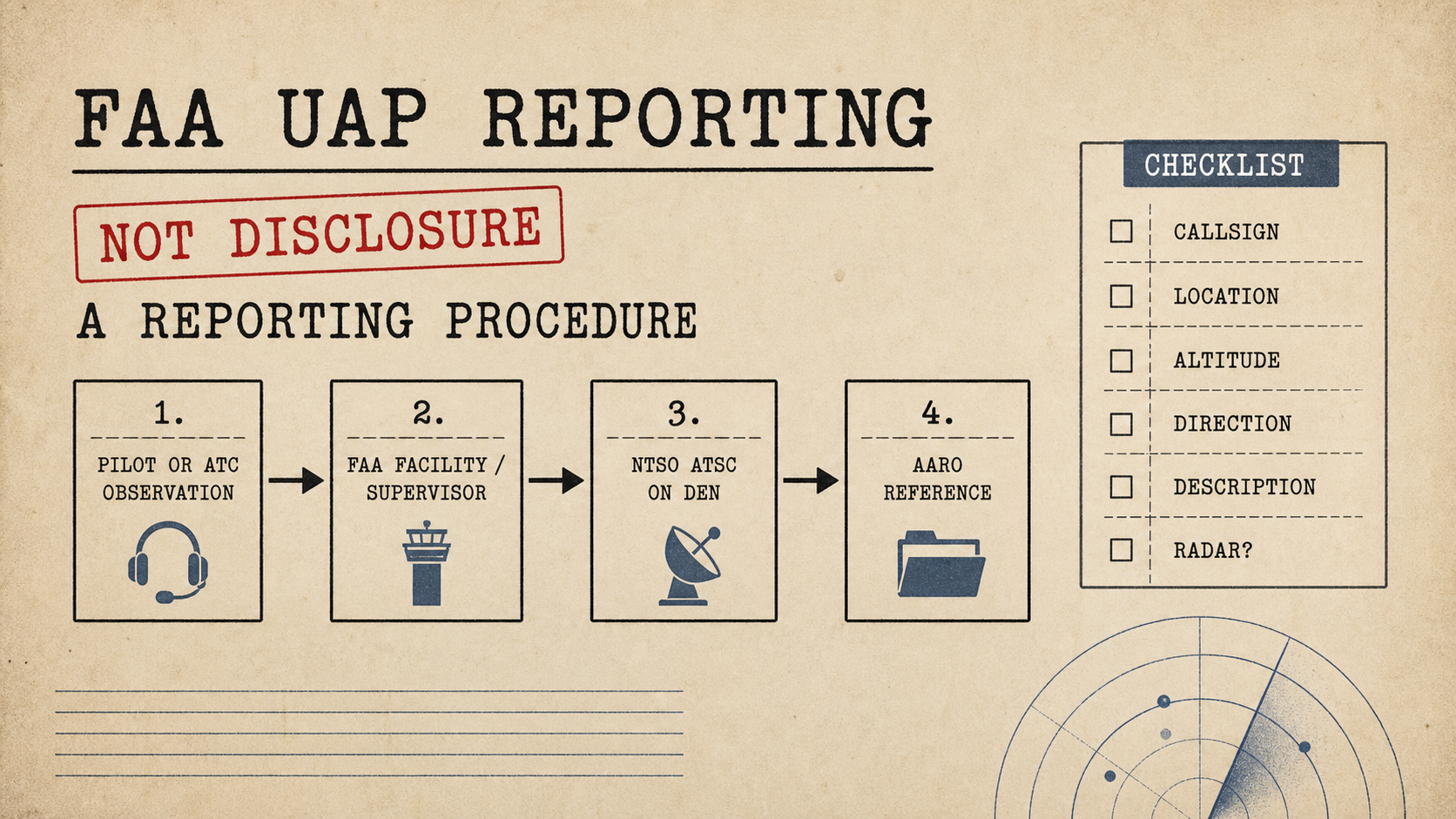
FAA Order JO 7210.3 says pilot reports and air traffic personnel observations of UAP activity must be reported to the National Tactical Security Operations Air Traffic Security Coordinator team on the Domestic Events Network.
That is a long sentence, but the meaning is simple:
- a pilot or controller reports or observes UAP activity;
- the report goes through the FAA facility chain;
- the NTSO Air Traffic Security Coordinator team receives it on the Domestic Events Network;
- other people who want to report UAP activity may be referred to AARO.
The order also says that, if someone expresses concern that life or property might be endangered, the activity should be reported to local law enforcement.
Again: this is a reporting procedure, not a finding.
The checklist matters
The FAA procedure asks for practical details if they are available:
- the call sign of the reporting aircraft, or whether it was an air traffic personnel observation;
- the location, altitude, and flight direction of the reporting aircraft, or the location of the reporting air traffic personnel;
- the UAP location in relation to the aircraft or air traffic personnel;
- a general description of the UAP, including known altitude, direction of flight, and speed;
- whether the UAP appeared on ATC radar displays.
That checklist is more useful than most public UAP language.
It does not ask whether the witness believes in aliens. It does not ask for a documentary trailer. It asks for position, motion, observer role, and radar context.
That is the minimum structure needed before a report becomes analyzable.
What it does not mean
The FAA rule does not prove that any specific UAP case is extraordinary.
It does not say pilots are seeing non-human technology.
It does not create a public archive of reports.
It does not tell outsiders whether AARO receives all of the data, summaries of the data, or only referrals from non-FAA reporters.
It also does not solve the larger transparency problem. A report can be properly routed and still disappear from public view.
Why it is still worth noting
The change matters because it moves the subject into routine operational language.
For years, public UAP arguments have tended to jump from sighting to conclusion. The FAA procedure points in the opposite direction. It treats UAP as something that may need to be captured as an air traffic/security report before anyone argues about explanation.
That is the sober version of progress.
Not “the government admits aliens.”
Not “nothing is happening.”
Something narrower: the aviation system now has a UAP reporting lane, and that lane asks for the kind of details that can make a sighting more than a story.
The open question
The next useful question is not whether the FAA used the word UAP.
It did.
The useful question is what happens after the report moves through the system.
How many UAP reports are received? How many come from pilots versus controllers? How many include radar depiction? How many are resolved as drones, balloons, satellites, weather, aircraft, or sensor error? How many remain unresolved because the data was not enough?
That is where this becomes a records story.
The FAA checklist is the start of the trail. It is not the end of it.