Main Article / Jul 20, 2026
Jason Samosa's UAP map runs from Vallée to the Bahamas
In a two-and-a-half-hour American Alchemy conversation, Jason Samosa connects UAPs to religion, secret societies, private intelligence, casinos and apocalypse. The claims are mostly unverified. The format is still a revealing document of the current disclosure moment.
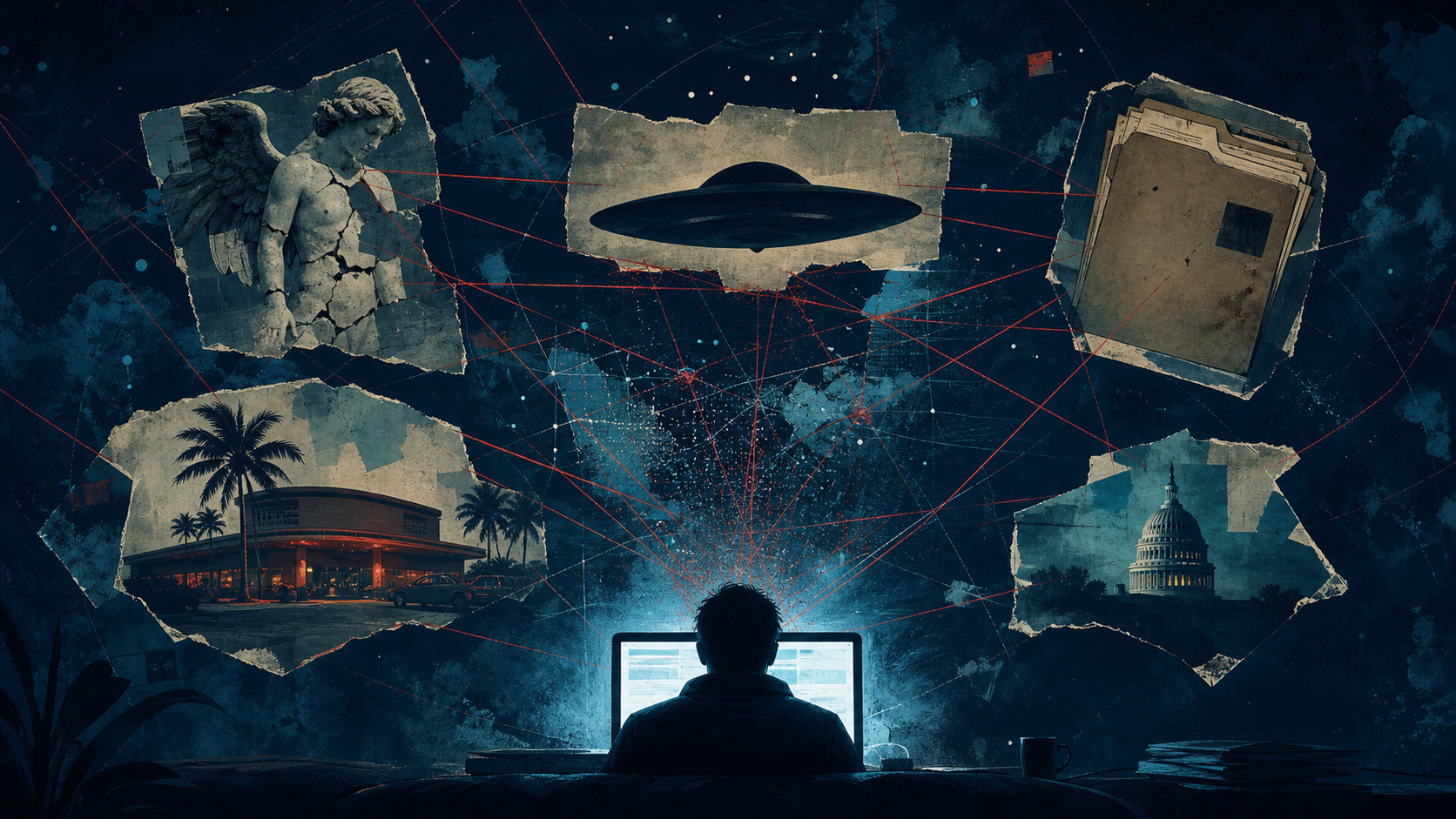
A figure sits in front of a laptop while a UAP-shaped silhouette, a damaged angel, a government folder, a tropical resort and the Capitol all pull toward the same point. That is not a scene from Jesse Michels' American Alchemy interview with Jason Samosa. It is the visual logic of the conversation.
For two and a half hours, the pair move through UFO cases, Jacques Vallée, end-times prophecy, the supposed “Collins Elite,” Cold War intelligence, Thomas Townsend Brown, the World Commerce Corporation, the Bahamas, Resorts International and contemporary American politics. The title promises that a UFO cover-up leads to “one secret society — and one final event.” The discussion offers a very different kind of material: a snapshot of how the UAP conversation can become a theory of almost everything.
That makes the episode worth documenting. Not because its largest connections are established, but because it shows what happens when a long-running mystery becomes a framework into which history, religion and political anxiety can all be fitted.
From an unexplained phenomenon to a total explanation
The opening stretch begins with a real intellectual reference point. Samosa invokes Vallée's criticism of the simple extraterrestrial hypothesis: if reports describe a phenomenon that returns for decades in inconsistent forms, he argues, it may be worth asking about its cultural effects as well as its physical origin. That is a recognisable Valléean question. The conversation then moves quickly from interpretation to intention: perhaps the phenomenon is shaping human belief; perhaps apocalyptic messages are part of that work.
By the time the talk reaches the “Collins Elite,” the register has changed again. Samosa says the name may cover more than one thing: an alleged early intelligence programme examining UFOs and the occult, as well as informal religious networks around government. He is candid about one central problem: “we don't know the real name” of the first supposed programme. The rest of the argument nevertheless proceeds as if the missing identity can be bridged by adjacent people, institutions and stories.
That bridge is the episode's real subject. A connection is presented, then a second association makes it feel less isolated, then a third supplies a wider historical atmosphere. The listener is not asked to inspect one decisive document. The listener is asked to remain inside a widening pattern.
The Bahamas sequence
The most revealing section arrives late in the interview. Samosa follows Thomas Townsend Brown into the Bahamas, then brings in the World Commerce Corporation, Resorts International, a private-intelligence subsidiary, casino history and Donald Trump. Each item has its own historical setting. In the episode, however, their proximity is made to carry a larger UAP implication.
That is not the same as showing a UAP connection. The programme provides no document that establishes a chain from any of those companies or people to recovered technology, a UAP programme, or a secret society directing disclosure. It is a sequence of historical associations and interpretation. The distinction matters because the podcast's title turns that accumulation into a singular answer.
“World Commerce Corporation” is a particularly good example of why this format works. It is a vague, bureaucratic-sounding name with a real Cold War atmosphere. In a long conversation, it can hold intelligence history, private business and an offshore setting together long enough for the connective tissue to feel like a discovery. But atmosphere is not a source chain.
The episode's own chapter list shows that the chain does not stop there. It moves on to Prescott Bush, Allen Dulles, Robert Maxwell, Jeffrey Epstein and the British royal family. Those names do not create the same claim. In the structure of the conversation, though, each new association broadens the sense that one hidden system can explain the last.
Why the Collins Elite keeps returning
The episode lands in a UAP culture that already has a vocabulary for this kind of synthesis. “Collins Elite” is no longer just the title of Nick Redfern's 2010 book Final Events. It has become a shorthand for a cluster of ideas: religious resistance inside government, occult history, classified technology and a hidden explanation for why disclosure stalls.
That shorthand has political life now. It has been invoked publicly by Luis Elizondo and sits beside a broader 2026 argument about demons, UAPs and official secrecy. But the name's documentary foundation has not grown with its cultural reach. Redfern's book rested on an unnamed source; no publicly available organisation chart, government file or independently verified witness account has established the alleged group. UAP Logbook's earlier reconstruction of that source trail is important context for this interview.
Redfern signalled the problem himself with a line from Walter Scott: “I cannot tell how the truth may be; I say the tale as 'twas said to me.” That caution is not a minor footnote. It is part of the story's original frame. Aaron John Gulyas later treated the narrative in a 2014 chapter, “Space Demons,” as part of modern UFO religion and conspiracy culture rather than as documented intelligence history.
Samosa does not simply repeat Redfern's version. He expands its possible meanings. The move is significant. A claim that began as a single, unverifiable account becomes flexible enough to absorb other networks, figures and eras. It gets harder to disprove because it gets harder to define.
A disclosure-era genre
None of this makes the programme trivial. It is better understood as a disclosure-era genre: the long-form UAP conversation that treats the phenomenon not as one unanswered technical question, but as an organising mystery. A pilot report, a Catholic argument, a CIA anecdote, a corporate history and an old prophecy can all appear on the same board.
There is a genuine question underneath the genre. Vallée's work did help make social effects, mythology and witness experience part of the UFO discussion. Those questions are legitimate subjects for historians, scholars of religion and researchers of culture. They do not, on their own, establish that myths are being engineered by a nonhuman intelligence, or that historical institutions were coordinating around such a conclusion.
The American Alchemy episode makes its strongest contribution when it reveals that tension. It shows how quickly curiosity about a strange phenomenon can become a catalogue of hidden motives — and why the resulting story is so hard to leave once every new name seems to confirm the last.
What the episode documents
The programme is evidence of an argument in circulation. It documents the language now available to UAP audiences: apocalypse, disclosure, demons, private intelligence, anti-gravity, the deep state and secret societies. It also documents a method. Historical fragments are made meaningful not through a single released file, but through their placement beside one another.
That is a piece of time history in its own right. The question for the next phase of the UAP story is whether its most compelling media will begin moving back toward named documents and testable claims, or whether the map will keep expanding faster than the evidence underneath it.
Related UAP Logbook notes
- JD Vance, Lue Elizondo, and the 2010 book behind Washington's demon-UFO theory — the source trail behind the “Collins Elite” name.
- How the four-alien-species claim travelled from a podcast to headlines — another claim moving through the disclosure media chain.
- The UAP science council now has a board above it — the institutional lane operating beside the cultural one.
Sources
- American Alchemy, “The UFO Cover-Up Leads to One Secret Society — and One Final Event”, interview with Jason Samosa, YouTube, 2:31:31. The episode is the primary source for the statements and associations described here.
- Working transcript supplied with this draft:
content/research/jason-samosa-uap-podcast-time-document/kccrkCGGzX4-transcript.txt. - Nick Redfern, Final Events and the Secret Government Group on Demonic UFOs and the Afterlife, Anomalist Books, 2010. The Scott quotation is from The Lay of the Last Minstrel, Canto II, stanza 22.
- Aaron John Gulyas, “Space Demons,” in Conspiracy Theories and Secret Societies For Dummies, Wiley, 2014.
- UAP Logbook, “JD Vance, Lue Elizondo, and the 2010 book behind Washington's demon-UFO theory,” 15 July 2026.