
News / Jul 04, 2026
Mars is rewriting the search for life — one careful word at a time
Perseverance has a rock sample NASA calls a potential biosignature. Curiosity keeps finding more complex organics. The search for life now turns on chemistry, rocks, and evidence standards.
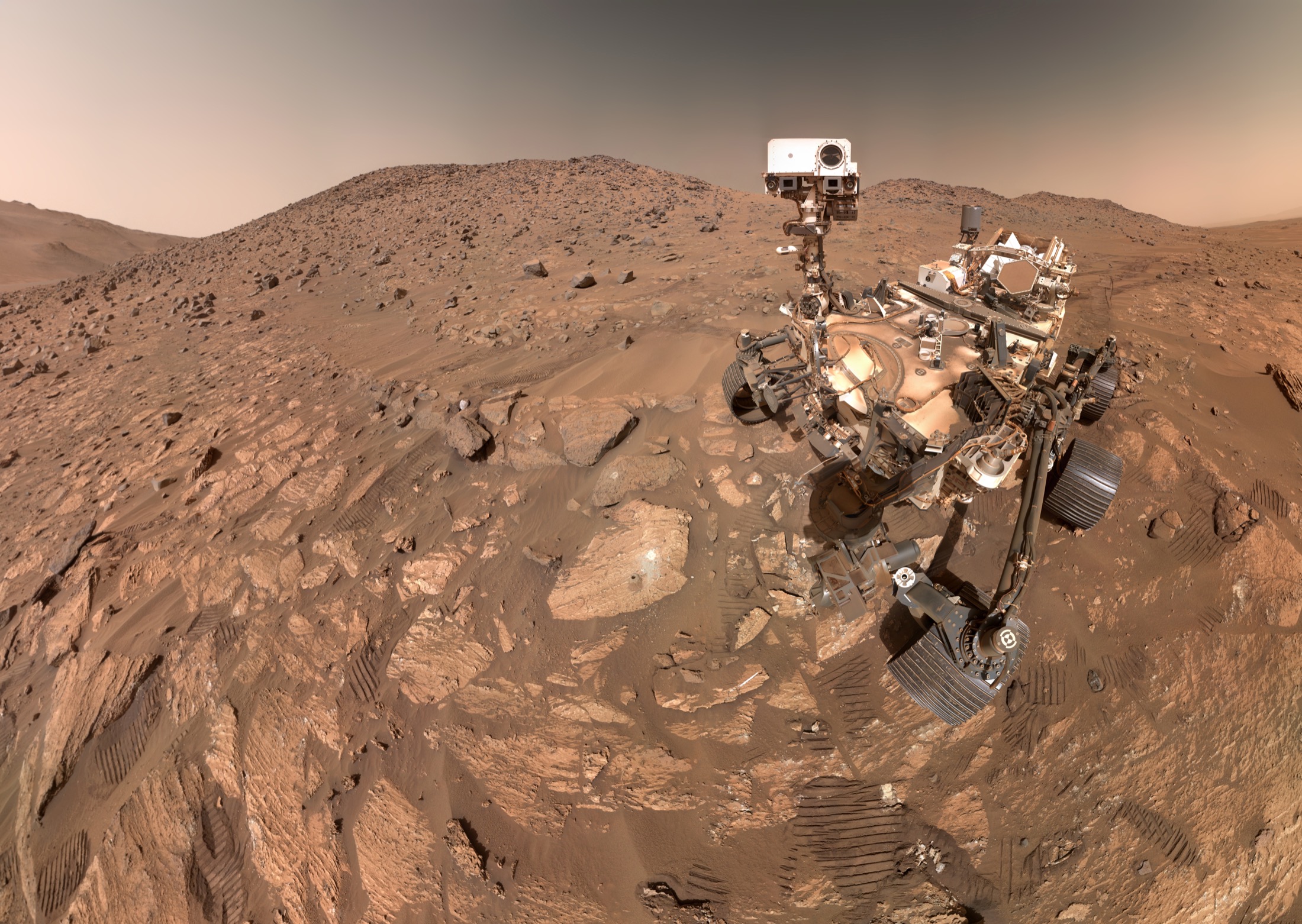
The rock got a name long before it will get an answer.
Perseverance found it in Jezero Crater, an ancient river delta where water once flowed into a lake basin. NASA calls the rock Cheyava Falls. The sealed sample taken from it is labeled Sapphire Canyon. In 2025, after a full year of analysis, NASA announced that the sample contained what it called a "potential biosignature."
Every word in that phrase matters. "Potential" because the signal is ambiguous. "Biosignature" because the chemical and textural clues are precisely the kind that, on Earth, sometimes point to microbial life. The announcement wasn't a discovery. It was an invitation to look harder.
That is the state of the Mars life search in mid-2026: richer in data than ever, further from a simple yes or no.
Why Cheyava Falls matters
Perseverance investigated the rock in July 2024 in a formation called Bright Angel, along Neretva Vallis. What made mission scientists stop and cache a sample were the so-called "leopard spots" — pale patches ringed with dark material, embedded in reddish rock. Instruments detected organic carbon, sulfur, phosphorus, and iron minerals arranged in reaction fronts that suggest low-temperature chemical activity in an ancient water-soaked environment.
On Earth, structures like this can form when microbes interact with minerals. But they can also form without any biology at all. Volcanic fluids, groundwater shifts, and mineral reactions can all leave similar fingerprints. Perseverance's PIXL instrument confirmed the presence of vivianite and greigite around the spots, minerals that tell a story of chemical change — but not necessarily a biological one.
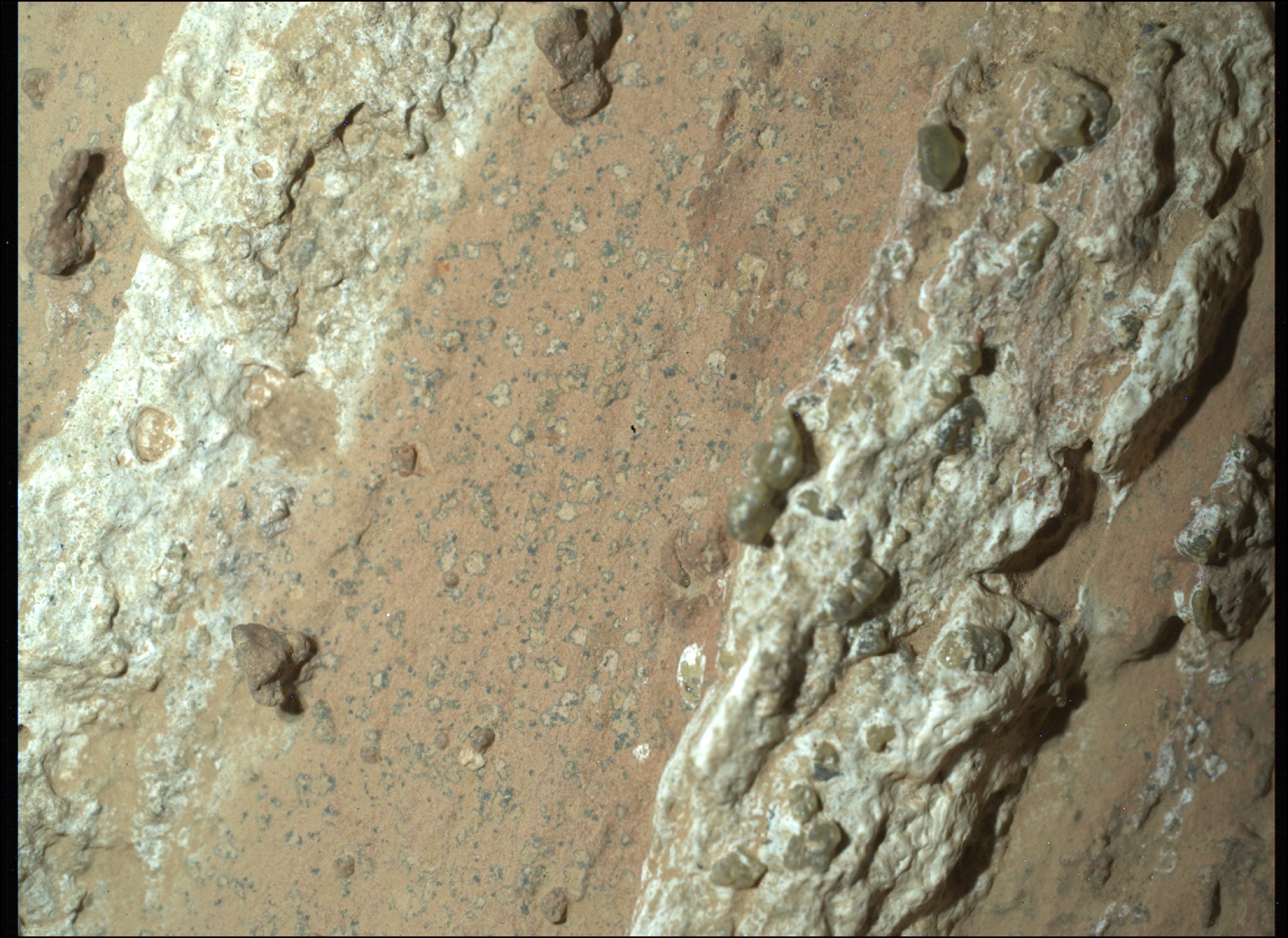
That is why Sapphire Canyon is a target, not a conclusion. Perseverance can drill, map, scan, and seal. It cannot run the full suite of tests — isotopic analysis, high-resolution microscopy, contamination studies — that an Earth laboratory can. The sample's real value lies in what happens after it comes home.
The problem is that nobody yet knows when that will be.
Curiosity adds the chemistry
While Perseverance drills for rocks that might tell a life story, Curiosity has been quietly building a different kind of case for Mars.
In April 2026, JPL reported that Curiosity's Mary Anning 3 sample — drilled from clay-rich rock on Mount Sharp in 2020 — contained the most diverse set of organic molecules ever detected on the Martian surface. The tally: 21 carbon-bearing compounds. Seven of them had never been seen on Mars before.
The new finds include a nitrogen heterocycle, a ring-shaped molecule that is structurally related to the building blocks of RNA and DNA, and benzothiophene, a carbon-sulfur compound also known from meteorites. NASA was clear: this is not evidence of biology. Scientists cannot tell whether the molecules were produced by living processes or by geological ones.
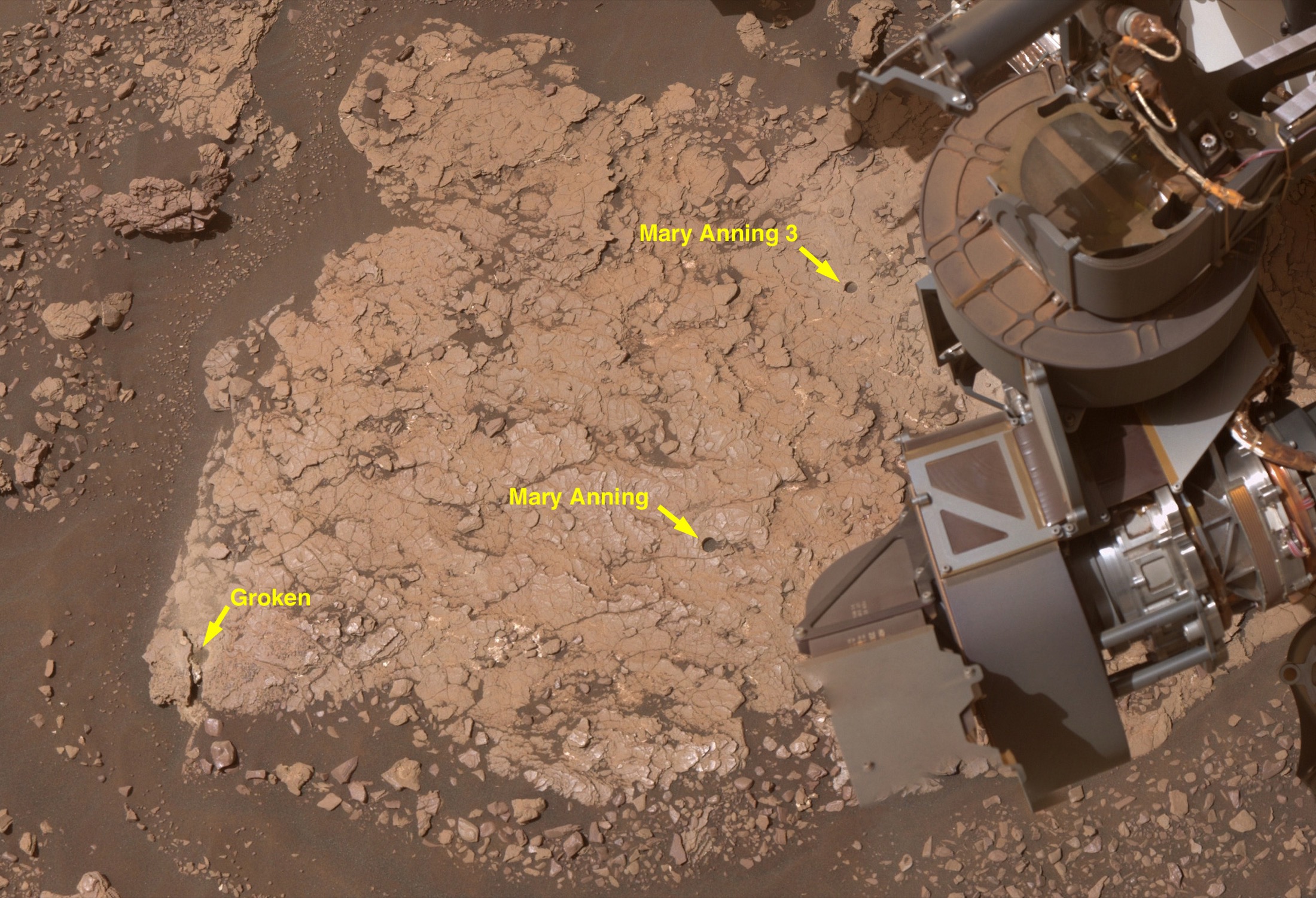
What matters is that they survived at all. Mars is cold, dry, oxidizing, and bombarded by radiation. Organic molecules near the surface should break down quickly, but clay-rich rocks like the Mary Anning formation act as a protective shield. Because clay minerals have a high surface area, they can trap organic compounds between their microscopic layers, sheltering them from the harsh environment. Curiosity keeps proving that these compounds can survive, meaning future missions can realistically search for preserved chemical traces — not necessarily living cells, but molecular fossils that held on for billions of years.
The false-positive planet
A paper published in Nature Communications in May 2026 put the challenge into a useful phrase: an "organics-forward approach." The authors argued that searching for life on Mars now means studying both sides of the signal at once — the possible biological remnants and the non-biological background that produces similar patterns.
This is the uncomfortable core of modern biosignature science. Organic molecules are not rare. Meteorites deliver them. Comets deliver them. Titan makes complex atmospheric chemistry without needing a single organism. Laboratory experiments can push molecules toward life-like complexity without crossing the threshold into life.
So the question is no longer "did we find organics?" Curiosity has made that question too small. The real question is whether a specific combination — of molecules, minerals, textures, isotopes, and geological context — makes a non-biological explanation less plausible than a biological one. That is a more demanding standard. It's also the only one that will hold up.
The sample-return vacuum
Mars is now the place where astrobiology's ambition and its funding reality collide most visibly.
Perseverance has cached samples. One of them is publicly described as the mission's strongest candidate for ancient microbial processes. Curiosity has expanded the catalog of organic chemistry. The next step is not a sharper adjective or a better press release. It's getting those samples into laboratories.
That step, for now, is stalled. In early 2026, Congress defunded the original NASA Mars Sample Return architecture. Some technology work continues under a smaller Future Missions budget line, and commercial alternatives are being studied. But as of today, the cached samples have no funded U.S. flight program to retrieve them.
China's Tianwen-3 mission is moving forward on a different timeline, targeting a late-2020s launch and sample return by 2031. The science question hasn't changed. It's just waiting, sealed in titanium tubes on a cold desert floor.
The wider search
Mars has the names and the rocks, which is why it dominates the headlines. But the search for life beyond Earth is moving on other fronts too.
At Enceladus, scientists re-examined Cassini data from a 2009 plume flyby and reported finding previously undetected organic compounds in ice grains ejected from the moon's subsurface ocean. The material comes from below the ice, shot into space, and sampled by a passing spacecraft. It's not life. It's access — a cleaner path to an ocean environment than anything Mars offers.
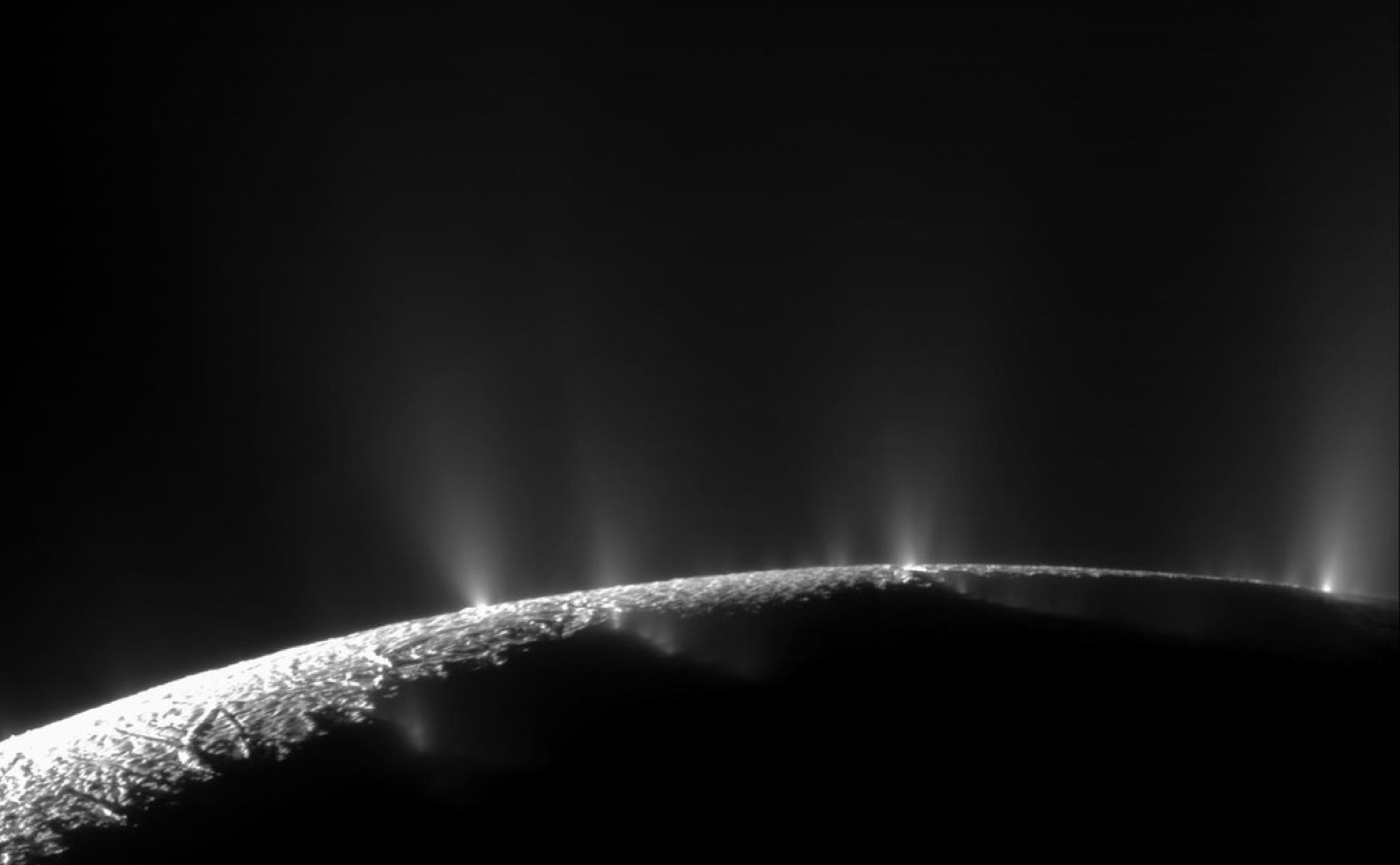
Europa Clipper is now en route to do something similar at Jupiter. Its instruments won't look directly for life. They will study whether Europa has the right conditions: ocean chemistry, ice-shell behavior, and material exchange between the surface and the water below.
Titan will get its turn later. NASA's Dragonfly rotorcraft, now in integration and testing, is being built to fly through a thick atmosphere over dunes of organic sand, near methane rivers and lakes. It's a chemistry mission for a world that looks like prebiotic Earth frozen in time.
And then there is K2-18b, an exoplanet 124 light-years away. In 2025, JWST data hinted at dimethyl sulfide and dimethyl disulfide in its atmosphere — molecules that, on Earth, are overwhelmingly tied to marine microbes. The headlines came fast. The follow-up literature came faster. Other groups reanalyzed the data and found the evidence insufficient, pointing to instrument noise, modeling assumptions, and alternative chemical pathways.
K2-18b is now a cautionary tale. Remote biosignatures are fragile things. A spectrum is not a sample tube. A potential gas feature has to survive instruments, atmospheric models, stellar contamination, cloud behavior, and independent verification. For Mars, the problem is whether a rock texture and its chemistry can be linked to ancient biology. For K2-18b, the problem is whether the molecule is even there. Same word. Much weaker chain.
What comes next
Astrobiology in 2026 is a field defined by a peculiar tension. The signals keep getting more interesting. The public language around them keeps heating up. But the actual scientific work is moving in the opposite direction — toward more caution, more cross-checks, more insistence on ruling out false positives before anyone uses the word "discovery."
Cheyava Falls is still a rock in Jezero Crater. Sapphire Canyon is still a sealed sample. The most accurate word on the label remains "potential."
The story is not that life has been found. It's that the search is getting harder to fool.
Related UAP Logbook notes
- Physics words keep slipping into UFO stories
- Donald Hoffman, UFOs, and the perception interface
- The CIA's UFO fringe file starts with psychoweapons panic
- The Navy UFO patents sit between physics language and public belief
Sources
- NASA/JPL: "NASA Says Mars Rover Discovered Potential Biosignature Last Year", Sept. 10, 2025.
- NASA/JPL: "NASA's Curiosity Finds Organic Molecules Never Seen Before on Mars", April 21, 2026.
- D. K. Buckner and A. Mojarro: "An organics-forward approach to searching for life on Mars", Nature Communications, May 11, 2026.
- NASA/JPL: "NASA Cassini Study Finds Organics 'Fresh' From Ocean of Enceladus", Nov. 18, 2025.
- NASA Europa Clipper: MASPEX instrument overview.
- NASA Europa Clipper: SUDA instrument overview.
- NASA Science: "NASA's Dragonfly Mission Begins Rotorcraft Integration, Testing Stage", March 10, 2026.
- Nikku Madhusudhan et al.: "New Constraints on DMS and DMDS in the Atmosphere of K2-18 b from JWST MIRI", arXiv:2504.12267.
- "Insufficient evidence for DMS and DMDS in the atmosphere of K2-18 b", arXiv:2505.13407.
- NASA Astrobiology: life-detection resources and standards of evidence.
- NASA/JPL image use policy.