Main Article / Jul 26, 2026
Ning Li: the anti-gravity physicist the internet says vanished
She was born in Shandong, graduated from Peking University, emigrated in 1983, and ended up running AC Gravity LLC on a $448,970 DoD contract. The 2008 rumor that sent her to China turned out to be wrong. The papers, the grant, the accident, her husband's death, and the son who finally told the story are all real. What is still missing is the classified work she was doing for almost twenty years.
The clip that built the legend runs about twenty seconds.
In July 2008, a physicist named Jack Sarfatti answered a question on camera. He had been asked about anti-gravity work in the United States. The answer landed, then took off on its own.
"One of the key scientists is a Chinese woman named Ning Li," Sarfatti said. "She has disappeared and gone back to China. She was working at NASA and the Redstone Arsenal but she has disappeared for several years now. The people at the Pentagon cannot reach her anymore."
The video cut to black.
By 2026, the clip had been folded into longer conspiracy edits, repackaged on YouTube, and quoted in forums as evidence that a missing American researcher had handed the keys to anti-gravity propulsion to the Chinese military. The version of the story that traveled was clean, dramatic, and almost entirely wrong.
What is true is stranger.
From Shandong to Huntsville
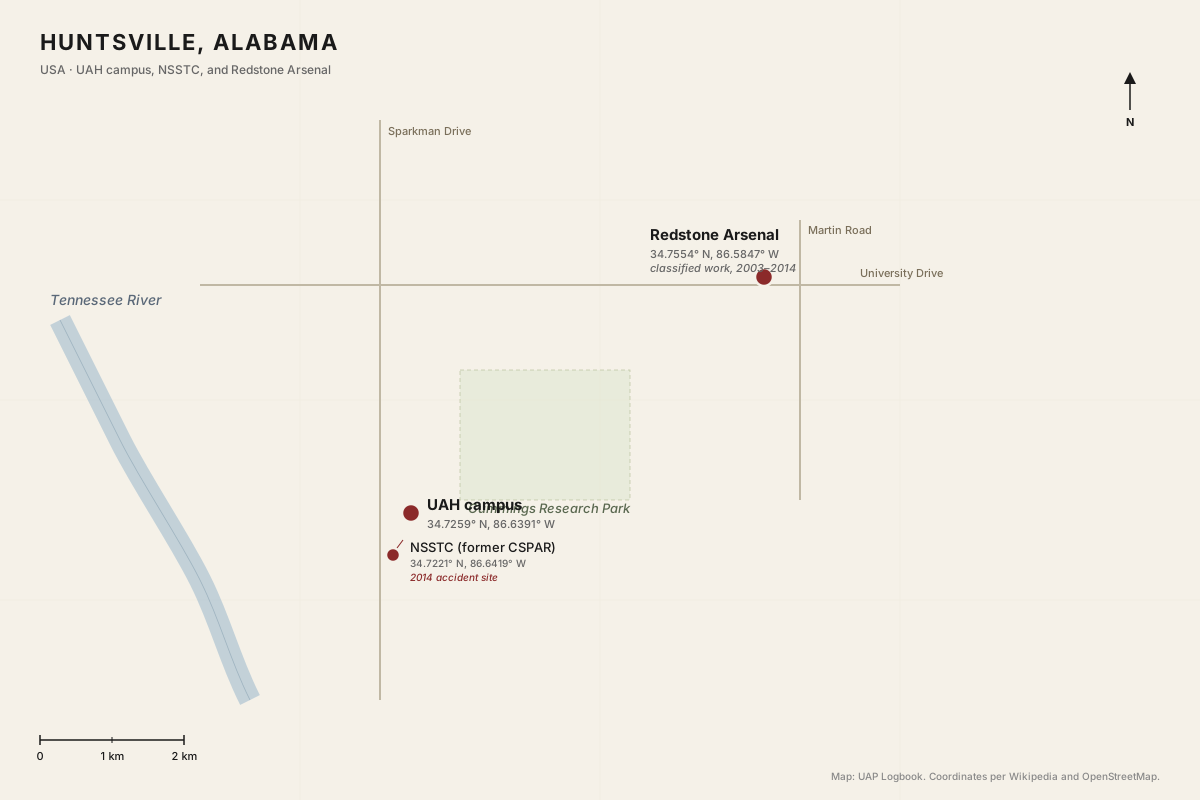
Ning Li was born on January 14, 1943, in Shandong province, China. She graduated from the physics department of Peking University and emigrated to the United States with her family in 1983.
She did not work on anti-gravity because of UFOs. She worked on it because of a series of papers she and Douglas G. Torr, a colleague at the University of Alabama in Huntsville, started publishing in 1991 from the Center for Space Plasma and Aeronomic Research.
The 1991 paper and what followed
The first paper appeared in Physical Review D. It argued that a small residual magnetic field inside a superconductor would, in the right regime, drag a small gravitomagnetic field along with it. A second paper followed in 1992 in Physical Review B. A third, more ambitious one, appeared in Foundations of Physics Letters in 1993.
The 1993 paper made the larger claim. If a large number of ions in a high-temperature superconducting disc could be aligned into a single quantum state, the coupled gravitoelectric and gravitomagnetic fields inside the material would become strong enough to produce a measurable, gravity-like force outside the disc. Press coverage at the time noted potential applications including facilitating payload launches, and the pair sought funding from NASA and the U.S. Army Aviation and Missile Command. A 2008 Defense Intelligence Agency assessment later described this body of work as a possible route to a "laboratory-detectable gravitomagnetic field."
A reviewer named Edward G. Harris at the University of Tennessee read the 1993 paper and concluded, in print, that Li and Torr had assumed values for internal fields that were unrealistic. By Harris's calculation, the predicted effects were too large by many orders of magnitude. The paper was not retracted. The disagreement was simply left standing.
In 1997, Li, Koczor and colleagues published a paper describing Eugene Podkletnov's reported weight changes of 0.05 to 2.1 percent for a test mass suspended above a rotating superconductor. Their own experiments with a non-rotating superconductor failed to reproduce the effect.
The work is real. The replication is not.
Academic friction at UAH
Li's work drew the involvement and funding of NASA's Marshall Space Flight Center in Huntsville. The arrangement did not last. According to the Huntsville Times, an "academic turf war" developed around Li and her colleagues at the university during this period. Li was reported to have become frustrated with the pace of research at NASA.
In 1999, Li left the University of Alabama in Huntsville and incorporated AC Gravity LLC to commercialize the superconductor-based anti-gravity work.
The Wired moment
In March 1998, Wired published Charles Platt's long feature "Breaking the Law of Gravity." The piece was framed around the Russian researcher Eugene Podkletnov, who had reported small weight changes above a rotating superconducting disc in Tampere in 1992. Platt spent most of the article on Podkletnov. He used Li and Torr as the U.S. theoretical counterpart, and the 1993 paper as evidence that the American side had a framework to take seriously.
Two years later, Popular Mechanics ran a second wave of coverage under the headline "Taming Gravity." By that point, Li had already left the University of Alabama in Huntsville, and the cable-news version of the story had taken root.
The grant, the company, the silence
In 2001, AC Gravity received a $448,970 contract from the U.S. Department of Defense. Public reporting on the contract gives a window, not a result. The grant period ended in 2002. No findings were published. AC Gravity's business registration was renewed in Alabama year after year. As of 2025, the LLC was still listed as extant, although nothing new had come out of it in public for more than two decades.
In 2003, Li presented "Measurability of AC Gravity Fields" (paper HFGW-03-106) at the MITRE Corporation's High Frequency Gravitational Wave conference, May 6–9, 2003, with co-author James C. Bradas. The reported affiliation of the co-author was Redstone Arsenal and the U.S. Army Aviation and Missile Command. Hal Puthoff, who attended the same conference, later described Li's 2003 paper as a "major presentation." No evidence exists that AC Gravity performed any other public-facing work after this.
After 2003, Li stopped publishing.
The 2008 rumor and what was actually wrong
Sarfatti's 2008 clip was reposted widely. It was 2008. China had just hosted the Beijing Olympics. Congressional concern about Chinese military modernization was high. A Chinese-American researcher working on anti-gravity for the U.S. Department of Defense was a perfect fit for a story about technology transfer in the wrong direction.
Almost none of the public version of the story was true.
In 2023, the Huntsville Business Journal published a long investigation by reporter Noah Logan, built around an interview with Li's son, George Guangyu Men. According to Men, Li never left Alabama and never defected. She continued anti-gravity research for the Department of Defense but stopped publishing or discussing her findings after attaining a top-secret security clearance. The "disappearance" had a specific shape: a classification, not a kidnapping.
Sarfatti's specific claim that she had been recruited by China also turned out to have a real, smaller version behind it. In 2008, Chinese government officials approached Li with an offer to return to China and continue her research there. She rejected the offer. Chinese authorities later refused to let her return to the country to attend her own mother's funeral.
Sarfatti was right that there was a Chinese connection. He was wrong about who had moved.
The accident, and a second death
In 2014, Li was struck by a vehicle while crossing the street on the University of Alabama in Huntsville campus, near the same research corridor where her public career had started. The impact left her with permanent brain damage and an early-onset Alzheimer's diagnosis.
What most versions of this story do not mention is what happened next. Li's husband witnessed the accident. He suffered a heart attack from the shock and died a year later, in 2015. Her son George Guangyu Men became her sole caretaker for the following six years while she lived with Alzheimer's. George has confirmed this timeline in interviews with the Huntsville Business Journal and with researcher Jim Landrith.
She died on July 27, 2021. Her age at death is given as 78 in the Wikipedia entry and 79 in the Huntsville Business Journal account — a small discrepancy across secondary sources that traces back to conflicting birth-year reporting. Her obituary, posted by Berryhill Funeral Home, called her "one of the world's leading scientists in super-conductivity anti-gravity" and noted that she had constructed the first 12-inch high-temperature superconducting disc in the late 1990s. The obituary does not describe a working anti-gravity device.
What is still missing
The 2023 reporting closed the most important part of the loop. The "disappearance" was a security classification story, not a kidnapping. The China story was a misunderstanding about who left whom. The 2014 accident was not a cover-up, even though it quietly produced a second death that almost no version of this story mentions.
Two things are still genuinely missing.
The first is the actual experimental record. Li's last published work is more than twenty years old. A 2016 attempt by Martin Tajmar to replicate the Podkletnov-style rotating-superconductor weight-change claim came back negative. No one has publicly claimed a working anti-gravity device built on Li and Torr's framework. Attempts to gain insight into her later work through Freedom of Information Act requests were reportedly denied. The classified work that Li was doing for the Defense Department between roughly 2003 and 2014 has never been described in any document an outsider can read. The grant money that went to AC Gravity did not produce a public result.
The second is a more interesting question. The Defense Intelligence Agency's 2008 assessment, "Role of Superconductors in Gravity Research," referenced Li and Torr's work as the most prominent theoretical program in the area. Salvatore Pais, the Navy aerospace engineer whose "Pais Effect" patents have their own afterlife, cited Li and Torr in a 2022 interview with Curt Jaimungal as part of the lineage his work sits inside. Eugene Podkletnov, whose 1992 result lit the whole field, is still alive and still publishing. The cluster of researchers is small, real, and connected by mail, citations, and federal grant paperwork.
The fact that none of them have produced a working gravity-manipulation device in public has not disproven the work. It also has not proven it.
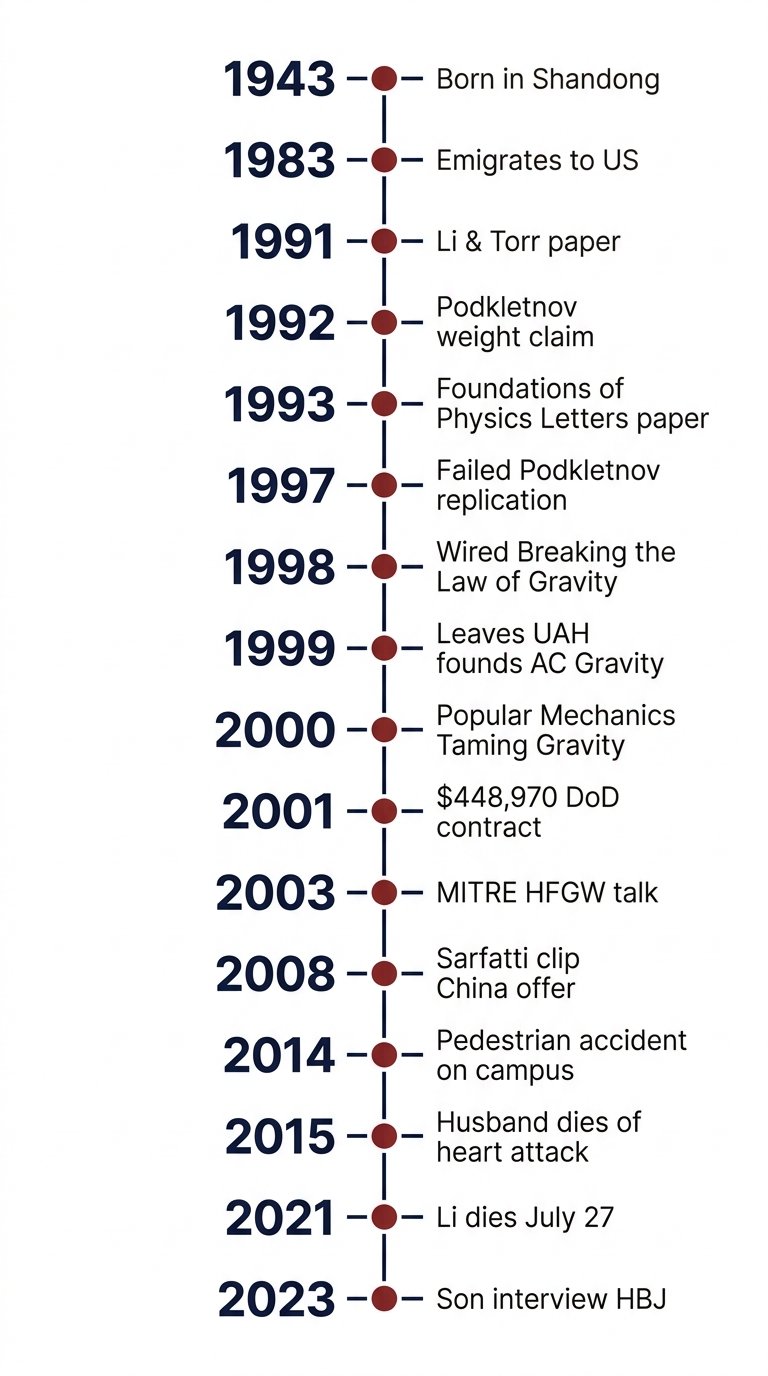
Case timeline
Sixteen dates that turn a series of physics papers into the case the public record could not let go of.
-
Born in Shandong, China
Ning Li is born on January 14, 1943 in Shandong province. She later graduates from the physics department of Peking University.
-
Emigrates to the United States
Li and her family leave China. She eventually settles in Huntsville, Alabama.
-
Li & Torr publish in Physical Review D
The first of three papers, theorizing that a small residual magnetic field inside a superconductor can drag a small gravitomagnetic field with it. Done at the Center for Space Plasma and Aeronomic Research at the University of Alabama in Huntsville.
-
Podkletnov reports weight changes in Tampere
Russian-born Eugene Podkletnov, then at Tampere University of Technology, observes small weight changes above a rotating superconducting disc. The result does not survive peer review, but travels further than any confirmed result in the field.
-
Foundations of Physics Letters paper
Li and Torr make the larger claim: a Bose–Einstein condensate of lattice ions could produce a measurable gravity-like force. The University of Tennessee physicist Edward G. Harris publishes a critique saying the predicted fields are unrealistic by many orders of magnitude. The disagreement is left standing.
-
Failed Podkletnov replication
Li, Koczor and colleagues try to reproduce the Podkletnov result. With a non-rotating superconductor, they see nothing. The paper is published; the result is not.
-
Wired publishes "Breaking the Law of Gravity"
Charles Platt's long feature frames Li and Torr as the U.S. theoretical counterpart to Podkletnov.
-
Academic friction at UAH; AC Gravity incorporated
The Huntsville Times reports an "academic turf war" around Li and her colleagues. She leaves UAH and incorporates AC Gravity LLC in Huntsville.
-
Popular Mechanics runs "Taming Gravity"
A second wave of cable-news-ready coverage.
-
$448,970 DoD contract to AC Gravity
Grant period ends in 2002. No public findings.
-
MITRE HFGW talk "Measurability of AC Gravity Fields"
Li presents paper HFGW-03-106 with co-author James C. Bradas, May 6–9, 2003. Hal Puthoff later described it as a "major presentation." Her last public appearance.
-
Sarfatti clip goes viral; China delegation visits
In July, Jack Sarfatti tells a camera that Li has "disappeared and gone back to China." The same year, Chinese government officials separately offer Li a return to China; she declines. Chinese authorities later refuse to let her into the country to attend her mother's funeral.
-
Pedestrian accident on the UAH campus
Li is struck by a vehicle near the same research corridor where her public career began. Permanent brain damage. Early-onset Alzheimer's. Her husband witnesses the accident.
-
Li's husband dies of a heart attack
A year after witnessing the accident. The story's second death, present in almost no public version of the case.
-
Li dies, July 27
Age 78 (Wikipedia) or 79 (Huntsville Business Journal) — discrepancy in secondary sources. Berryhill Funeral Home obituary calls her "one of the world's leading scientists in super-conductivity anti-gravity." Does not describe a working anti-gravity device.
-
Son interview with the Huntsville Business Journal
Reporter Noah Logan publishes a long investigation built around an interview with George Guangyu Men. According to Men, Li never left Alabama, never left the Department of Defense, and never defected. The "disappearance" was a security classification story.
Sources
- Ning Li, "Measurability of AC gravity fields," paper HFGW-03-106, Gravitational-Wave Conference, ed. P. Murad and R. Baker, The MITRE Corporation, McLean, Virginia, May 6–9, 2003.
- Ning Li and Douglas G. Torr, "Effects of a Gravitomagnetic Field on Pure Superconductors," Physical Review D 43, no. 2 (15 January 1991): 457–459.
- Ning Li and Douglas G. Torr, "Gravitational effects on the magnetic attenuation of superconductors," Physical Review B 46, no. 9 (1 September 1992): 5489–5495.
- Ning Li and Douglas G. Torr, "Gravitoelectric-Electric Coupling via Superconductivity," Foundations of Physics Letters 6, no. 4 (1993): 371–383.
- Edward G. Harris, "Comments on 'Gravitoelectric-Electric Coupling via Superconductivity' by Douglas G. Torr and Ning Li," Foundations of Physics Letters 12, no. 2 (1999).
- Ning Li entry, Wikipedia (Chinese-American physicist, 1943–2021). https://en.wikipedia.org/wiki/Ning_Li_(physicist)
- Charles Platt, "Breaking the Law of Gravity," Wired, 1 March 1998. https://www.wired.com/1998/03/antigravity/
- "Taming Gravity," Popular Mechanics, 2000.
- Defense Intelligence Agency, "Role of Superconductors in Gravity Research." https://www.dia.mil/FOIA/FOIA-Electronic-Reading-Room/FileId/170046/
- Noah Logan, "Uncovering the mystery of Huntsville's brilliant anti-gravity scientist," Huntsville Business Journal, 30 July 2023. https://huntsvillebusinessjournal.com/news/2023/07/30/solving-the-mystery-of-huntsvilles-brilliant-scientist-disappearing/
- Noah Logan, interview on "The Ning Li Disappearance," YouTube, 2023. https://www.youtube.com/watch?v=SUeQWs1vWDw
- Jim Landrith interview by Tim Ventura, "The Mysterious Demise Of Dr. Ning Li," YouTube. https://www.youtube.com/watch?v=CQJMBdT5WEk
- "Ning Li (physicist)" obituary, Berryhill Funeral Home, 2021.
- American Alchemy Magazine / Jesse Michels, "The Ning Li Cover-Up They Got Completely Wrong," Substack, 2025/2026. https://americanalchemymagazine.substack.com/p/the-ning-li-cover-up-they-got-completely
- Martin Tajmar, "Negative Result of a Rotating Superconductor Gravity Impulse Generator," 2016.
- Jack Sarfatti, "CASE A: DR. NING LI (Absorbed Into the Black World)," X / Twitter, 2025. https://x.com/JackSarfatti/status/2040686033499730203
- Hal Puthoff, public Q&A (referenced in the ufos-scientificresearch.blogspot.com archive of his comments on Ning Li and the 2003 MITRE conference).