Short Note / Jul 13, 2026
Phobos 2 and the Marina Popovich photo, 35 years on
On December 6, 1991, retired Soviet Air Force Colonel Marina Popovich stood at the Soviet Consulate in San Francisco and held up a photograph she said had been taken from the Soviet Phobos 2 spacecraft. The image, she said, showed a UFO near Phobos, the larger of Mars's two moons. Phobos 2 had lost contact with Earth on March 27, 1989, weeks before it was supposed to land. The photo Popovich showed was the last frame the probe transmitted. The image is now in the public NASA Planetary Data System archive, and the cleanest reading of it, in the MarsNews analysis, is that the "UFO" is an artifact of the Phobos 2 camera. The Popovich version, the "20-km cigar-shaped mother ship" version, and the Mars Observer loss have all been circulating in UFO press for more than three decades.
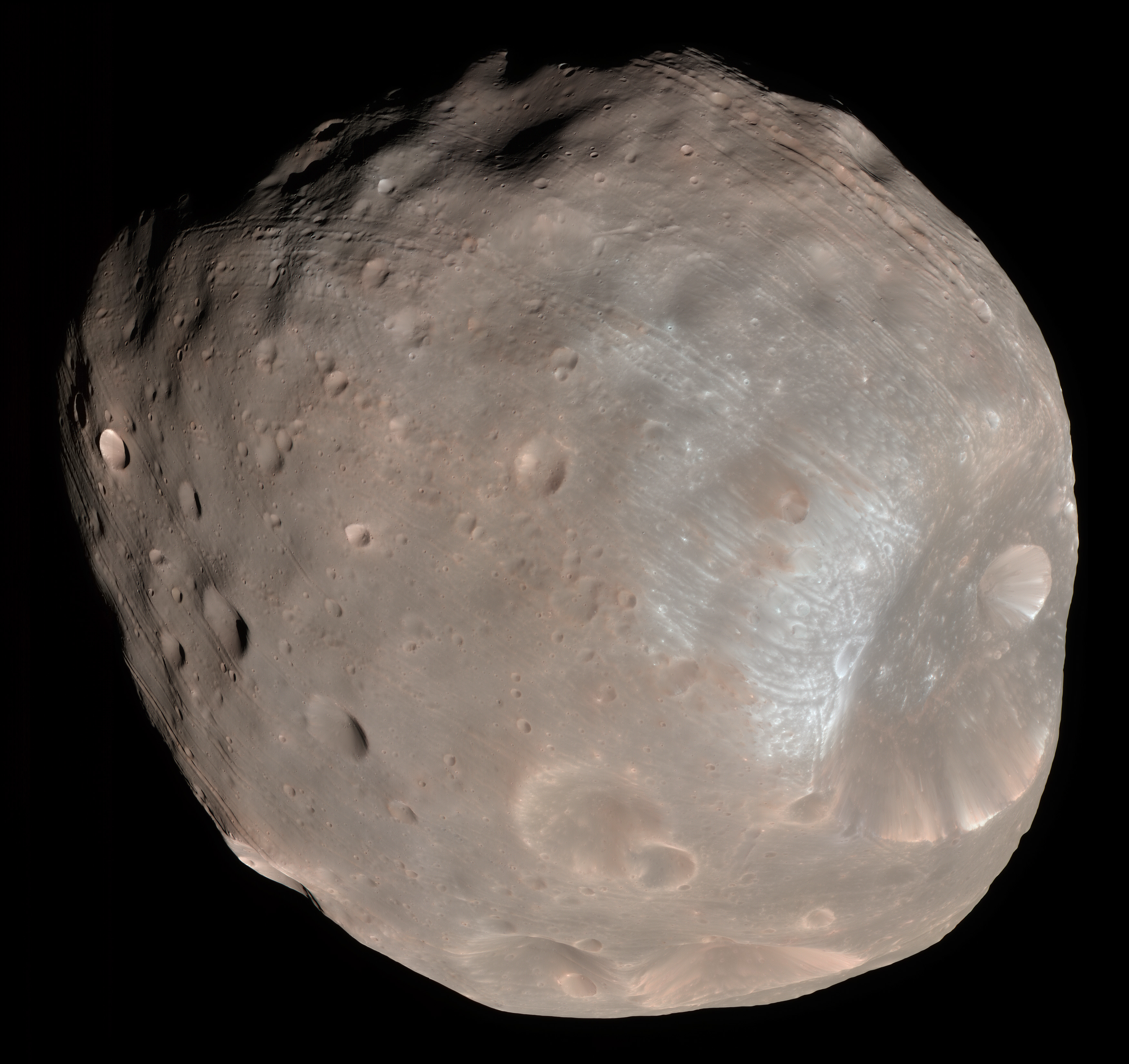
The newest UAP reference to a Soviet-era Mars photograph isn't new. The photo, the press conference, the person who showed it, and the date she showed it on are all part of the documented public record. What's worth tracing is how the story picked up its UFO framing in the first place — and what happened to the picture after 1991.
A two-stage story, not one
On March 27, 1989, Soviet mission control lost contact with Phobos 2 as the probe approached to within 50 meters of Mars's larger moon, ahead of a planned lander release. The first Soviet reports, via TASS around March 28, described a straightforward technical failure — a lost radio link, later attributed to an onboard computer malfunction that sent the spacecraft spinning out of its stable orientation. Only in follow-up reporting, carried by the Soviet program Vremya and picked up internationally by the Spanish agency EFE, did the story shift: officials were now said to describe an "unidentified object" — a thin ellipse roughly 20 kilometers long — captured by the probe's cameras in the seconds before contact was lost. Contemporary accounts placed that final image somewhere between March 25 and March 28, not cleanly on the March 27 failure date itself; the record on the exact date is not as tidy as later retellings suggest.
That two-step pattern — mundane failure first, anomaly claim second — is the actual origin of the "Phobos 2 was struck by something" story. It didn't start as a UFO account. It became one over the following days, before Marina Popovich ever held up a print in San Francisco.
What the photo shows
On December 6, 1991, retired Soviet Air Force colonel and test pilot Marina Popovich stood at the Soviet Consulate in San Francisco and held up an infrared image she said Phobos 2 had transmitted — the probe's last frame, in her account, before it lost contact with Earth. AP photographer George Nikitin recorded the moment. Two weeks earlier, on November 22, 1991, UFO researcher Don Ecker and author Keith Thompson had already discussed the image on Larry King Live, so the framing preceded the press conference itself.
The image has circulated since in two main versions. Ecker's account in UFO Magazine described a "top-secret infrared photograph" with an object roughly 25 kilometers long; other retellings, including Timothy Good's Alien Base, describe a 20-kilometer cylindrical shape. The strongest public analysis isn't from the UFO press: the independent site MarsNews located the original Phobos 2 image data in NASA's Planetary Data System archive and concluded the "object" is most likely a camera artifact — a product of how the imaging system rendered Phobos's long silhouette against the Martian surface, rather than a separate body. That doesn't resolve why the probe was actually lost; the documented, official explanation remains the computer fault, not the photograph.
Who was showing it, and why it carried weight
Marina Popovich had genuine credentials that made her testimony land differently than an ordinary claim: 90 flight records, a doctorate in flight technology, and a career the Los Angeles Times called "the Chuck Yeager of the Soviet Union" in a November 1991 profile. She'd also long been a public UFO advocate — her 1991 book UFO Glasnost claimed Soviet pilots had confirmed 3,000 sightings and that the KGB had recovered fragments from five separate crashed craft. At the same 1991 conference appearances, she also described Soviet scientists finding chemically altered blood at an alleged UFO landing site — a claim that rarely gets mentioned alongside the Phobos photo but comes from the same tour and the same advocacy pattern.
Popovich said Alexei Leonov, the first spacewalker and a senior Soviet space program figure, had given her the image and that she'd smuggled it out of the USSR; she also told Ecker the photos had been discussed at the 1989 Malta summit between Gorbachev and Bush. Neither claim has independent confirmation in the public record. Popovich died in 2017; her New York Times obituary noted the Phobos photograph as the most visible piece of her UFO advocacy, alongside her record-setting flying career.
Why the photo is back now
Ross Coulthart, on the July 8, 2026 episode of Reality Check, told viewers he plans to revisit the photo on an upcoming Mars-focused episode with the same on-air collaborator behind his lunar-anomalies series. That's a preview of a future segment, not a new finding — the photo, the mission loss, and the archive data have all been sitting in the public record since 1989 and 1991 respectively.
What changes nothing here is the object claim itself. What's actually new is the platform: a 35-year-old story, built on a genuine technical failure that only became a UFO account in its second wave of reporting, is about to get another television pass.
Sources
- Alamy / Associated Press: George Nikitin, "Retired Soviet Air Force Colonel Marina Popovich shows a photo of what she believes is a UFO near Phobos," December 6, 1991 — primary record of the press conference at the Soviet Consulate in San Francisco
- Los Angeles Times, Paul Dean: "Out of This World: UFOs: A former Soviet air force colonel preaches the gospel of extraterrestrial visitation," November 20, 1991 — Popovich's 1991 US tour, the "Chuck Yeager of the Soviet Union" framing, and her 1991 advocacy claims
- The New York Times, Marina Popovich obituary, December 15, 2017
- The Independent, Marina Popovich obituary, December 2017 — second obituary confirming the "3,000 sightings" claim and her 1990 San Francisco press conference
- Wikipedia: Phobos 2 — Launch, Mars orbital insertion, March 27, 1989 contact loss, 37 Phobos images, mission profile
- Wikipedia: Marina Popovich — Biography, UFO Glasnost (1991), five-crash-site claim, three-thousand-sighting claim, blood-sample claim
- Bibliotecapleyades.net: "Whither Phobos 2?" — independent confirmation of the Phobos 2 image in NASA's Planetary Data System archive, and the TASS-then-Vremya two-stage reporting sequence
- Howandwhys: "Mystery Of Phobos 2 UFO Photo" — Don Ecker account and Larry King Live timeline
- NewsNation Reality Check Q&A, July 8, 2026 (YouTube) — Coulthart's reference to Popovich and the Phobos 2 mission