Short Note / Jul 12, 2026
The Ubatuba UFO fragments arrived without a witness
A small package reached a Rio newspaper with a dramatic claim and three metal fragments. Decades of testing examined the metal; none repaired the missing chain of custody.
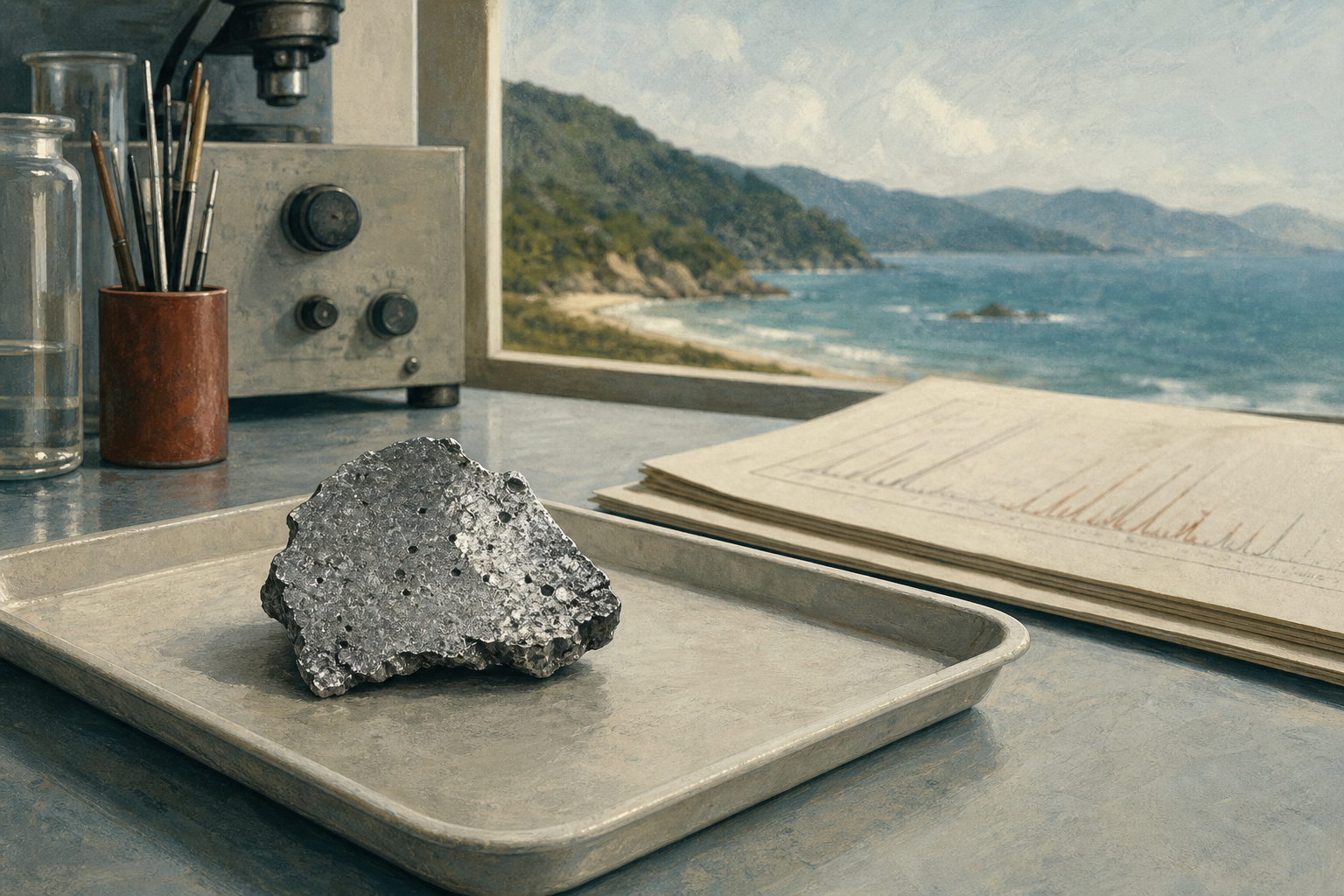
Three small, dull-grey pieces of metal reached the Rio de Janeiro newspaper O Globo in September 1957, tucked inside an unsigned letter. The anonymous writer claimed he had been fishing near Ubatuba, on Brazil's Atlantic coast, when a disc climbed sharply and broke apart in a shower of fiery fragments. The letter supplied a story. The metal supplied a puzzle. Neither supplied a named witness, a recoverable collection site, or a documented path from beach to laboratory.
A sample, not a recovery
Columnist Ibrahim Sued passed the fragments to Olavo Fontes, a Rio physician who served as the Brazilian representative of the Aerial Phenomena Research Organization. Fontes forwarded material to Brazil's Mineral Production Laboratory, where a 1957 spectrographic analysis—run first by Luisa Barbosa and then confirmed by a second analyst, Elson Teixeira—reported magnesium with no other metallic elements detected within the instrument's range.
That single finding became the engine of the case. “No trace elements detected” quietly became “no trace elements exist,” and then “purer than any terrestrial foundry could produce”—a much larger claim than the original spectrographic result supported. The original Sample No. 1 used in those Brazilian tests was consumed, so its exact result could never be independently re-run on the same material.
The surviving pieces then moved through decades of private research rather than a formal chain of custody. Later accounts trace pieces from Fontes to APRO, and eventually to physicist Peter Sturrock. That research trail is better documented than the alleged explosion. It is not a recovery record from the beach.
What later testing found
More sensitive instruments told a different chemical story. A 2022 paper by Robert Powell and colleagues, using a surviving fragment for isotope analysis, reported magnesium at roughly 99.88 percent purity with trace strontium, barium, zinc and copper—not the element-free picture suggested by the early test. An Oak Ridge examination in 1958 also detected trace elements in the material it tested.
That does not make the material ordinary in every respect. The 2022 authors describe the strontium pattern as unusual enough to warrant repeat testing. But their magnesium isotope results fell within known terrestrial limits; the trace-element isotope results were inconsistent between laboratories and therefore inconclusive.
The 2022 result sits inside a longer and messier testing history. Different labs examined different surviving fragments, with different trace compositions reported over time. The University of Colorado's Condon study reached a narrower conclusion in the late 1960s: the sample it examined was not purer than terrestrial magnesium available before 1957, and the material did not by itself establish an extraordinary vehicle in the atmosphere.
The missing part of the case
The Ubatuba fragments themselves are not in dispute. There was metal in an envelope, and it has been tested repeatedly across seven decades. What remains missing is everything that would turn a chemistry result into a flight history: an identified original witness, an independent account of the explosion, and any secure link tying the tested metal to a specific beach or event beyond the anonymous letter's word.
That gap is why Ubatuba still matters in the UAP materials debate. A laboratory can describe what a sample is made of with increasing precision. It cannot, after the fact, reconstruct where the sample came from. An unusual trace-element pattern is a reason to test again. It is not, on its own, a recovered aircraft.
Related UAP Logbook reporting
- Garry Nolan, UFO metals, and what Oak Ridge actually found
- Garry Nolan on CBS, isotope claims, and the evidence gap
- Elizondo, UFO files, and the 1940s non-human materials line
Sources
- A.P.R.O. Bulletin, March 1960: contemporary account of the Fontes investigation and the Brazilian laboratory reports.
- Powell, Swords, Rodeghier and Budinger, “Analysis of the 1957 Brazilian Ubatuba Fragment”, Journal of Scientific Exploration, 2022.
- Jerome Clark, “Ubatuba Residue”, historical case summary and source trail.
- University of Colorado UFO Project / Condon Report archive, including Roy Craig's discussion of the Ubatuba sample.