Short Note / Jul 13, 2026
The "longer Gimbal" story may be a FLIR/Tic Tac conflation
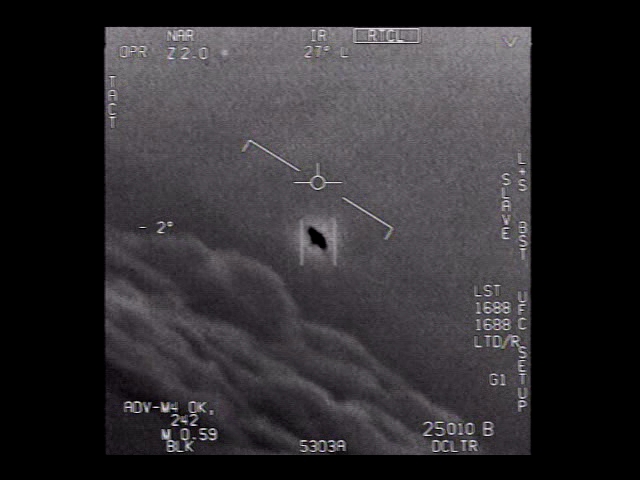
On the July 8, 2026 Reality Check Q&A, host Ross Coulthart laid out his working theory of a long-standing UAP story: the recurring claim that the publicly released "Gimbal" video is a shortened version of a longer, classified version of the same encounter is, he said, most likely a conflation with the FLIR footage of the 2004 Tic Tac incident involving the USS Princeton. The three witnesses who have gone on record with the "8 to 10 minute" version of the story are tied to the Princeton's classified consoles, not the Gimbal track. Coulthart is not certain. He is making the case that the evidence trail is cleaner for the longer Tic Tac/FLIR clip than it is for a longer Gimbal.
The most-quoted UAP claim about a "longer video" may not be about the video people usually say it is about.
On the July 8, 2026 episode of NewsNation's Reality Check, host Ross Coulthart took a viewer question from someone named Joe about the recurring claim that the publicly released "Gimbal" video is a shortened version of a longer, classified encounter. Coulthart's answer laid out a working theory that has circulated in UAP press for years, built on three named witnesses with a clear source trail — but pointed at the wrong video.
The theory, in Coulthart's framing, is that the "longer Gimbal" claim is most likely a conflation with longer FLIR footage from the 2004 USS Nimitz / USS Princeton Tic Tac encounter. The witnesses who have put their names to the "8 to 10 minute" claim, Coulthart said, are tied to the Princeton's classified consoles from that 2004 encounter — not to Gimbal at all. He was careful with the framing: "I think this is where the confusion occurred." The underlying argument is that the public evidence for a longer Tic Tac/FLIR clip is considerably stronger than any public evidence for a longer Gimbal clip.
Two different videos, two different years
The U.S. Navy's three well-known UAP videos — FLIR1 (the Nimitz "Tic Tac" clip), GIMBAL, and GOFAST — sit in different sensor tracks from different encounters. FLIR1 and GIMBAL were confirmed authentic by the Department of Defense in 2020; GOFAST followed in 2021.
FLIR1 comes from a Raytheon ATFLIR pod on an F/A-18F Super Hornet from Carrier Air Wing 11, flying off USS Nimitz on November 14, 2004. GIMBAL comes from a separate ATFLIR pod on a Super Hornet attached to the Theodore Roosevelt Carrier Strike Group, recorded off the Florida coast in January 2015 — sources differ on whether that was January 20 or January 21. (Some accounts attribute the GIMBAL aircraft to squadron VFA-11; that detail isn't independently confirmed in the sourcing available here and shouldn't be treated as settled.) The two clips are eleven years and one full carrier deployment apart, with different aircraft, different telemetry overlays, and no shared engagement. The "longer version" claim, in the public record, traces almost entirely to the 2004 track — not the 2015 one.
Three witnesses, one console, one year
Coulthart walked through the witnesses who've gone on record with the "8 to 10 minute" version of the story, and all three place themselves aboard the Princeton in 2004 — none in the 2015 Gimbal encounter.
Gary Voorhis, a former cryptologic technician on the Princeton, told Popular Mechanics he'd seen a video "roughly eight to 10 minutes long and a lot more clear" than what was later released, showing an object making "tight right angle turns" the pilot struggled to match. Jason Turner, a former petty officer on the same ship, said in the same reporting that "the video you see now, that's just a small snippet in the beginning of the whole video," and that he'd seen the longer version on a monitor in the ship's signal exploitation space while delivering supplies there. Ryan Weitz, a Seahawk power-plant specialist also aboard the Princeton, said the footage ran continuously on a screen in the Combat Information Center the entire time he was in the room — and was explicit, per Coulthart, that what he saw was the Tic Tac, not Gimbal.
Three witnesses, three separate accounts, one ship, one year. None of them puts a longer video anywhere near the 2015 encounter that produced Gimbal.
The skeptic, and the story that started it
David Fravor, the former VFA-41 commanding officer who piloted the aircraft that acquired the Tic Tac on ATFLIR in 2004, has publicly questioned the "longer version" claims — for both the FLIR/Tic Tac and Gimbal tracks. That skepticism doesn't settle anything either way; Fravor can be doubtful and the three witnesses can still be describing something real, since he wasn't present for their side of the encounter.
Coulthart traced the conflation itself back to the original Popular Mechanics reporting that first surfaced the longer-version claim, which he described as "a bit vague at the time" — blurring the FLIR/Tic Tac track and the Gimbal track into what UAP press has since treated as a single, undifferentiated "there's a longer video somewhere" story.
It's also worth noting that the Gimbal footage itself has a competing mundane explanation in circulation: some analysts have argued the apparent rotation is consistent with an ATFLIR pod's autotracking behavior locking onto a distant aircraft or even a bird, rather than an object genuinely spinning in place. That reading doesn't touch the "longer video" question directly, but it's a reminder that Gimbal already has an open debate about what it shows — on top of, not instead of, the separate question of whether a longer clip exists.
What's still missing
The public record has the released videos, three consistent witness statements about a longer FLIR/Tic Tac capture, and Fravor's skepticism about whether that longer version exists. What it doesn't have: a second witness from either encounter corroborating an extended clip with a date and console location; a document or signal-exploitation log recording an 8-to-10-minute Tic Tac capture aboard the Princeton in 2004; or any on-the-record Defense Department statement addressing the longer-version claim for either track.
Coulthart's theory, stated plainly, is that UAP press has been telling one "longer video" story that's actually two — and that the witness trail belongs entirely to 2004, not 2015. If that holds, the Gimbal "longer version" claim isn't debunked. It's just never had witnesses of its own.
Sources
- NewsNation Reality Check Q&A, July 8, 2026 (YouTube) — Coulthart's full conflation argument, named witnesses, and direct quotes
- Popular Mechanics, "The Navy Has Officially Released the UFO Videos" — original "8 to 10 minutes" claim and Voorhis, Turner, Weitz summaries
- Vice, "The Navy Has Secret Classified Video of an Infamous UFO Incident" — Pentagon confirmation of source-video length and Navy FOIA response
- Naval Technology: history of the Tic Tac, Nimitz, and Princeton engagements
- Wikipedia: USS Princeton (CG-59) — Ticonderoga-class cruiser, home to the 2004 Nimitz Strike Group
- Wikipedia: Advanced Aerospace Threat Identification Program (AATIP) — Program history, scope, and the post-resignation publicity cycle