News / Jul 15, 2026
The Phobos monolith and the PRIME mission proposal
A 90-meter boulder on Mars's moon Phobos has been called a monolith, a triangular sentinel, and a target for a robotic lander. Here is the actual record behind the claims.
In 2009, Apollo 11 astronaut Buzz Aldrin sat on a C-SPAN panel and suggested that humanity's next destination should be a small, potato-shaped moon of Mars.
"We should go boldly where man has not gone before," Aldrin said. "Fly by the comets, visit asteroids, visit the moon of Mars. There's a monolith there. A very unusual structure on this little potato-shaped object... When people find out about that, they're going to say, 'Who put that there? Who put that there?'"
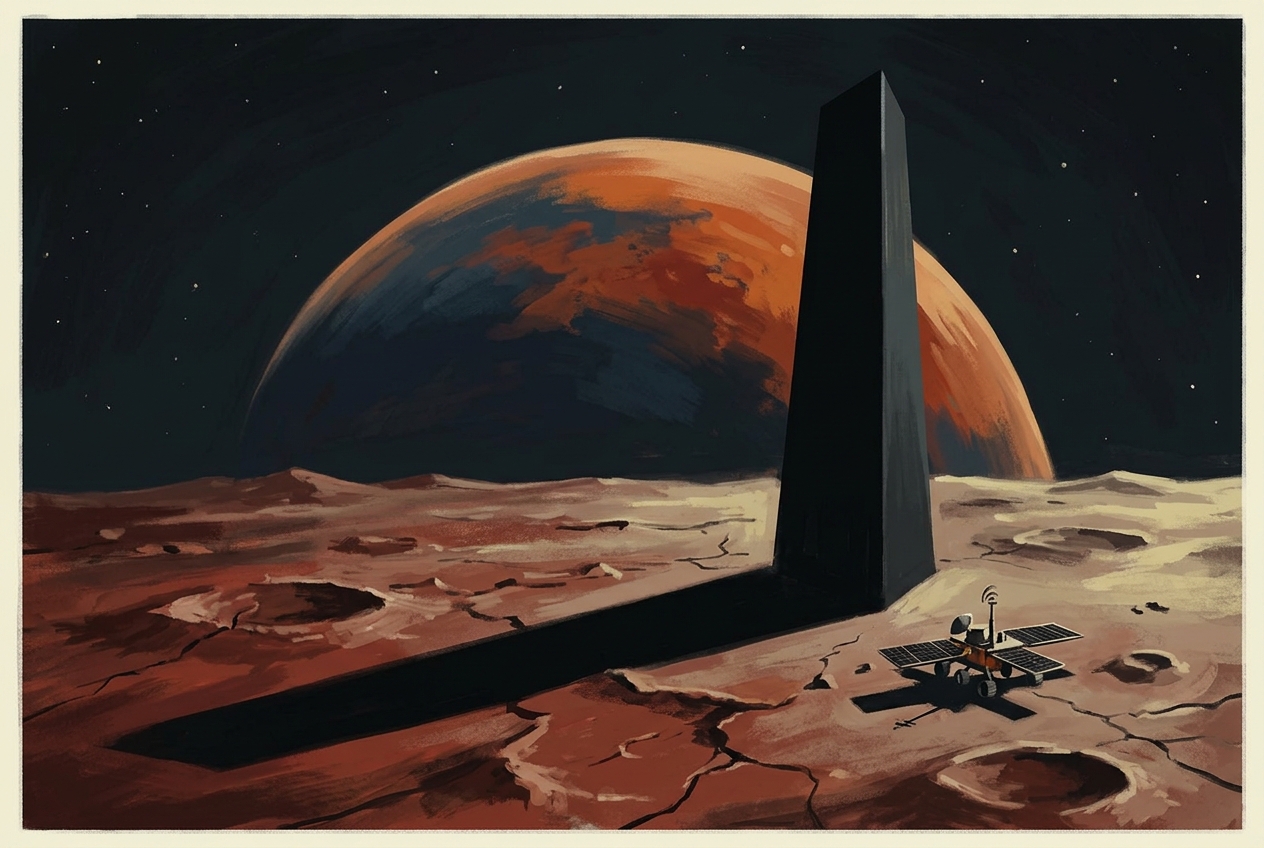
The line stuck. Within days it was circulating alongside stills from 2001: A Space Odyssey, and Aldrin's monolith became shorthand for a certain kind of space mystery — famous witness, strange object, no visit yet. What gets lost in that shorthand is that the object itself has a paper trail: orbital photographs from the 1990s, a shadow-based 3D reconstruction, and a real mission proposal that named the boulder as a landing target.
What is the Phobos monolith?
NASA's Mars Global Surveyor photographed the object in 1998 using its Mars Orbiter Camera. It appears in two catalogued images, SP2-52603 and SP2-55103, sitting near Stickney crater — the largest impact scar on Phobos. An independent researcher named Efrain Palermo spotted it first while going through the probe's imagery; Lan Fleming, an imaging subcontractor at NASA's Johnson Space Center, later confirmed the feature.
Planetary scientists call it a "discrete positive relief feature," which is a careful way of saying: a large boulder, standing where you wouldn't expect one. Shadow measurements put it at roughly 85 meters across and about 90 meters tall, close to the length of a football field. It reflects far more light than the dark, weathered regolith around it, which is why it shows up as a bright shape against Phobos's surface in every image where it appears.
The PRIME mission proposal
In early 2007, the Canadian Space Agency backed a mission concept study led by Robert Richards of Optech Inc., along with Pascal Lee of the Mars Institute and Alan Hildebrand of the University of Calgary. Their proposal, called PRIME — Phobos Reconnaissance and International Mars Exploration — described a fixed lander that would first survey candidate landing sites from a pseudo-orbit around Phobos, then use a short-range lidar system called CAMELOT-2 to bring itself down slowly and precisely.
The monolith was their first choice. The proposal describes it directly as a "90 m wide boulder" and calls for the lander to settle within arm's reach of it — under half a meter.
Nobody on the team was chasing alien technology. They wanted the boulder because it was likely a chunk of Phobos's interior, blasted to the surface when the Stickney impact happened. A lander with a gamma-ray spectrometer and an X-ray spectrometer could read that material directly, without drilling. NASA had a second interest too: landing gently and precisely on a low-gravity body is exactly the kind of skill a future Mars sample-return mission would need to practice first.
A second monolith — but not on Phobos
People sometimes bring up a second monolith in the same breath as this one. It's a different object, on a different world. Around 2008, the Mars Reconnaissance Orbiter's HiRISE camera photographed a rectangular boulder on the Martian surface itself — not on Phobos. A HiRISE team member at the University of Arizona described it at the time as a small block, likely broken off from nearby bedrock, and pushed back on calling it a "structure" at all, since that word implies something built.
The confusion is understandable. Both objects got called "monolith" by the same wave of online coverage, often in the same articles, sometimes in the same sentence. NASA's own documentation keeps them separate: one is a boulder on Mars's moon that scientists once wanted to land next to; the other is a boulder on Mars, useful mainly as an example of how surface rock breaks apart over time.
The geological consensus
Most planetary scientists explain the Phobos monolith through impact ejecta. Stickney crater formed when something large struck Phobos and threw enormous amounts of bedrock outward. Phobos's gravity is weak enough that much of that debris escaped into space permanently — but some blocks fell back and settled on the surface at low speed.
That low-speed landing would explain why there's no fresh crater around the monolith itself: it didn't slam in, it drifted down. The brightness comes from the rock's age relative to its surroundings — freshly exposed, crystalline material hasn't yet been dulled by billions of years of radiation and micrometeorite weathering the way the surrounding dust has.
Where the record stands
PRIME never made it past its concept study. No agency funded a follow-up, and no other mission has proposed landing at the site since. Russia's Phobos-Grunt probe, aimed at sample return from the moon more broadly, failed shortly after launch in 2011 and never reached Phobos at all.
The boulder is still sitting there, unvisited, exactly as it was when Palermo first noticed it in a Mars Global Surveyor image decades ago.
Related notes
Sources
- C-SPAN: Buzz Aldrin Reveals Existence of Monolith on Mars Moon, July 2009
- Richards, Lee, Hildebrand et al.: "PRIME Lander: A Canadian-Led International Mission to Determine the Origin of Mars's Inner Moon," Workshop on the Exploration of Phobos and Deimos, 2007
- Phobos monolith overview
- Mars monolith (separate object, HiRISE)