Short Note / Jun 10, 2026
The 415th Night Fighter Squadron called them Foo Fighters
Before flying saucers became the American word, night crews over Europe were reporting lights that followed aircraft, changed color, and disappeared when challenged. A 1945 SHAEF file shows World War II Foo Fighters moving from sortie reports into Allied command channels.
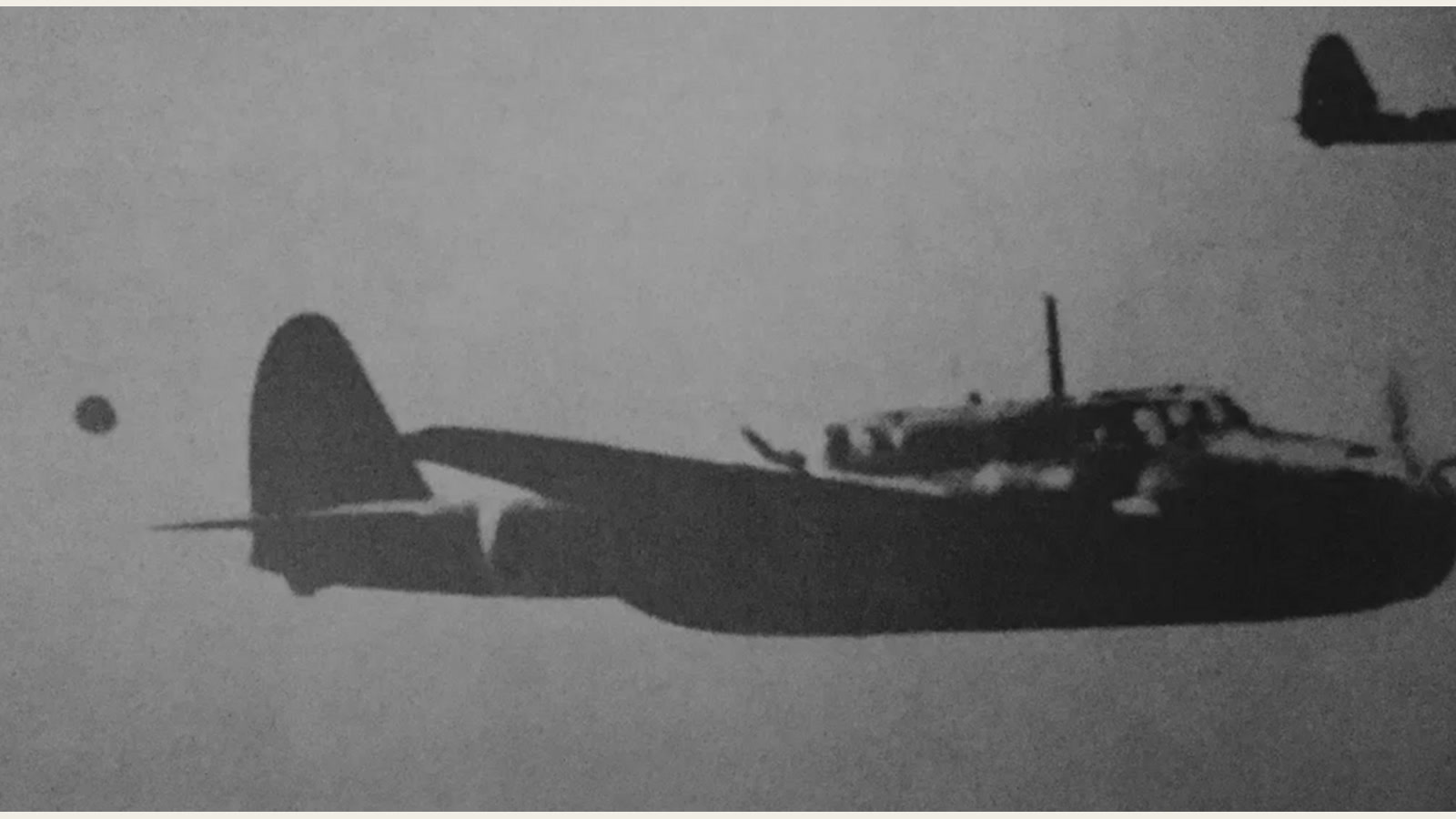
Before the word UFO entered the public vocabulary, a World War II night fighter squadron had a simpler name for what its crews were seeing: Foo Fighters.
The phrase surfaced again this week when Fox News pulled an old wartime file into the current whistleblower and immunity cycle. The source is a 1945 SHAEF document on the 415th Night Fighter Squadron. Its story is stranger, tighter, and more limited than a television segment can carry in a few minutes.
What the file preserves is a chain of wartime correspondence: night crews over Europe, unexplained lights, practical questions from headquarters, and no clean answer.
The World War II Foo Fighter reports
On January 16, 1945, XII Tactical Air Command forwarded a problem from the 415th Night Fighter Squadron's December reports. Crews had been trailed by lights that blinked, changed colors, and flew close enough to hold formation with their aircraft. The squadron wanted to know if other night units were seeing the same thing.
Headquarters responded practically, not dramatically. It asked for colors, intensity, size, duration, altitude, direction of travel, and proximity to the aircraft.
The squadron answered with sortie reports.
On the night of December 16-17, 1944, one crew spotted five or six flashing red and green lights arranged in a T shape north of Breisach. They first assumed flak. Then the same lights reappeared closer, behind them. When the aircraft turned, the lights followed.
On December 22-23, two lights rose from the ground near Hagenau, climbed to the aircraft's altitude, and held position on its tail for about two minutes. The report describes a large orange glow and says the lights appeared to be under perfect control.
On December 26-27, a crew reported red balls of fire and yellow streaks, radioed GCI Blunder to ask if enemy aircraft were nearby, and was told no. A separate report from the same night described a light closing to within 100 feet, following for five minutes, then pulling up sharply and disappearing.
By January 29-30, the crews were using the name openly. A pilot flying between Weissembourg and Landau logged a Foofighter off the starboard rear, roughly 1,000 feet back and matching his course.
What SHAEF did with it
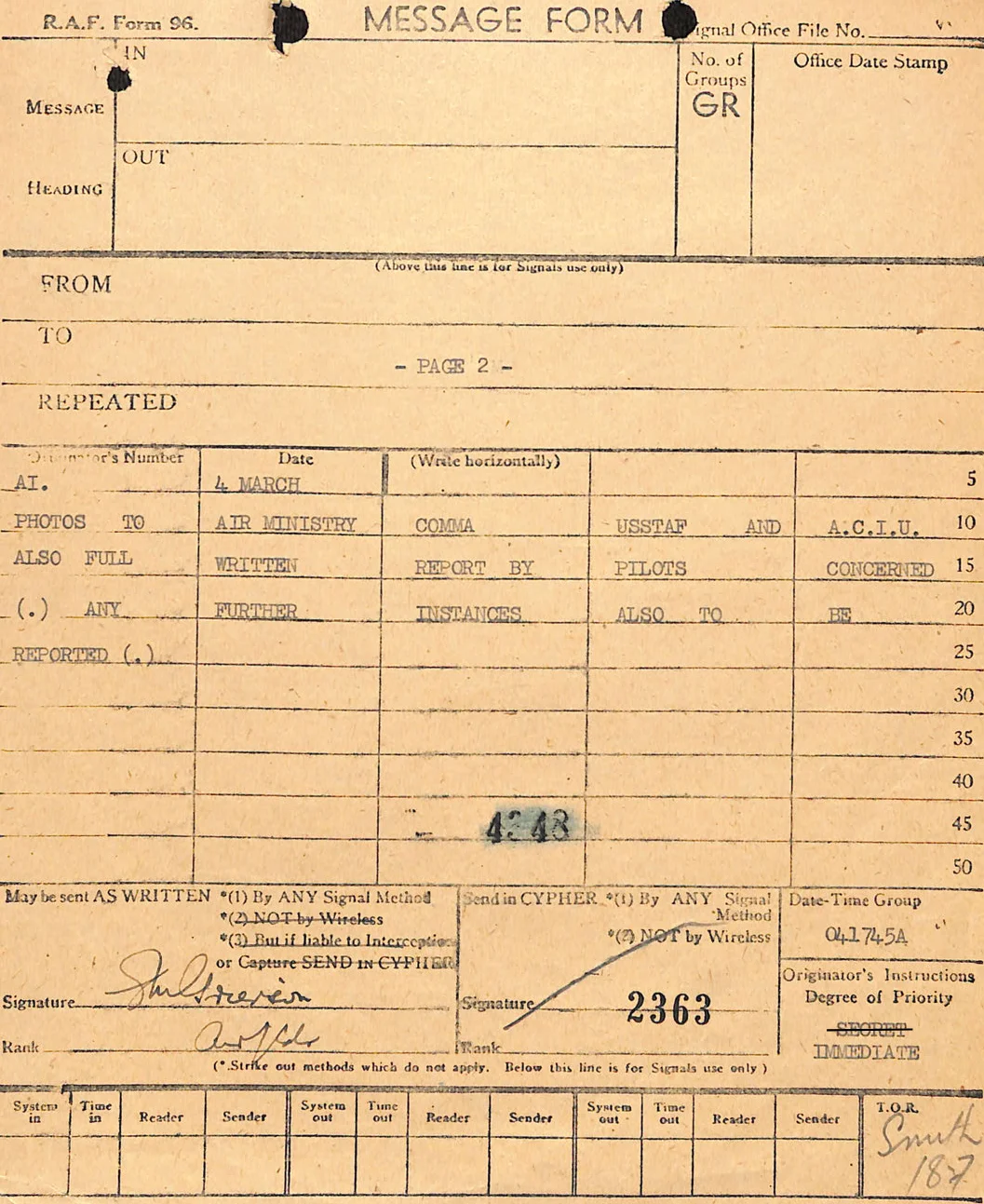
The reports moved upward through channels rather than disappearing into a squadron rumor file. On February 11, SHAEF noted that the volume of reports alone suggested something beyond imagination. Pilots and crews were growing uneasy. The file went to the Air Ministry. SHAEF's Scientific Investigation Division was asked to look into it.
No clean answer came back.
The Air Ministry confirmed that Bomber Command crews had reported similar phenomena. Some sightings might have been Me 262 jets. Flak rockets were suggested for others. A March 13 memo still called the matter a mystery, with the evidence too inconsistent and scattered for any satisfying conclusion.
Elsewhere in the file, a different object appears: an aluminum-colored cylinder, roughly 12 feet long and one foot wide, hanging vertically at 9,000 feet. Pilots attacked it. It partly deflated and produced a red flame without smoke. Photography was attempted, but the file notes the pictures were unsuccessful.
Before Blue Book
The file sits before the familiar public sequence: before the 1947 flying-saucer wave, before Project Sign, before Project Grudge, before Blue Book.
It does not identify a source for the lights. It leaves Me 262 jets and flak rockets in the file as possible explanations, alongside the crews' own reports of lights that followed, climbed, held position, and disappeared.
The objects remain where the crews left them: lights in the night sky, close enough to unsettle trained airmen, significant enough to travel through Allied command channels, and unresolved enough to be back on television eighty years later.
Related UAP Logbook notes
- war.gov UFO files: PURSUE portal, UAP videos, and old cases
- What is PURSUE? The UAP records release program explained
- Air Materiel Command, December 1947: "Flying discs still a matter of concern"
- The green-blue light over Kodiak Naval Air Station
Sources
- PURSUE Release 01: 331_120752_Numeric_Files_1944-1945_37153_German_Armament_Equipment_Documents, Department of War / SHAEF file on night phenomena, flak rockets, cylindrical objects, and 415th Night Fighter Squadron Foo Fighter reports.
- Local extracted file text:
content/research/war-gov-ufo-release-001/txt/331-120752-numeric-files-1944-1945-37153-german-armament-equipment-documents.txt. - Fox News / Special Report: "UFO FILES: Search for answers returns to earliest UAP sightings", uploaded June 10, 2026. Used as the current media hook, not as the primary source.