Main Article / Jul 11, 2026
PURSUE Release 04 split into a record drop, a TV segment, and a viral clip
The fourth PURSUE release reached X and YouTube within hours. The early reaction shows how a 40-record UFO archive becomes separate stories: a single clip on social media, a 19-video package on television, and a small set of expert interviews.
Within hours of the Department of War posting PURSUE Release 04, the 40-record batch had already become several different stories.
On X, a short clip was framed as the return of a “Starfish UFO.” On YouTube, CBS News and other outlets assembled all 19 newly released videos into long packages. CBS also put two different guests in front of the release: Harvard astrophysicist Avi Loeb and Disclosure Foundation executive director Jordan Flowers. The official archive, meanwhile, contains much more than clips: 1949 Los Alamos material, Project Sign records, NASA audio and images, and recent sensor files.
By the next morning, one batch had become a single ambiguous image on X, television playlists, disclosure interviews, and a set of documents that still required reading.
PR104 gets a nickname
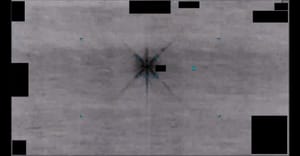
One of the fastest-moving posts came from Skywatch Signal on X. Posted on July 10, it called a release clip “The Starfish UFO” and asked whether the video looked like other images. When viewed by UAP Logbook on July 11, the post displayed about 99,600 views, 1,490 likes and 167 reposts.
The post is a useful example of the way a release record acquires a public name before its file details travel with it. The Department of War entry for DOW-UAP-PR104 does not identify a starfish or an object. It describes an infrared sensor panning while tracking “an area of contrast resembling a six-pointed star” from 00:01 to 00:15. Its index location is the Yellow Sea; the detail page supplies no platform, range, altitude, speed, or identification.
The social version is therefore not invented out of nothing: the record itself uses a shape comparison. But it changes the unit of the story. A qualified description of a contrast area becomes a named thing that can circulate independently of the short runtime and missing metadata.
YouTube leads with 19 videos
The first major YouTube response was not a document-by-document audit. It was aggregation. Face the Nation, CBS News, and The Hill each posted packages of the newly released videos. Their titles put the count — 19 — in the foreground.
That framing has a practical effect. It makes Release 04 easy to enter through moving pictures, while its documents and audio files sit behind the same portal. The video index is consequential, but it is only one part of the release: 19 video records alongside 14 PDFs, four Apollo audio files, and three NASA STS-80 images.
Some YouTube titles also show how quickly the portal’s cautious language can compress. The official PR104 description says “area of contrast resembling a six-pointed star.” One early video headline calls it a “Six-Pointed Star Object.” Those are not identical claims. The first describes an image appearance; the second makes the appearance sound more like a defined object.
CBS put two guests on the release
CBS News published a 5-minute interview with Avi Loeb under the title “Astrophysicist Avi Loeb on Pentagon’s 4th UFO files release.” Its video description identifies him as Harvard’s Baird professor of science. CBS also ran a separate interview with Jordan Flowers, executive director of the Disclosure Foundation, on what stood out in the batch.
The pairing matters more than any claim that the release produced a single expert consensus. Loeb is a scientist associated with the search for extraterrestrial technology; Flowers leads an advocacy organization focused on disclosure. Their appearances make the batch part of a continuing public argument over what government release should mean. They do not convert a portal category — “unresolved UAP report” — into a finding about the underlying events.
The first day of coverage produced interviews and video packages, not a technical consensus on individual files. The portal still omits the metadata outside analysts would need to establish size, distance, speed, sensor configuration, or identification.
What the first-day coverage leaves out
Release 04 is unusually good at exposing the gap between those two systems. The archive adds a 1949 Los Alamos conference, early Air Force studies, and records from modern military sensors. The feed selects the visually sticky parts: a star-shaped contrast area, a fast clip, a list of videos.
A short clip can bring readers to a release. It cannot supply the context the clip lacks. The risk is that a shareable nickname outlasts the entry it came from.
Whether this batch yields more than first-day reaction depends on what follows: named analysis tied to complete files, or technical context from the Department of War that lets outside reviewers move beyond what a contrast area resembled on one display.
Sources
- Department of War: PURSUE Release 04 portal and record index, July 10, 2026.
- Skywatch Signal (@UAPWatchers): “The Starfish UFO returns in the 4th batch of UFO Files”, July 10, 2026.
- Face the Nation: “Fourth batch of Pentagon UFO files released: See all 19 videos”, July 10, 2026.
- CBS News: “Here are the released videos from Pentagon’s fourth batch of UFO files”, July 10, 2026.
- CBS News: Avi Loeb on the fourth UFO-files release, July 10, 2026.
- CBS News: Jordan Flowers on the latest Pentagon UFO-files release, July 10, 2026.