Main Article / Jul 11, 2026
The 1948 Air Force UFO study that asked a Soviet question
PURSUE has officially republished a 1948–49 Air Intelligence study already released through FOIA in 1985. The file did not identify the reported objects, but it set out a detailed Soviet-capability contingency.
“It appears that some object has been seen; however, the identification of that object cannot be readily accomplished.” That is the central finding in a 1948 Air Force intelligence study of reported flying objects in the United States.
DOW-UAP-D093 is the December 10, 1948 U.S. Air Force Air Intelligence Division study Analysis of Flying Object Incidents in the United States, also known as Air Intelligence Report No. 100-203-79 and Study No. 203. DOW-UAP-D094 is an April 28, 1949 version of the same study. The All-domain Anomaly Resolution Office describes D093 as the earlier draft and D094 as the later revision; it says their contents are substantively similar.
This is not a newly discovered file. It was declassified through a Freedom of Information Act request on March 5, 1985, according to a contemporaneous MUFON publication, and has circulated in historical UFO archives for decades. PURSUE makes the two dated versions part of a current official release and states their relationship.
The studies do not identify the reported objects. They first ask whether domestic balloons, rockets, experimental flying-wing aircraft, or celestial phenomena could account for them. Only if that explanation failed, the report says, should foreign devices be considered. Its foreign branch is explicitly Soviet.
The Soviet contingency
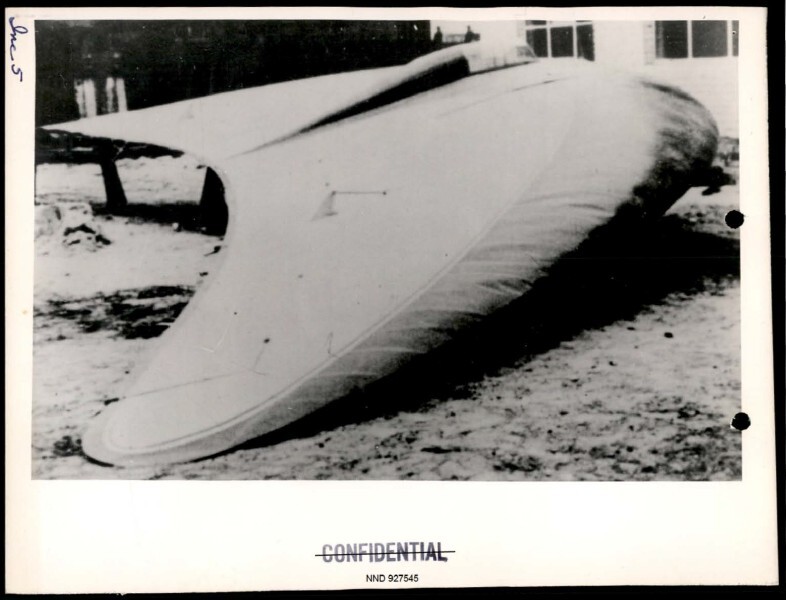
The 1948 report names the Northrop B-35 and jet-powered YB-49 among the American flying-wing aircraft investigators had to exclude. It then turns to German designs whose information, it says, the Soviets possessed: the Gotha P60A, Junkers EF 130 and Horten 229. The study says the Soviets had enlisted Dr. Günther Bock, whom it identifies as the wartime head of Germany’s flying-wing programme. Those statements are the report’s intelligence assessment, not an independently established account of Soviet aircraft development.
On that assumption, the authors listed four possible reasons for Soviet unconventional aircraft to appear over the United States: to undermine confidence in the atomic bomb, conduct photographic reconnaissance, test U.S. air defences, or conduct familiarisation flights. None is presented as an established Soviet operation.
The file does not establish a Soviet aircraft or device behind any report. It records a contingency assessment: in the early Cold War, unidentified observations had to be examined against the possibility of an adversary capability.
Two versions, no reversal
The release contains both the December 1948 study and its April 1949 revision. AARO says the later file is substantively similar to the earlier one. The two records therefore show continuity, not a dramatic reversal: unresolved reports, domestic and foreign technology as possibilities, and a Soviet threat question if the foreign branch proved true.
The dates place the study in the same institutional moment as Project Sign, the Air Force programme that investigated UFO reports. Release 04 includes Project Sign’s 1948 progress report, DOW-UAP-D097, alongside the two studies. The Project Sign Estimate of the Situation has its own history; the available documents do not establish that Report 100-203-79 was a revision of that separate estimate.
The flying-wing problem
D093 and D094 include contemporary UFO reports alongside examples of experimental “flying wing” planforms. The report also records a September 16, 1947 radar track at Fukuoka, Japan, estimated at 840 to 900 mph over a 70-mile track. It says the crew was good and the measurement was believed accurate. That is a reported radar observation in the file, not a demonstrated performance figure for an identified craft.
The documents do not say that a flying-wing aircraft explained the incidents. They show that domestic experimentation was in the investigators’ explanation set, alongside the foreign-capability question.
What the studies leave open
The studies do not establish that the sightings were Soviet, American, extraterrestrial, or a single class of thing. They show that, by late 1948, Air Force intelligence considered the foreign-capability question serious enough to state in writing while admitting it could not readily identify what witnesses had reported.
Sources
- Department of War PURSUE: DOW-UAP-D093, Analysis of Flying Object Incidents in the United States, December 10, 1948.
- Department of War PURSUE: DOW-UAP-D094, Analysis of Flying Object Incidents in the United States, April 28, 1949, including AARO’s version note.
- Department of War PURSUE: DOW-UAP-D097, Project Sign Progress Report, 1948.
- Historical copy of Air Intelligence Report No. 100-203-79: Analysis of Flying Object Incidents in the U.S., December 10, 1948.
- MUFON UFO Journal, 1985: contemporaneous account of the report’s FOIA declassification.