Main Article / Jul 10, 2026
PURSUE Release 04 puts Project Sign, Los Alamos, and 19 UAP videos on the record
PURSUE Release 04 adds 40 records: a 1949 Los Alamos green-fireball conference, Project Sign material, Air Force UFO studies, NASA Apollo audio, and 19 video files. The new public record is wider than its viral clips.
On July 10, the Department of War added a fourth tranche to PURSUE — the Presidential Unsealing and Reporting System for UAP Encounters, its rolling public-release programme for unresolved UAP records. Release 04 has 40 files. Its most clickable material is 19 newly posted video records. Its better archival material is on paper: a 1949 Los Alamos conference on the green fireballs, an early Project Sign report, two versions of an Air Force analysis of flying-object incidents, Project Blue Book correspondence, and NASA audio from Apollo debriefings.
That mix matters. Release 04 is not one new UFO case with an answer attached. It is a cross-section of how the U.S. government has handled reports at very different moments: a Cold War laboratory trying to explain strange lights, an early Air Force programme cataloguing sightings, and recent military sensor clips released with only broad locations and limited technical context.
The index breaks down cleanly: 14 PDFs, three NASA images from STS-80, four Apollo audio files, and 19 video records. The Department of War calls the materials unresolved UAP cases. That is a release category, not an official finding that any particular object was anomalous, foreign, or non-human.
Release 04 is also the smallest PURSUE batch so far. The official release data lists 158 records for the May 8 opening tranche, 64 for Release 02 on May 22, and 72 for Release 03 on June 12. This one is narrower, but much more concentrated: nearly half its entries are video files, while its historical side clusters around the late 1940s and the early institutional history of the UFO question.
Los Alamos and the green fireballs
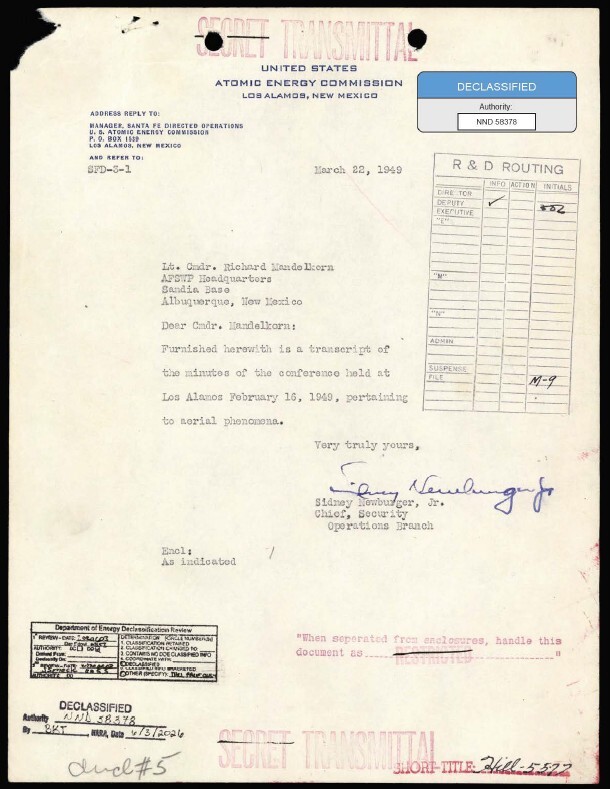
The strongest historical document is DOE-UAP-D004, a transcript of a 1949 conference at Los Alamos Scientific Laboratory. The subject was the run of “green fireball” observations reported near the laboratory over several months.
The cast is unusually heavy for a UFO-adjacent file. The Department of War’s record description says the attendees included scientists and physicists who had worked on the first nuclear weapons during the Manhattan Project. It summarizes Teller as suggesting an “electron phenomenon” if the reports did not involve a material body, and LaPaz as saying that nothing comparable had been observed in meteorite drops, to his knowledge.
The underlying February 18, 1949 Project Grudge trip report — also included in the earlier Sandia correspondence file released as DOW-UAP-D017 — is more specific about the exchange. It records LaPaz’s account of more than ten closely analogous observations since December 5, 1948, then says Teller’s calculation led him to a tentative view that the reported phenomena were not material objects moving through the air. The point is historical, not a retrospective verdict: the scientists were testing competing explanations from the limited observations they had.
The group did not reach a consensus. The leading hypothesis was still a natural one: meteors entering at a shallow angle and high altitude. That is why the document is useful. It records a serious technical argument around a strange local pattern without converting the lack of an immediate explanation into a recovered-technology story.
Los Alamos gives Release 04 its clearest scene: scientists at an atomic laboratory, fresh from the Manhattan Project, trying to decide whether bright green phenomena over New Mexico belonged to meteor science, atmospheric electricity, or a category they could not yet name.
Project Sign arrives with 100 reports
DOW-UAP-D097 is an initial report from the Air Materiel Command on Project Sign, the U.S. Air Force programme that investigated UFO reports in 1948 and 1949. The document details 100 sightings from 1947 and 1948.
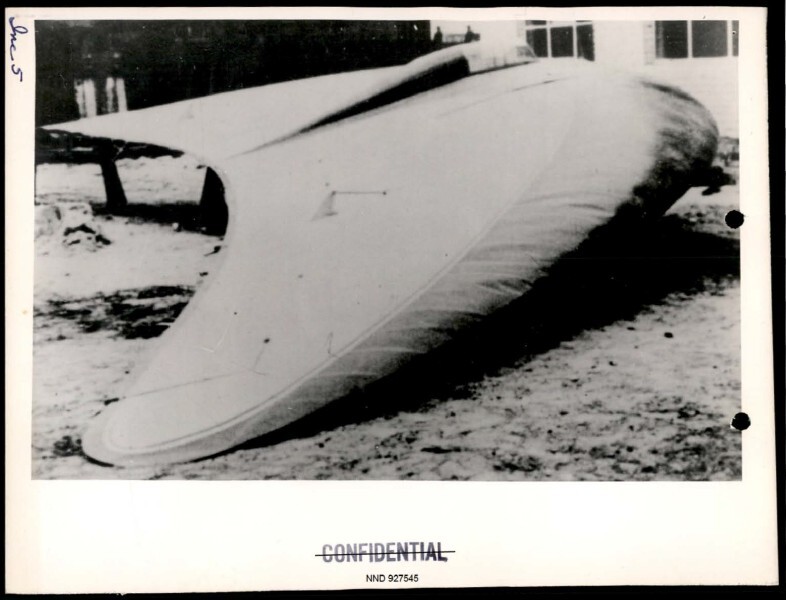
One odd inclusion makes it more than a routine programme history. The file also contains an excerpt from an aviation magazine called The Aeroplane, titled “The Biology of the Flying Saucer.” That does not make the article a military conclusion. It shows the intellectual weather around the file: formal Air Force reporting sat alongside speculative civilian ideas almost from the beginning.
The neighbouring Air Force studies are blunter. DOW-UAP-D094, an April 1949 Air Intelligence Division study, says that “some object has been seen” in certain reports but that identification cannot readily be accomplished. It treats domestic or foreign technology as the two reasonable broad origins and argues that, if foreign, officials should take seriously a possible Soviet scientific, military, or intelligence role.
The record also includes contemporary reports and examples of experimental flying-wing aircraft, which it presents as possible explanations for some commonly reported characteristics. AARO notes that D094 appears to be a later revision of the substantively similar D093 file. This is the 1949 security problem in its original form: not a government declaration of alien craft, but uncertainty filtered through fear of a Soviet capability.
The release is also a video archive
The long tail of Release 04 is video. Nineteen entries are tagged as unresolved UAP reports, spanning the Middle East, the Yellow Sea, the East and South China seas, the Atlantic, and broad eastern and western U.S. locations. The files range from 2015 to 2025.
The strongest geographic cluster is in the Indo-Pacific. The release adds one Yellow Sea video from 2023, two East China Sea files from 2024, a South China Sea file from 2024, and two more 2025 files from the Yellow Sea and East China Sea. That does not establish a regional wave; it establishes that multiple Indo-Pacific Command sensor records were selected for this public batch.
DOW-UAP-PR100, from the Yellow Sea in 2023, runs for 4 minutes 45 seconds. It begins in infrared mode, shifts briefly to an electro-optical day-TV feed that shows a dark object against blue, returns to infrared, and then cycles through zoom and contrast changes. The official description says the video progressively degrades and appears to skip or lose coherence between 03:28 and 03:32. Those details are not side notes. They are part of what a viewer is seeing.
DOW-UAP-PR101, from the South China Sea in 2024, describes an elongated contrast area that becomes a line of several contrast areas moving across the sensor field. Over the final minute, the marks become less distinct as their distance from the sensor increases. Again, the public description tells readers how the image behaves. It does not give distance, speed, altitude, sensor mode history, or an identification.
Two new 2025 files near China
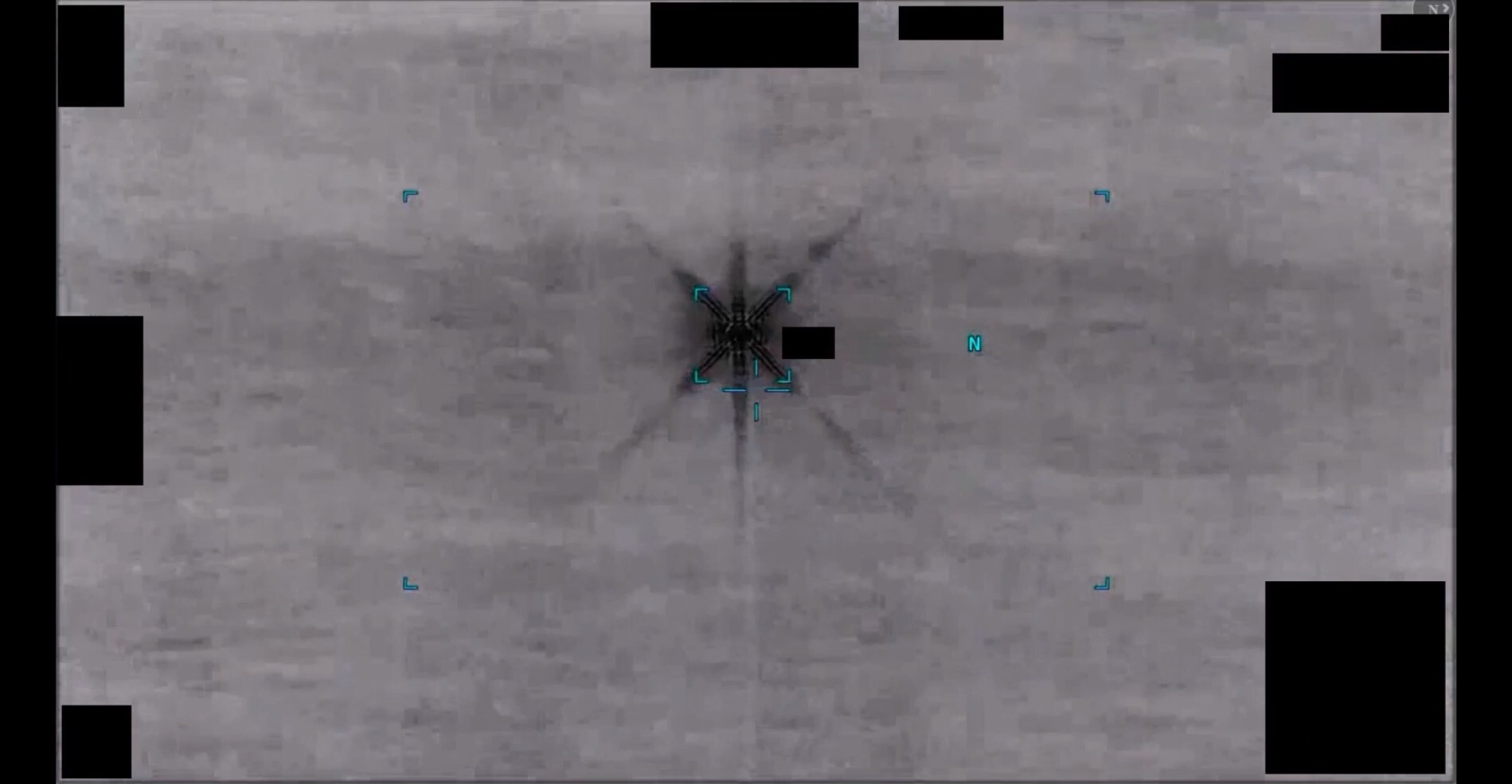
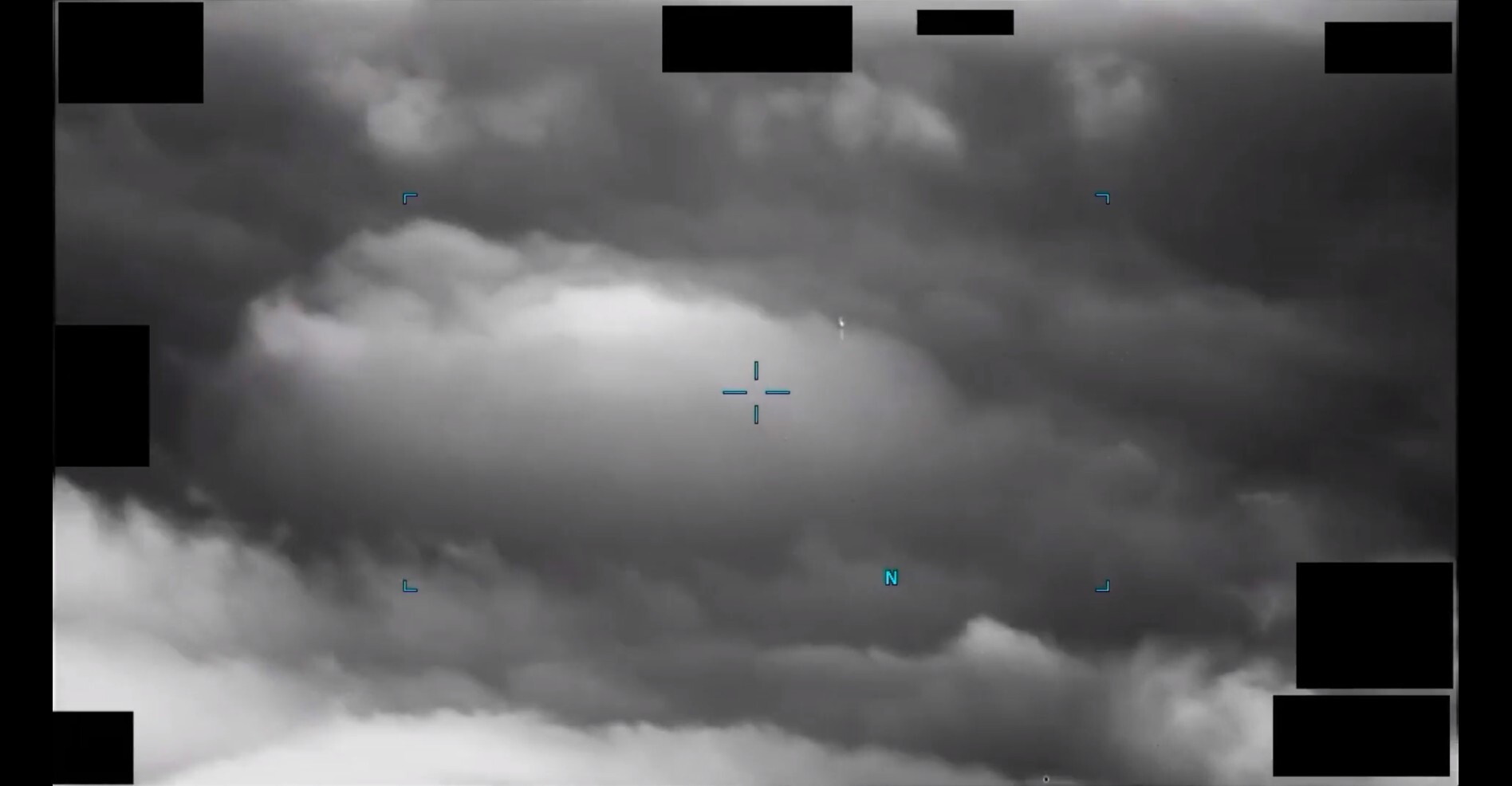
DOW-UAP-PR104 is a 2025 Yellow Sea file submitted by United States Indo-Pacific Command to AARO. Its description says the package consists of 18 seconds of infrared footage from a U.S. military platform. From 00:01 to 00:15, the sensor pans while tracking an area of contrast resembling a six-pointed star.
There is a small record-level discrepancy worth retaining: the detail page lists its playable length as 15 seconds. The index calls the incident location the Yellow Sea, but the detail page uses the broad location code Q9. There is no named platform, coordinate, range, altitude, or analytical conclusion.
DOW-UAP-PR105, also dated 2025 and attributed to Indo-Pacific Command, is much longer: 4 minutes 59 seconds. Most of the description concerns a sensor panning and zooming on an area of contrast that intermittently loses distinction against the background. The final section, from 02:06 to 04:59, is described simply as “No content.” The label says unresolved UAP report; the visible public account is a tracked contrast area with substantial empty runtime.
One archival clip was already altered
DOW-UAP-PR113 is the release’s most important qualification. AARO says the Navy UAP Task Force transferred this likely infrared 1996 video to the office in 2022. It also says no formal data-handling practices existed when the media was reported to the task force and that the file had been digitally altered before it reached the UAPTF.
The 2-minute-56-second video is therefore presented as received, not as an original sensor record. A contrast area crosses the field of view for only a few seconds. The file then repeats that segment frame by frame, repeats it at a slower speed, and ends by holding on an extracted frame. That caveat should travel with any repost of the clip.
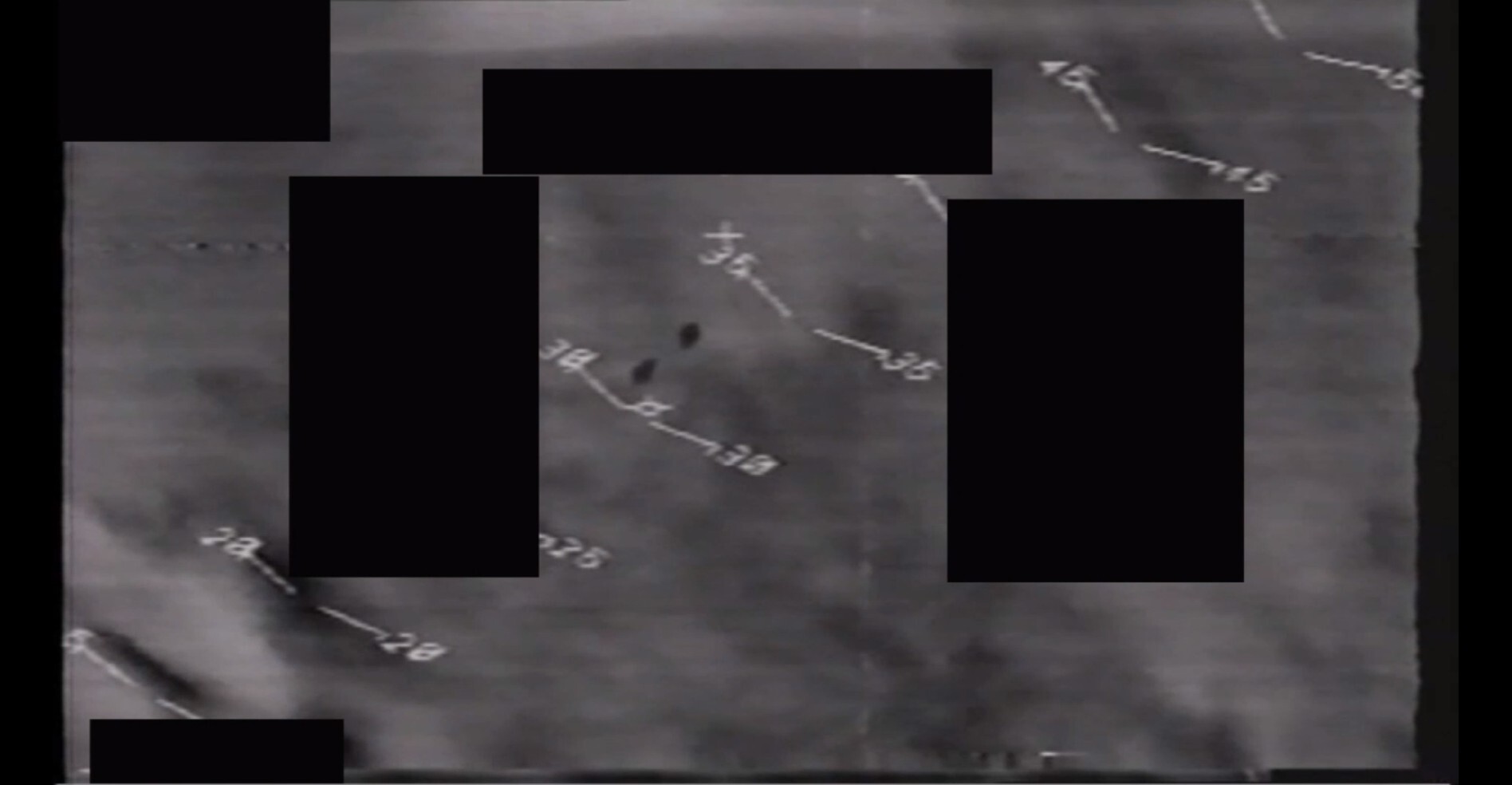
DOW-UAP-PR115, an eight-second 2019 Gulf of America file submitted by the Air Force, has a different kind of note. The description says a contrast area flickers as the sensor zooms and pans. AARO explains that infrared auto-gain filters can make a tracked source blend into its background or appear to flicker when its temperature is close to the surrounding environment. It is not an identification of PR115. It is the only one of the 19 video entries that the release itself pairs with a concrete sensor-effect explanation.
NASA’s images and Apollo audio are context, not proof
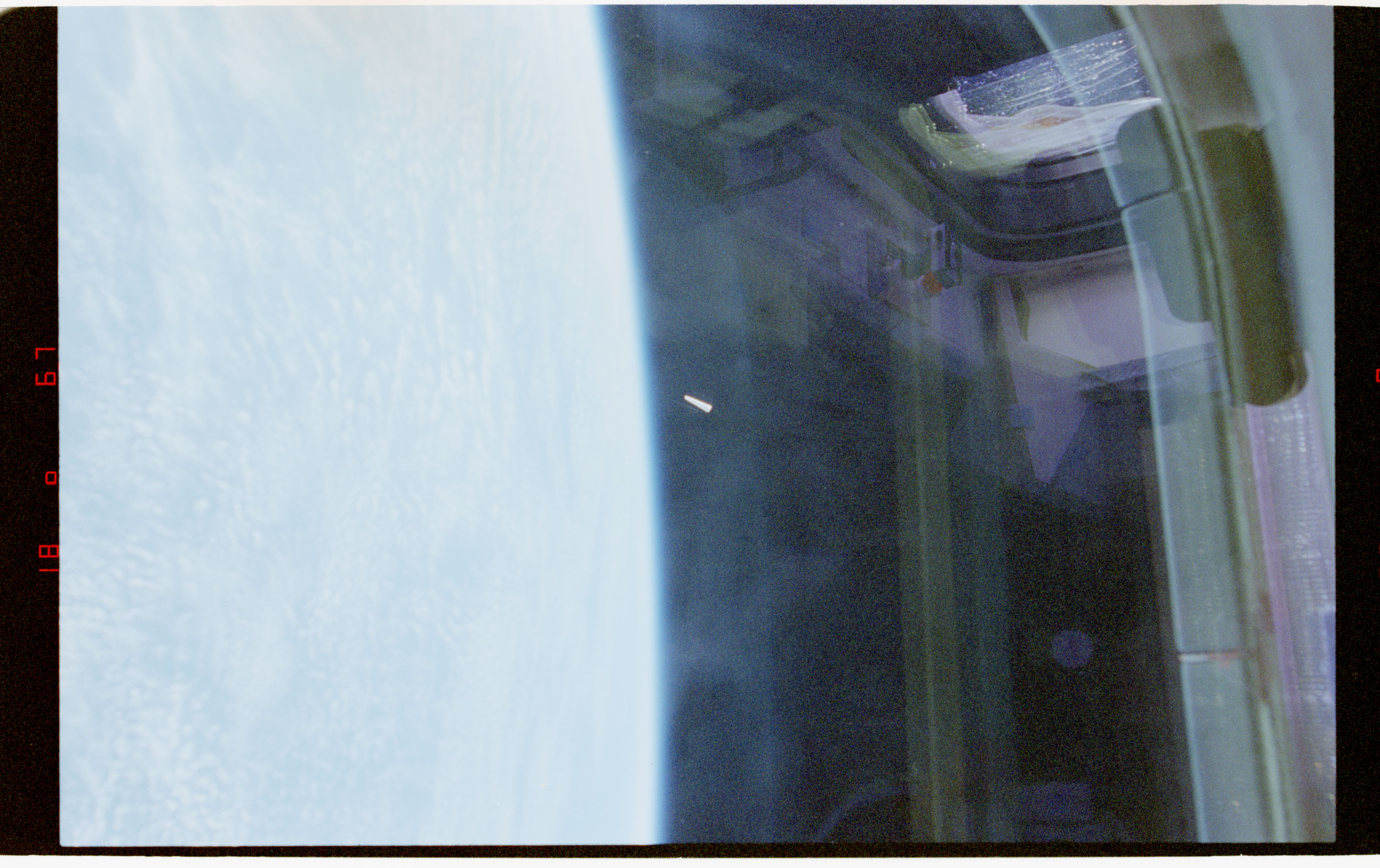
The release also contains three STS-80 “unidentified object” images from 1996 and four NASA audio files: two Apollo 14 debriefing segments from 1971 and two Apollo 17 crew medical debriefing segments from 1972.
The reason the Apollo recordings are in the release is stated on the detail pages. They concern “light flash phenomena”: a then-novel, now well-documented biological effect in which high-energy cosmic rays pass through the eye and strike the retina, producing perceived streaks or flashes. The Apollo 14 debriefers were trying to distinguish the characteristics of those flashes. In the Apollo 17 medical debriefing, two of the three crew members said they had noticed them at points during the mission, including in lunar orbit and on the surface.
That is a much narrower story than “NASA UFO files.” The audio documents astronauts and mission doctors discussing a physiological observation. It is in the PURSUE archive because it concerns an initially unusual visual phenomenon, not because NASA presents it as evidence of extraterrestrial craft.
What Release 04 actually changes
It changes the accessible record. A researcher can now place a 1949 Los Alamos conference beside Project Sign’s early catalogue, a 1949 Air Force threat analysis, later Blue Book material, recent range-fouler debriefs, and recent sensor files from the Indo-Pacific. That is a fuller map of institutional attention than any single viral clip can provide.
It does not resolve the green fireballs. It does not identify the six-pointed-looking contrast area in PR104. And the public files still omit the metadata that would let outside analysts establish size, range, speed, sensor configuration, or a confident identification.
Release 04 is therefore most revealing at the seams. The Los Alamos material shows a real 1949 investigation before anyone knew which physical explanation would hold. The Apollo recordings show how a strange visual report can become an understood biological effect. The modern clips sit at the opposite end of that process: public enough to watch, but still too thinly documented to settle what produced the marks on the sensor display.
Sources
- Department of War: fourth PURSUE release statement, July 10, 2026.
- Department of War: PURSUE Release 04 portal and 40-file record index.
- DOE-UAP-D004, “Los Alamos Conference on Aerial Phenomena, 1949”.
- DOW-UAP-D093, D094 and D097: 1948–49 Air Force flying-object studies and Project Sign report.
- DOW-UAP-PR100, PR101, PR104, PR105, PR113 and PR115: Release 04 video detail pages.
- NASA-UAP-D026 through D032: Apollo debriefing audio and STS-80 image entries.
- Department of War PURSUE index: Release 01–04 record counts and programme description.
- UAP Logbook: Release 02 and DOW-UAP-D017, the Sandia correspondence file containing the February 1949 Project Grudge Los Alamos trip report.