Main Article / Jul 07, 2026
Where to point the camera if you actually want to see something strange
Six places where the sky is genuinely darker than your backyard and the folklore has earned its weight — because real instruments, or real witnesses, keep showing up beside it.
There is no honest short list for "places where you will see a UFO." Anyone selling one has not been out much. What there is, though, are six places where the dark is genuinely darker than the average night you remember from your backyard, and where the folklore has earned its weight because real instruments — or real witnesses — keep showing up beside it.
This is a travel reporter's list, not a mystery list. If you go, take a coat, a thermos, a red flashlight, and patience. The odds of seeing something stranger than a satellite are honestly low. The odds of seeing a sky you remember for a long time are very high.
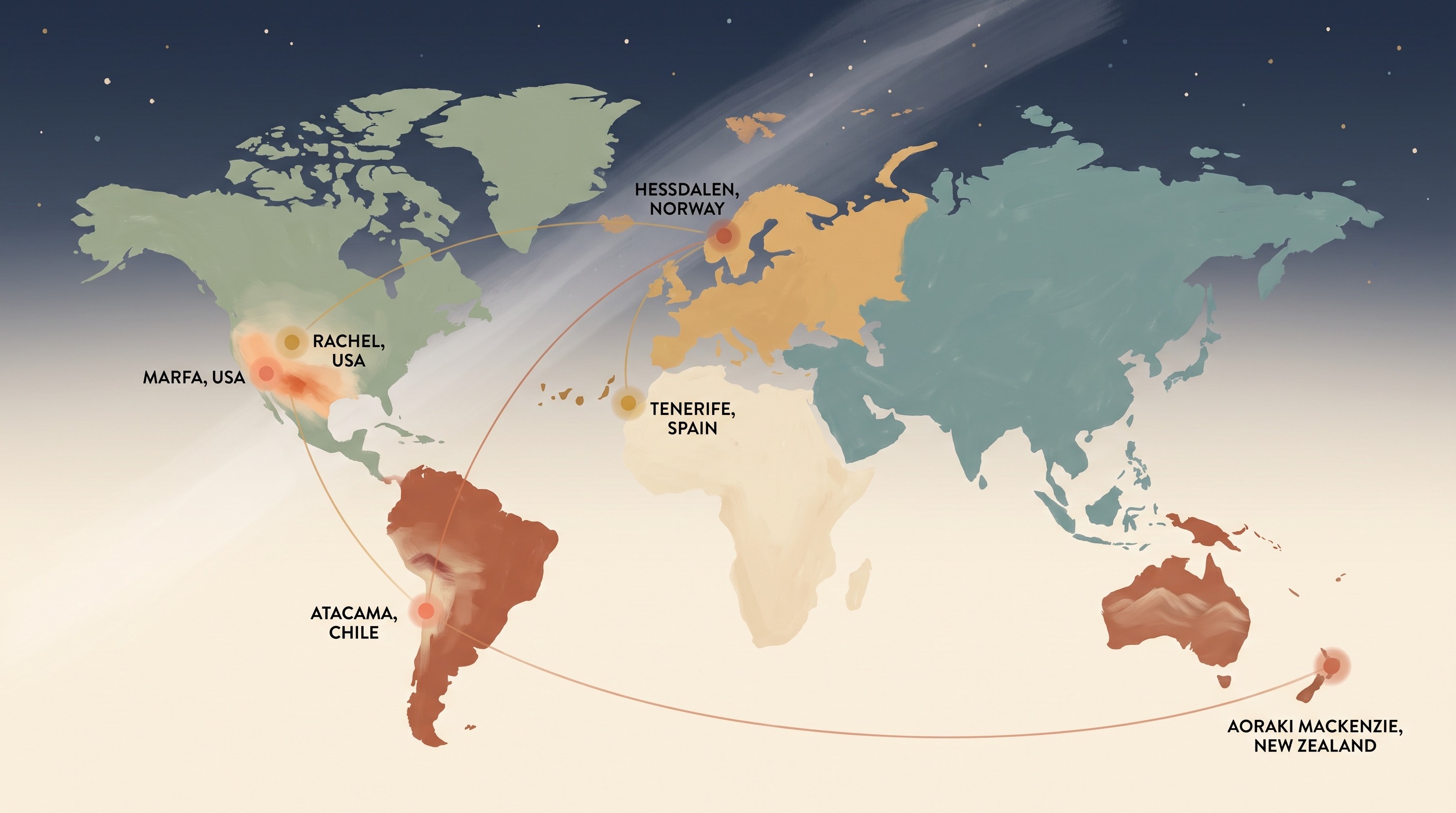
1. Marfa, Texas, USA
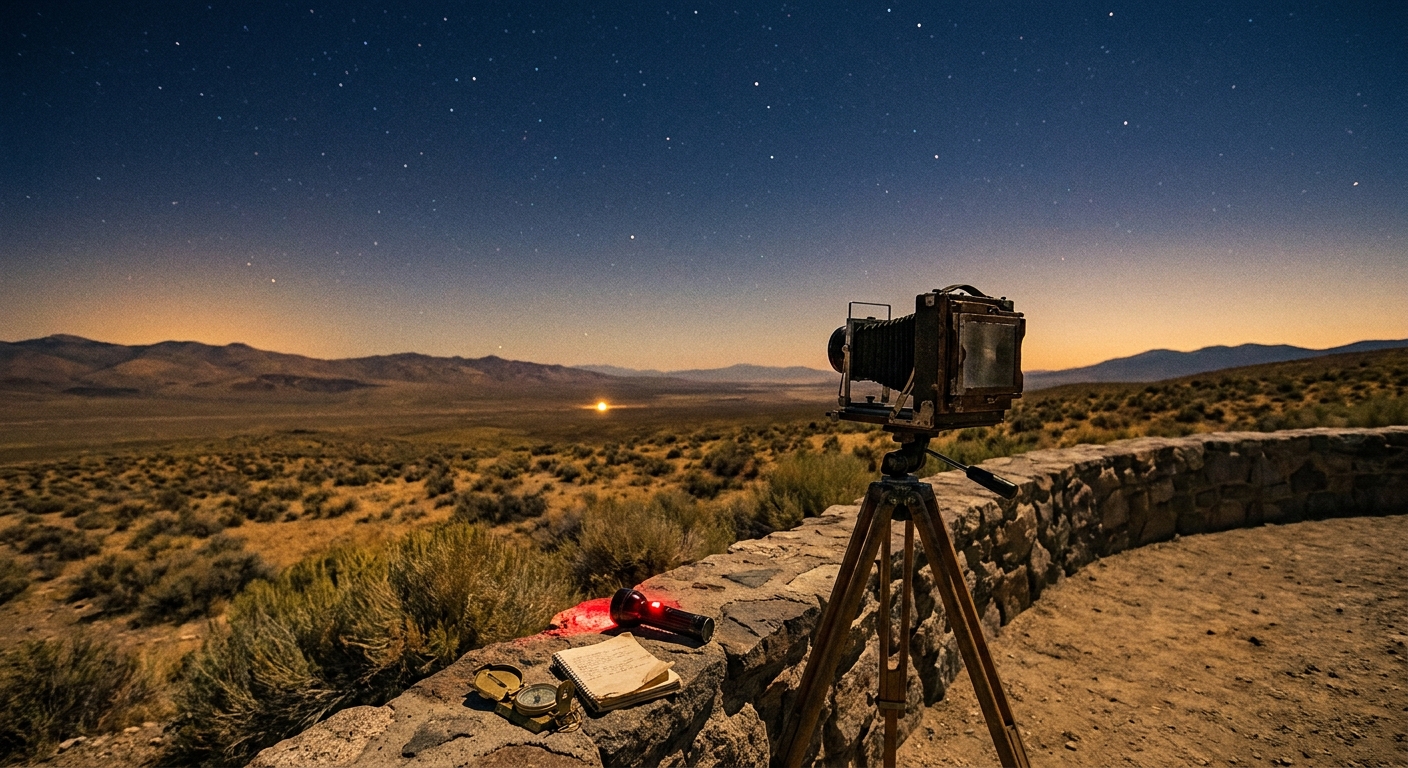
Pull off Highway 90 about nine miles east of Marfa, park at the official Marfa Lights Viewing Area, walk past the low stone wall, and look southeast across the desert toward the Chinati Mountains. On a clear, moonless night the lights begin to show up within twenty minutes.
The "Marfa lights" are an entire small industry. They have been reported since 1883 — wrong-way stagecoach drivers were the first to mention them — and the local story has gathered every layer of explanation: ranch lights from the old cavalry ground, atmospheric refraction of headlights on Highway 67, temperature inversions, ball lightning, piezoelectric effects. Two separate campaigns, by University of Texas at Dallas physics students in 2004 and by Texas State University researchers with spectroscopic equipment in 2008, both concluded that nearly everything they measured over multiple nights matched vehicle headlights on Highway 67 — in one test, the UT Dallas team had a colleague flash a car's lights on the highway and reproduced a "Marfa Light" on demand. The honest verdict on the record is the opposite of romantic: the instruments that went looking for something unexplained mostly found headlights, and the handful of genuinely unresolved sightings are rare enough that researchers say more data is needed before calling them anything at all.
When to go: April to May, or September to October. Cool enough to stand still outside for an hour, dry enough that nothing glows humidly, light enough to drive in before dark. Avoid the full moon. Arrive 45 minutes after sunset, give your eyes 20 minutes. Stay two hours if you want to see anything move.
What you will actually see: the Perseids in August and the Geminids in December if you pick a meteor-shower night on purpose. On most nights you will see satellites, aircraft landing lights, sometimes a stray balloon, and — more often than the legend admits — a car's headlights on the distant highway doing exactly what the lights are famous for. The sky itself, on a moonless West Texas night, is the actual show.
2. Rachel, Nevada, USA — the Extraterrestrial Highway
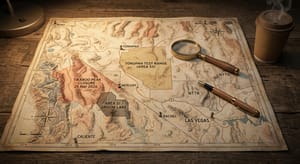
Drive north from Las Vegas on US-93, turn left at the sign for Rachel on Nevada State Route 375, and you are on what the state legislature officially named the Extraterrestrial Highway in 1996. The road runs 98 miles through some of the emptiest high desert in the lower 48, past the Tikaboo Peak overlook (which the BLM closed to public access on 25 March 2026 — see the UAP Logbook piece on that order for the details and coordinates) and the tonier pacing-station stops of the small town of Rachel itself.
The stop worth making in Rachel is the Alien Center, a fuel-and-snack-and-bookshop complex on the left at the northern end of town with a fifty-foot metal alien out front, a wall of sighting reports, and an LCD screen running sky-camera footage from the highway. Mikey's, on the right at the southern end, does good burgers and is a reasonable place to ask the local questions. The town has about 60 residents. Most of them have a sighting story. None of them will sell you one.
When to go: April or October, moonless, again. Clear and dry. The Tikaboo closure means the old long-distance public viewpoint over Groom Lake is gone; the legal remaining public viewpoint on the Groom Lake side is now Reveille Peak at about 45 miles distance, harder to get to, and not the same view. Going now is mostly about the highway and the sky, not the old panoramic shot.
What you will actually see: the sky is the headline, including the Milky Way in summer. You will see Janet Airlines shuttles from Harry Reid to the Tonopah Test Range / Area 51, identifiable by their tail markings and scheduled behavior. You may see F-117s at the Tonopah end of the range, identifiable by their planform. You will probably not see a flying disc. You will definitely see why this corridor of the Great Basin is the place where UAP rumours concentrate. The drive itself, late at night, is half of what you came for.
3. Hessdalen Valley, Norway
The Hessdalen valley is a twelve-kilometre-long trough in Holtålen municipality, central Norway, about two and a half hours' drive south of Trondheim. The valley's claim to fame is a category of luminous phenomenon that locals call the Hessdalen lights — free-floating balls and elongated shapes, often white, sometimes yellow or red, lasting from a few seconds to an hour, drifting low above the valley floor at unpredictable intervals. Reports of the lights go back to the 1930s and concentrated as a wave in 1981–1984.
What makes Hessdalen different from every other place on this list is the live measurement program. Project Hessdalen has been running in some form since 1984, currently hosted at Østfold University College, with an instrumented station on the valley floor that has been operating continuously since 1998. The published literature is open and peer-reviewed — the most recent major paper is a 2024 VLF electromagnetic survey in the Journal of Applied Geophysics covering 100 km² of the valley. The measurements show correlations between the lights and the local geological structure (a gabbro intrusion with mineralized zones), VLF emissions, and geomagnetic disturbances; they do not produce a confirmed causal model. They produce a measured record.
When to go: September to March is the active season; the lights appear at a rate of roughly 10 to 20 reports per year in recent times, after the 15 to 20 per week of the early-1980s wave. There is a small research station and a museum at the southern end of the valley, near the village of Hessdalen itself. Lodging is rustic: a few guesthouses, the Østfold summer field station when it is running, or a tent. Bring layers; the valley gets cold and the wind comes down the trough.
What you will actually see: if you go specifically to see lights, pick a known active period (the station staff and the project's online bulletin will tell you when activity is up), bring a camera capable of long exposures, and be prepared to wait. You will see the lights, or you will see stars, and the difference between "actually saw lights" and "good clear night in a quiet valley" is one of those things that never quite gets decided on the spot.
4. Atacama Desert, Chile — Paranal, ALMA, and the high plain
The Atacama is the clearest sky on Earth for ground-based astronomy. The reasoning is plain: a high cold desert between the Pacific and the Andes, almost no atmospheric water vapor, low cloud cover, low population density, and a long-standing national policy that protects the dark sky with outdoor-lighting regulation. The European Southern Observatory runs Cerro Paranal, home of the Very Large Telescope, less than three hours' drive south of Antofagasta. ALMA, the Atacama Large Millimeter Array, sits at 5,000 metres on the Chajnantor plateau east of San Pedro de Atacama. The Extremely Large Telescope is under construction on Cerro Armazones, adjacent to Paranal.
If you want the sky on your own time and the sky on the world's most modern telescopes on theirs, the Atacama is the cleanest version of both. San Pedro de Atacama is the practical hub: daily flights to Calama, an hour to San Pedro by transfer, a small town built almost entirely around astro-tourism, with high-altitude desert day trips out to ALMA, the Valle de la Luna, the Geysers del Tatio at sunrise, and a few observatories that run nightly tours.
When to go: October to March is the Atacama's high season, both for the dry weather and for the southern-sky summer. Avoid the full moon. Most of the public observatories run tours every night regardless of moon phase, but the sky itself is best with less moon. Plan at least three nights. Two nights for tours, one night on your own at altitude.
What you will actually see: the Milky Way galactic centre from October to December, low and bright in the south, is what people fly in for. You will see shooting stars at a rate you cannot match at lower latitudes. You will see the Magellanic Clouds as small smudges of light, which northern-hemisphere observers cannot see at all. You will not see anything officially called "UFO" because there are too many planets and satellites being mistaken for things, plus the observatories' automatic sky cameras catch most streaks the second they happen. If something lights up over the Atacama and it is not a known satellite, it is on the public record within a day.
5. Tenerife, Canary Islands, Spain — Teide and the southern sky
The Canary Islands are home to two of the world's best mid-latitude observatories. The Teide Observatory, on Mount Teide at 2,390 metres on Tenerife, is operated by the Instituto de Astrofísica de Canarias and has been a Starlight Reserve since 2014. The Roque de los Muchachos Observatory on La Palma is similarly protected. Both are within a few hours' flight of most of Western Europe.
The islands also have a quieter history that is part of why they end up on this list. On the night of 22 June 1976, multiple witnesses across the Canary archipelago — not confined to Tenerife alone — reported glowing spherical objects, an incident later documented in the Spanish Air Force's own declassified UFO files. The current Teide National Park is not a UAP archive. It is one of the few places in Western Europe where, on a moonless night, you can see the Milky Way with a small telescope and chase the same objects the research telescopes above you are chasing on the same patch of sky.
When to go: May to October, summer high season, dry, trade-wind-cooled, low humidity at altitude. The Santa Cruz de Tenerife–to–Teide access road runs up through the volcanic pine forest to the cable car. Make sure you book the cable car or the permit for the upper observatory trails in advance. Bring warm clothes even in summer — 2,000 metres up is not warm.
What you will actually see: the Teide summit is one of the few places in Western Europe where you can see the Magellanic Clouds with the naked eye on a moonless night. The zodiacal light is dramatic in spring and autumn. You will see what most mid-latitude northern-hemisphere observers never see, and you will see it from a parking lot. The advantage is real, even if the UAP folklore is not what brings you there.
6. Aoraki Mackenzie, New Zealand — the southern sky, low budget
New Zealand's Aoraki Mackenzie International Dark Sky Reserve sits in the South Island between Aoraki / Mount Cook and Lake Tekapo, covering about 4,367 km² of alpine and lake country. It was certified in 2012, and at the time was both the largest Dark Sky Reserve in the world and the first of its kind in the Southern Hemisphere. The reserve includes Lake Tekapo, the Church of the Good Shepherd (small stone church with a window pointing at the southern sky), the Mount John Observatory operated by the University of Canterbury, and the larger Mount Cook / Aoraki villages to the north.
The southern hemisphere sky is the show. From this latitude — roughly 44° south — the southern Milky Way is overhead for most of the year, the Magellanic Clouds are obvious to the naked eye, and the southern polar constellations (Southern Cross, Centaurus, Carina) are the headline rather than the footnote. The reserve is not particularly associated with UAP folklore; it makes the list because the night sky is the actual subject, and a New Zealand Dark Sky Reserve on a good night is harder to beat than most places get.
When to go: February to April is the prime New Zealand stargazing shoulder season, with the high Milky Way overhead. The ski fields in the area also make winter (June to August) workable for darker skies if you drive up from Christchurch. Book Lake Tekapo early; it is small and gets booked out.
What you will actually see: the Magellanic Clouds, the southern Milky Way from dark-sky altitude, the Zodiacal Light as a distinct cone, and a sky that most northern-hemisphere observers will describe for the rest of their lives as "the night I saw it from the other side."
Things to remember on any of these nights
A few habits survive across all six. Let your eyes dark-adapt for 20 minutes before you start watching. Use a red flashlight for any paper, map, or phone. Don't point a phone at the sky to film a "sighting" — the camera will not capture what your eye is seeing, and the footage will look bad. Note the time, the place, the weather, anything visible in the sky (including the planes and satellites), and any camera settings. If something genuinely odd happens, write it down before you talk about it.
The odds across these six places of seeing a sighting that the existing public record cannot already answer are honestly low. What you get in exchange is a sky that the average night behind your house cannot give you. That is the trade. It is a good trade.
Sources and further reading
- Marfa Lights: University of Texas at Dallas Society of Physics Students campaign (2004) and Texas State University spectroscopic survey (2008), both concluding most observations matched Highway 67 vehicle headlights; Texas Monthly and Marfa Public Radio oral histories; Marfa Lights Viewing Area at 30.3893° N, 104.0719° W, official pull-off nine miles east of Marfa on Highway 90.
- Extraterrestrial Highway / Rachel: Nevada State Route 375 signage and Alien Center public material; BLM temporary public-safety closure of 22,987 acres around Tikaboo Peak effective 25 March 2026 (see the UAP Logbook piece on the closure for the details and coordinates).
- Hessdalen: Vargemezis, Zlotnicki, Hauge, Kjøniksen and Strand, "Contribution of VLF electromagnetic survey to the investigation of Hessdalen lights (Norway)," Journal of Applied Geophysics 226 (2024) 105398; Project Hessdalen ongoing bulletins at hessdalen.org.
- Atacama: ESO Paranal Observatory and ALMA visitor pages; Starlight Reserve certification records; Antofagasta regional tourism authority transfer information.
- Tenerife / Teide: Instituto de Astrofísica de Canarias public observatory pages; Starlight Reserve certification 2014; Spanish Air Force declassified file on the 22 June 1976 Canary Islands sighting; Mount Teide cable-car reservation systems.
- Aoraki Mackenzie: International Dark-Sky Association reserve record for Aoraki Mackenzie, certified 2012 as the largest reserve worldwide and first in the Southern Hemisphere; University of Canterbury Mount John Observatory public outreach program; New Zealand Dark Sky Trust.
UAP Logbook notes referenced
- What is the Extraterrestrial Highway? — UAP Logbook's existing Extraterrestrial Highway page, with the highway history and Tikaboo vantage-point notes.
- Tikaboo Peak, the last public Area 51 viewpoint, is now off limits — the 25 March 2026 BLM closure the Rachel entry references.
- Area 52 was a name in a phone book before it was a meme — the Tonopah Test Range article that explains what Rachel-bound visitors are flying past.
- What other countries are doing about UAPs — the broader country-by-country baseline this list lives inside.