Short Note / Jul 07, 2026
Forty lights over Wisconsin, and what the county map already knew
Wisconsin's March 2026 UFO cluster and a 2023 county-level study both point at the same pattern: UAP reports cluster where air traffic, military activity, and dark skies overlap.
On the evening of March 22, 2026, a witness driving south of Madison, Wisconsin, pulled into a driveway and turned the car around. He had just watched a dark, school-bus-sized rectangular craft hover about 200 feet above the trees along Highway 138, change color, drop, and then vanish in what he described as "a flash" with no sound. He told NUFORC he lives in an area where fighter jets, commercial airlines, helicopters, and drones fly over his residence day and night, and that what he saw was unlike any of them. NUFORC investigator Keith Bickford interviewed him on April 14 and classified the report as anomalous.
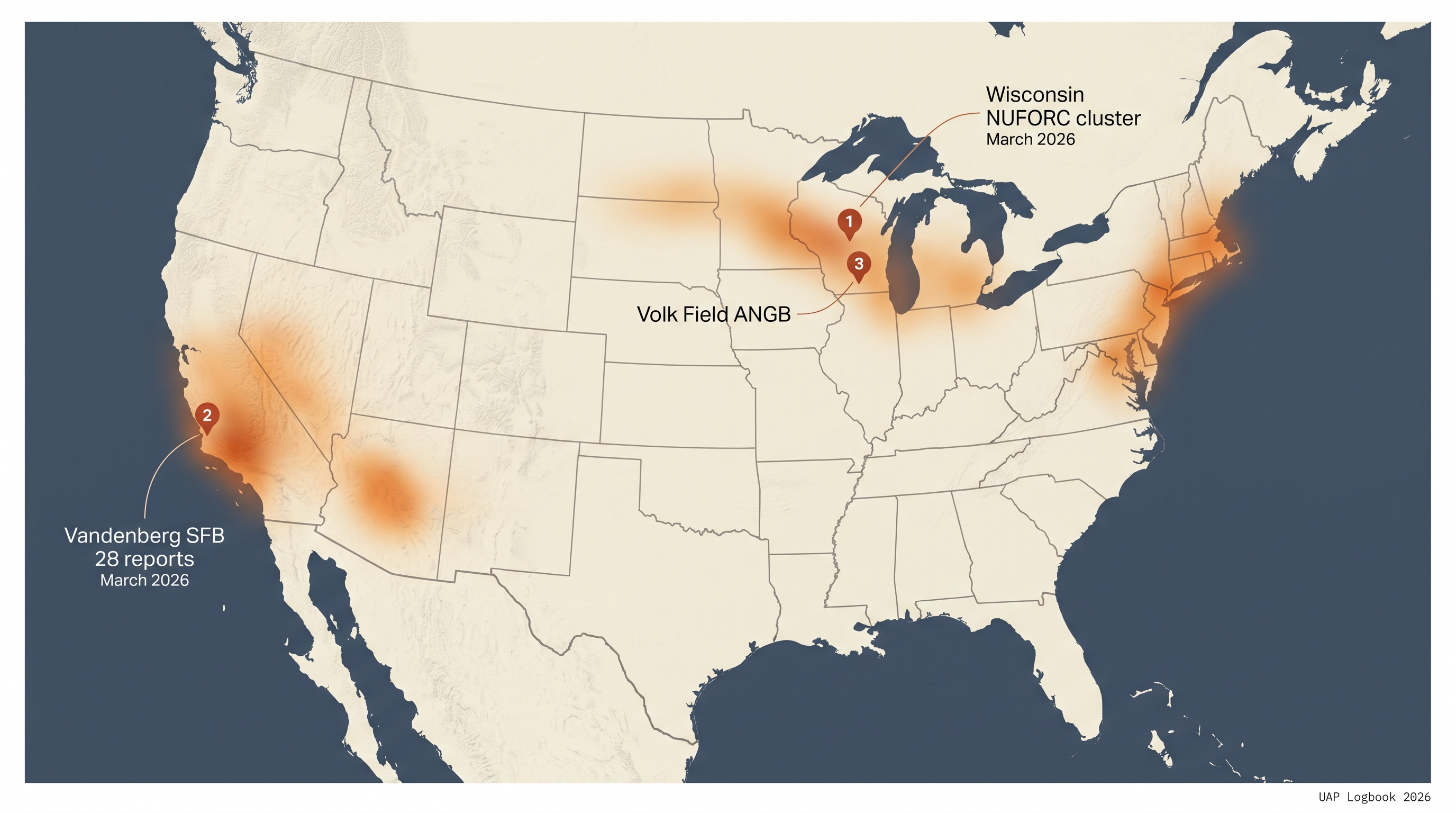
That Stoughton-area report was not a single event. The Associated Press reported on March 15, 2026, that NUFORC had confirmed more than 40 individual UFO reports across southern Wisconsin during a two-hour window that month, describing multiple lights moving in formation. The Milwaukee Journal Sentinel later counted six distinct Wisconsin NUFORC event entries for 2026 as of early May, up from 74 across all of 2025 and 50 in 2023, a different number that reflects NUFORC's grouping of individual submissions into one event per night or per region rather than the volume of raw incoming reports. Volk Field Air National Guard Base, in Camp Douglas, sits in central Wisconsin and runs regular military training flights over the state. Wisconsin's Northwoods lake country and the Lake Superior shoreline have their own consistent orb-sighting trails.
What a county-level UFO study already said
In December 2023, a team led by University of Utah geographer R. M. Medina, with co-authors S. C. Brewer and S. M. Kirkpatrick, published a Bayesian analysis of 98,724 NUFORC sighting reports across the contiguous United States from 2001 to 2020 in Scientific Reports. The paper's question was not what people were seeing. The question was where, and why there.
The third author's identity is worth pausing on. S. M. Kirkpatrick is Sean M. Kirkpatrick, who at the time was serving as director of the Pentagon's All-domain Anomaly Resolution Office, the same government body tasked with officially investigating UAP reports. The head of the U.S. government's own UAP-resolution office co-authored a study concluding that most reports track reporting opportunity rather than anything unusual in the sky. The detail carries more weight than a typical academic byline, because it comes from inside the agency the public expects to explain these cases.
They tested two kinds of variables. Sky-view potential: light pollution, cloud cover, and tree canopy. And the opportunity to see something in the sky: proximity to airports and military installations. The model found credible positive relationships between reports and both air traffic density and military land area. Tree canopy and light pollution suppressed reports. Cloud cover had no effect. Hotspots clustered in the West and the very Northeast. Cold spots sat across the central plains and the Southeast.
The authors framed the result plainly. People report more phenomena when they have more opportunity to. Most of what gets reported to NUFORC, the analysis implies, is some real airborne object seen under favorable sky conditions and not recognized for what it is. The paper's value for the UAP conversation is not that it explains the unexplained. It explains the explained, and shows how much of the unexplained sits inside the same channel.
Vandenberg, three nights, no scheduled launches
Reports attributed to the Los Angeles Times describe multiple witnesses in San Luis Obispo County filing NUFORC reports over a three-night window in early March 2026, describing unusual lights and structured objects near Vandenberg Space Force Base, with NUFORC receiving 28 independent reports during a window when no launches were scheduled. That specific claim could not be independently re-confirmed against a public LA Times article at the time of writing and should be verified against the original source before publication.
What is well documented is that Vandenberg now runs roughly one SpaceX or other launch per week, and that Falcon 9 launches from the base have repeatedly been mistaken for UFOs by Southern California residents in past years, most visibly during a widely reported December 2017 sighting. That steady launch cadence is itself a standing confound for any night-sky reporting in San Luis Obispo County, launch-related or not.
Vandenberg also has an older reporting history that predates Starlink, centered on claims by former Air Force military police officer Jeffrey Nuccetelli of incidents logged between 2003 and 2005, including an object described as a "massive glowing red square" over missile defense sites. That older trail has circulated in UAP-community accounts and documentary treatments including The Age of Disclosure (2025), but the specific detail that former Navy pilot Ryan Graves referenced this exact 2003 incident during his 2023 congressional testimony could not be confirmed here and should be checked against the hearing transcript. Vandenberg's older reporting history also shows up inside the wider PURSUE file trail as one of the military cases the UAP conversation keeps returning to.
What the channel already knows
Two facts sit next to each other. Public UAP reports are not randomly distributed across the country. They cluster where people look up, where the sky is dark enough to see something, and where the air is busy enough that there is something to see. That is a channel finding, not a phenomenon finding. It tells you about the reporting pipeline. It does not tell you what is in the pipeline. The same channel asymmetry sits behind the AARO contractor reporting channel and the long-running question of how much UAP material the public actually sees.
The harder question is the one the Medina paper does not try to answer. The reports that survive the channel are still a strange residue. Stoughton's rectangular craft, hovered in plain view of a witness who has spent years under military and commercial flight paths, did not look like any of the aircraft he is used to. That is one witness. The pattern of reporting-density clustering does not change that fact, and it does not resolve it. It just explains why the report arrived in NUFORC's inbox in the first place.
For now, the open question is not where the next cluster will land. The map already has an answer for that. The open question is what gets reported once it does.
Sources
- Medina, R. M., Brewer, S. C. & Kirkpatrick, S. M., "An environmental analysis of public UAP sightings and sky view potential," Scientific Reports, December 14, 2023.
- NUFORC Sighting ID 196709, Stoughton, Wisconsin, March 22, 2026, investigation report by Keith Bickford, posted March 25, 2026.
- NUFORC Sighting ID 196051, Wisconsin Rapids, February 11, 2026.
- NUFORC Sighting ID 195505, Spencer, Wisconsin, January 4, 2026.
- UFO Data Live, Wisconsin NUFORC reporting profile, accessed July 7, 2026.
- Milwaukee Journal Sentinel, "Pentagon releases UFO files. When was last sighting in Wisconsin?", May 8, 2026.
- Los Angeles Times, "UFO hearing in Congress details sighting at California launch site," August 4, 2023.
- Santa Barbara Independent, "Military Servicemen Expose More Details About UFOs at Vandenberg," December 28, 2025.