Short Note / Jul 07, 2026
Billy Meier's UFO photos outlived the case against them
Billy Meier's UFO photos did not need the case to stay clean. The images became their own object, traveling through books, posters, television, and internet lists.
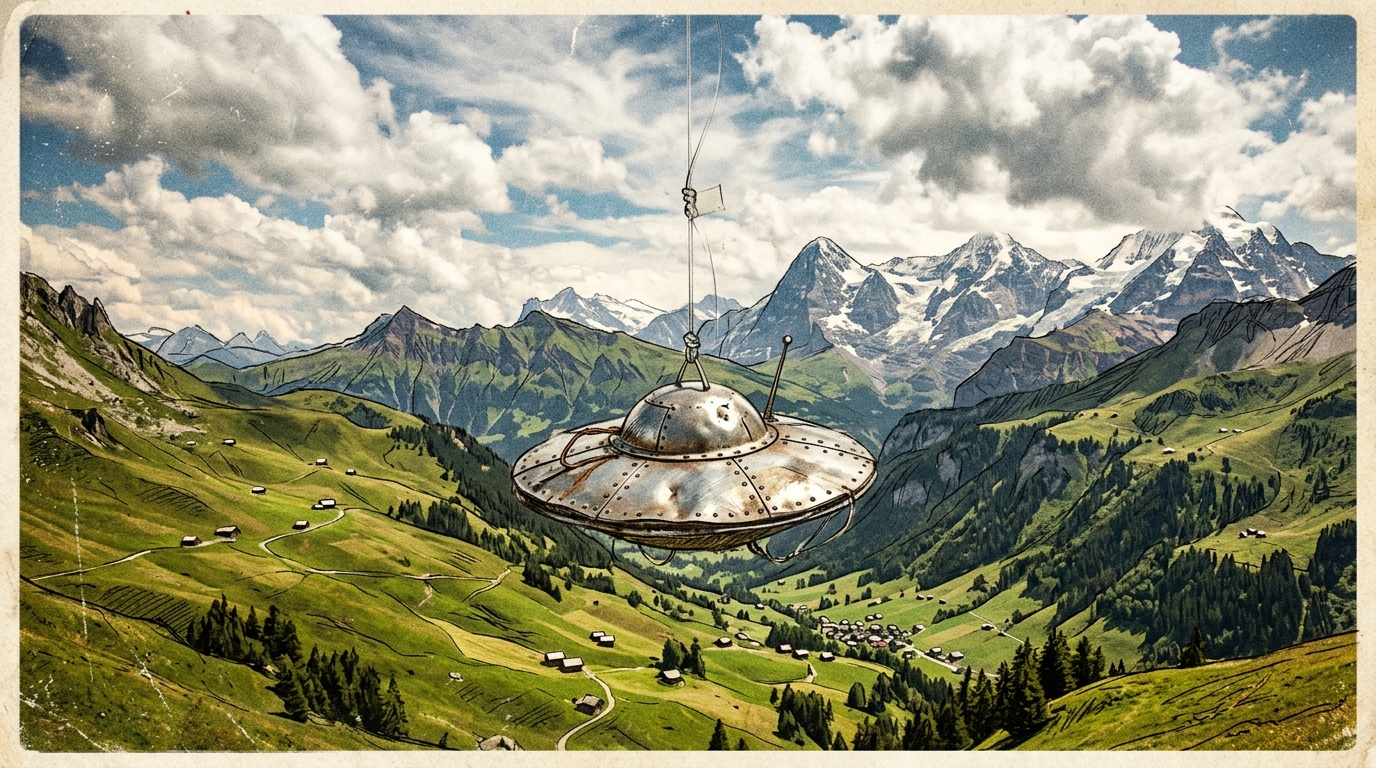
Billy Meier's UFO photos have a strange kind of afterlife.
You do not have to believe the case to recognize the look: silver craft, Swiss countryside, a contactee story big enough to build its own world around the images.
The pictures became independent from the argument. One of them ended up taped to the wall of a fictional FBI office and outlived the man who took it, the case against him, and most of the people who ever argued about either.
The image problem
Meier began photographing what he described as Pleiadian "beamships" near his home in Hinterschmidrüti, Switzerland, starting in spring 1976, using an Olympus 35 ECR he could operate one-handed — a detail that matters, since Meier had lost his left arm in an accident years earlier. The photographs first reached a wide audience in 1979, published in a book by former U.S. Air Force pilot Wendelle C. Stevens, who championed the case for years.
Critics have pointed to models, staging, and images that look less like impossible machines than physical props placed into a frame. The clearest confirmation came from within Meier's own circle: Gary Kinder's 1987 investigation "Light Years" documented that photographs obtained from Meier's estranged wife showed a small hand-carved saucer model, and that Meier eventually admitted to making it. MUFON, the largest pro-UFO research organization in the United States, went further in its own assessment, calling the case "the most infamous hoax in ufology" — a verdict from an organization inclined to believe such cases, not one built to debunk them.
Believers built a wider contact story around the photos anyway. Skeptics built a counter-case. The pictures kept circulating through both worlds.
That is the part worth watching.
The poster effect
Meier's photos are not just case material. They are design objects, and one of them proved it by leaving the UFO subculture entirely.
One of Meier's beamship images became the visual basis for the "I Want to Believe" poster that hung in Fox Mulder's office throughout The X-Files, reportedly triggering a licensing dispute that the production settled with Meier directly. That single placement did more to spread the image than three decades of contactee literature — millions of viewers who never heard the name Billy Meier absorbed the picture anyway, stripped of the story that produced it.
They have the clean silhouette people expect from a flying saucer. They look old enough to feel archival and sharp enough to reproduce. They are simple in a way many modern UAP clips are not. By 2019, that same visual appeal put a set of Meier's original prints into a Sotheby's space-photography auction, sold as artifacts in their own right, independent of whether anyone in the room believed the underlying claim.
That makes them sticky.
In the current UFO disclosure era, the Meier lesson is not that every clean image is false. It is that a clean image can become a cultural object faster than its source chain can be checked — and once it lands somewhere as visible as a hit television show, no later debunking pulls it back out again.
The photo travels first.
The case catches up later, if it catches up at all.
Related UAP Logbook notes
- The UFO hoaxes that still haunt disclosure
- The 1665 Stralsund air battle was printed before it became a UFO case
- Gulf Breeze had a UFO model in the attic
Sources
- Gary Kinder: Light Years: An Investigation into the Extraterrestrial Experiences of Eduard Billy Meier (Atlantic Monthly Press, 1987, page 225).
- MUFON: Official case assessment and "the most infamous hoax in ufology" verdict.
- Sotheby's: Space Photography Auction (2019), featuring original Billy Meier prints.
- The New Yorker: The Enticing Mysteries of U.F.O. Photography, accessed July 7, 2026.
- Wikipedia: Billy Meier overview and source trail.