News / Jul 21, 2026
The Apollo photo Jesse Michels calls “censored” — and what the original scan shows
The archive discrepancy is real. The conclusion drawn from it is not: an original-film scan contains the blue mark that Michels presents as censored.
A small blue vertical mark hangs above the lunar horizon in NASA photograph AS14-66-9301. Astronaut Edgar Mitchell, standing beneath it with a television camera, gives the frame its human scale. The mark is easy to spot in the current NASA scan once the frame number is known.
That image is now part of a much bigger allegation. In a July 20 interview, Jesse Michels titled the episode Proof That NASA Censored Moon Photos (and The Astronauts Knew!). His guest, theoretical physicist Maaneli “Max” Derakhshani, compares two versions of the Apollo 14 frame: an older Lunar and Planetary Institute display where the mark is hard to see, and a newer NASA/Arizona State University version where it is obvious.
At about 46 minutes into the interview, Derakhshani says Ken Johnston Sr. had been told to destroy early-generation Apollo negatives containing anomalies that “aren’t supposed to be there.” It is a serious allegation with a different evidentiary trail. Johnston does not appear in the episode to document it, and a comparison of one frame cannot test it.
AS14-66-9301 exists in more than one archival rendering, and the difference is worth showing. The original-film scan preserves the blue mark too. That fact breaks the proposed link between this frame and a NASA deletion.
The image can be checked
NASA's Johnson Space Center catalogue identifies the photograph as AS14-66-9301: Apollo 14, magazine 66, frame 9301. The catalogue provides a 5,700-by-5,800-pixel scan. The image belongs to a panoramic sequence; the adjacent frames are AS14-66-9300 and AS14-66-9302.
It is a lunar-surface scene: a broad grey foreground, low hills and a large field of black sky. Camera reseau marks—the small crosses printed into the image by the Hasselblad's calibration plate—run across the frame. The blue feature is in NASA's full scan, not something added by a YouTube editor.
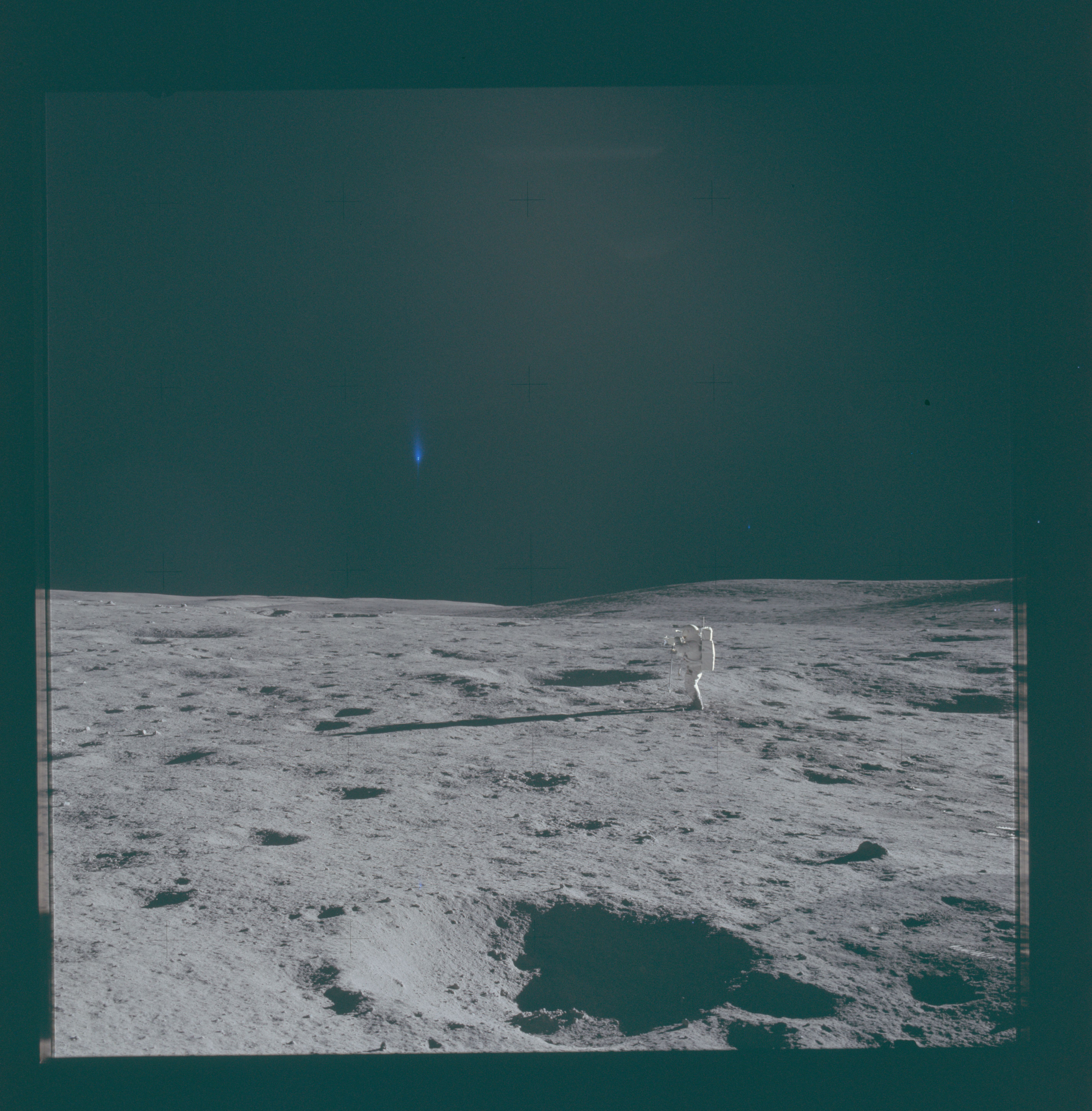
The online discussion often begins with a brightened crop. A full-frame view brings back the terrain, the reseau marks and the film edge that the crop leaves out.
Open the three source scans below to inspect them at full resolution. They are presented in sequence, not overlaid or aligned.
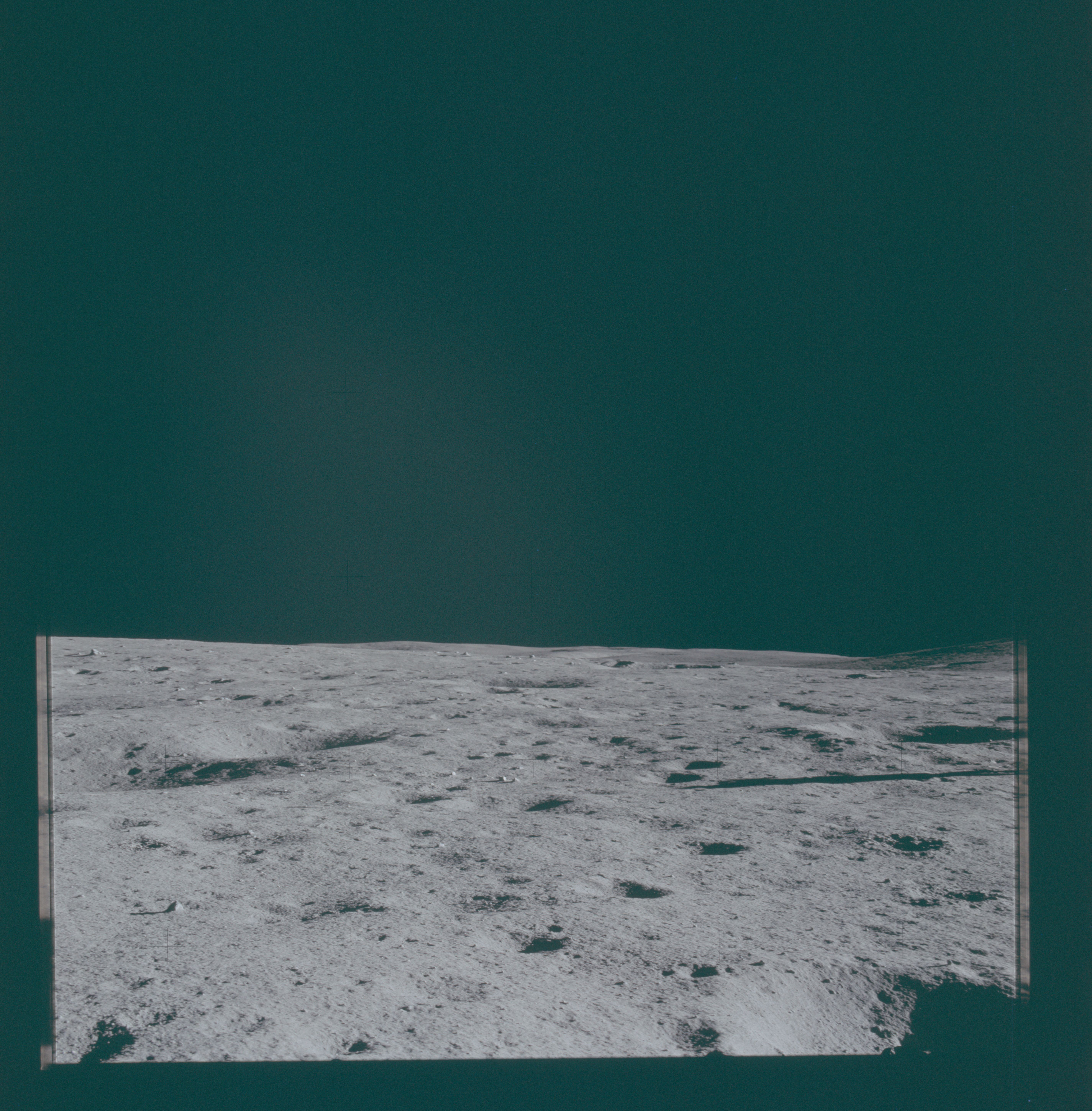
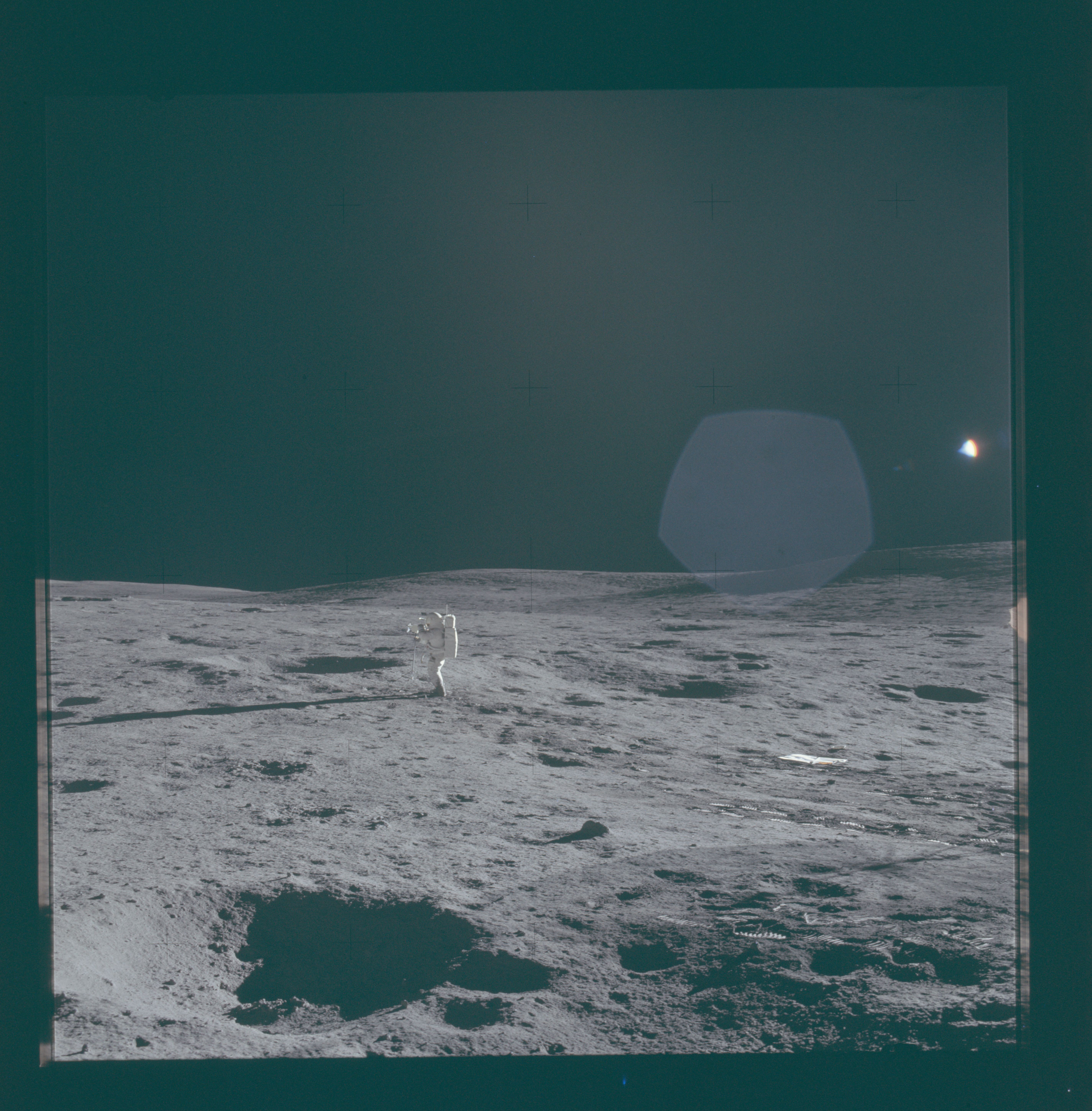
The archive comparison, precisely stated
The LPI difference needs a precise label. An archived 2022 LPI browse image is only 450 pixels across. Its sky is dark, and the blue mark is not obvious. We use that file because it is the historical web display at issue, not because it is the only LPI version. The LPI frame page also offers larger downloads.
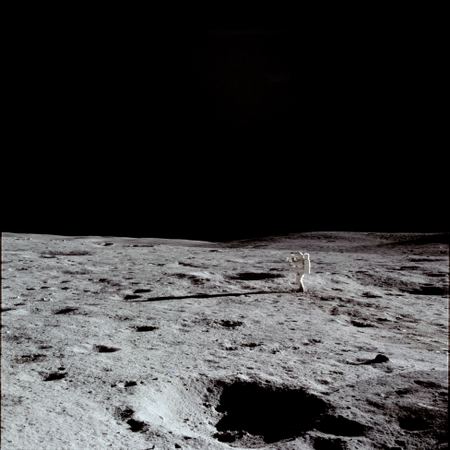
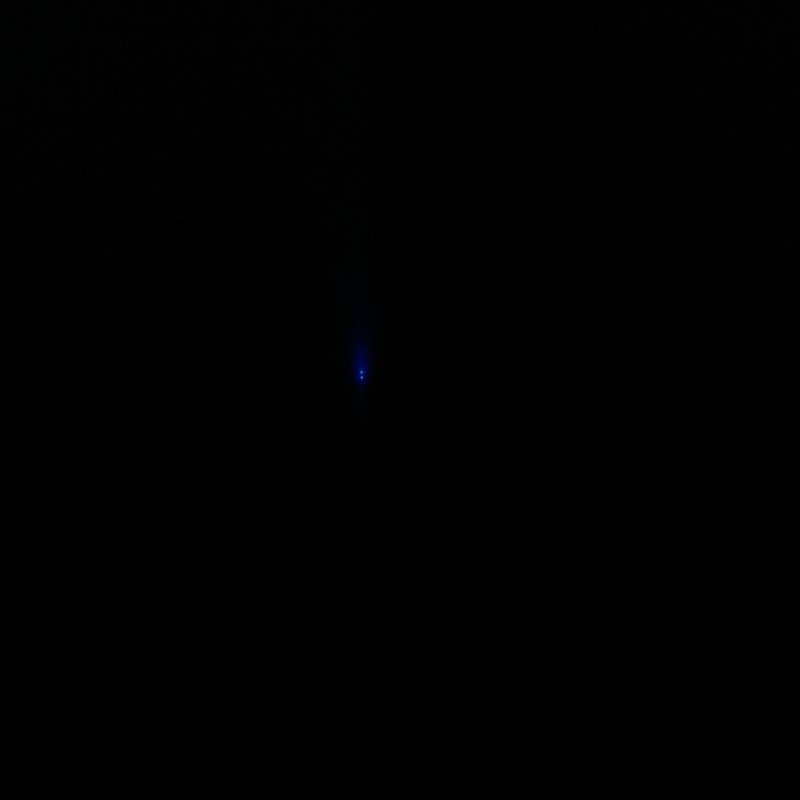
The decisive comparison sits in the NASA/JSC/ASU scan documentation. Its unprocessed TIFF comes from the original Apollo flight film held at Johnson Space Center. The blue mark is present there, along with the frame edge and the film’s calibration marks.
The image itself still needs an explanation. The neighbouring photographs are consecutive views in a changing sequence, rather than aligned exposures of the same patch of sky. A one-frame feature may come from the scene, the camera or the film. It cannot serve as an example of a deleted mark when the mark is visible on the original-film scan.
What the video establishes, and what it adds
Derakhshani has identified a genuine display difference. Before treating it as a blacked-out object, the episode does not provide the two source URLs, scan dates or a reproducible processing history. LPI says its individual Hasselblad frames were made from duplicate film, while the original flight film stayed at Johnson Space Center and was rescanned later. LPI directs users to ASU for raw and processed original-film frames.
The episode moves from this frame to a wider set of claims about Apollo imagery, astronaut knowledge, Clementine, lunar structures and alleged secrecy. They are not answered by this comparison. Nor can they borrow support from it. Each needs its own source trail.
What the blue mark might be
The scan record answers a provenance question, not a physics question. The blue mark could relate to the original exposure, an internal reflection, film damage or another camera- and film-level effect. The catalogue gives it no object identification, and the episode offers no technical assessment tied to this frame.
Apollo crews did report light flashes. NASA’s historical technical literature links dedicated Apollo 15, 16 and 17 observations to cosmic radiation. That work concerns what astronauts saw; it is not a diagnosis for every mark in a later scan of a lunar photograph.
The Johnston allegation is a different investigation
Johnston’s alleged instruction to destroy negatives is not a footnote to this image. If substantiated, it would concern a separate chain of people, negatives, dates and documents. The episode offers Derakhshani’s account of what Johnston said, but no alleged instruction, destruction record or connection to AS14-66-9301.
The old LPI browse image and the newer archive version look different. The original-film scan includes the blue mark. For this one frame, the censorship story stops there. The mark itself remains a legitimate subject for a more technical image analysis.
Related UAP Logbook reporting
- How could UFOs travel between stars?
- The Phobos monolith and Buzz Aldrin’s “prime mission”
- Mars biosignatures: what scientists are actually looking for
- NASA, space and UAP reporting
Sources
- Jesse Michels, “Proof That NASA Censored Moon Photos (and The Astronauts Knew!),” July 20, 2026. The source of the claims examined here.
- NASA Johnson Space Center, Gateway to Astronaut Photography of Earth: AS14-66-9301. Public high-resolution image and catalogue entry.
- NASA Johnson Space Center: AS14-66-9300 and AS14-66-9302. Adjacent frames used in the comparison.
- Lunar and Planetary Institute, archived browse image for AS14-66-9301, captured October 31, 2022. The older low-resolution rendition discussed in the video.
- NASA/JSC/Arizona State University, raw original-film scan of AS14-66-09301 and its scanning and processing documentation. The unprocessed TIFF contains the blue mark; NASA/JSC/ASU.
- Lunar and Planetary Institute, “About the Images”. Explains that LPI’s individual Hasselblad frames came from duplicate film, while original-film raw scans are available through ASU.
- NASA Technical Reports Server, “Visual light flash phenomenon”. Apollo 14–17 light-flash observations and analysis.
- NASA Technical Reports Server, “Apollo light flash investigations”. Dedicated Apollo 15–17 observations and cosmic-radiation simulation.