News / Jul 05, 2026
The Congo uranium mine saucers entered the CIA file
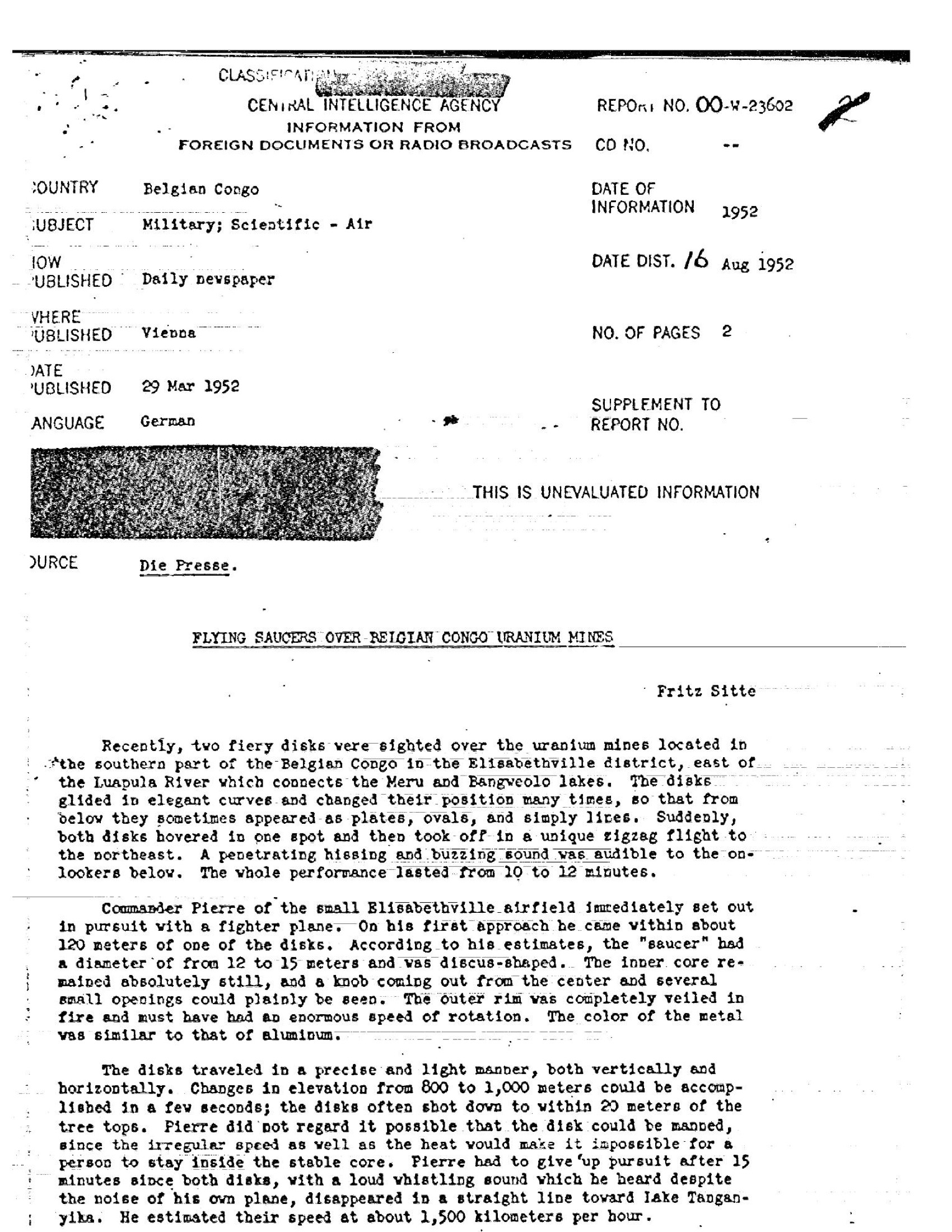
The title almost writes the myth by itself: flying saucers over Belgian Congo uranium mines. The CIA page is real. It is also marked unevaluated.
The title is doing the work.
"Flying Saucers Over Belgian Congo Uranium Mines."
The page is a CIA foreign-document report (report number 00-W-23602), distributed on August 16, 1952. The form logs information from the Vienna daily newspaper Die Presse, published March 29, 1952. It is explicitly marked as "unevaluated information."
The document is real. The saucers inside it are not verified. U.S. intelligence filed the press clipping because the combination of a UAP wave, a fighter pursuit, and strategic uranium mines was too significant to ignore in 1952.
The incident over Katanga
The translation describes an encounter in the southern region of the Belgian Congo (now the Democratic Republic of the Congo), specifically over the mining district of the Elisabethville (now Lubumbashi) area. According to the report, two "fiery disks" were observed gliding over the uranium mines in March 1952. The objects reportedly hovered, shifted shape, and exhibited a distinct buzzing and hissing sound that lasted between 10 and 12 minutes.
According to the account, a commander named Pierre took off from the Elisabethville airfield in a fighter plane to pursue the objects. At his closest approach, he reportedly came within 120 meters of one disk. He described a saucer-shaped craft, 12 to 15 meters in diameter, with a still inner core, a rotating, veiled outer rim, and a metallic color resembling aluminum. The report estimated the disk's speed at 1,500 kilometers per hour before it departed toward Lake Tanganyika.
The Austrian connection and Fritz Sitte
The source of the CIA's report was a story written by Fritz Sitte for the Vienna daily Die Presse on March 29, 1952. Sitte, then a 28-year-old Austrian journalist, was at the beginning of what would become a highly prominent career. He later became famous as an "extreme journalist" and war reporter, traveling to conflict zones in Yemen, Angola, and Southeast Asia to publish firsthand accounts in major magazines like Life, Time, and Stern.
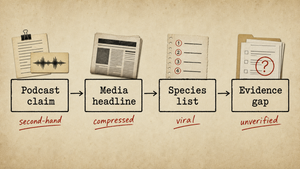
The presence of an adventurous reporter in the region explains how a local rumor or report from a remote colonial airfield reached a metropolitan newspaper in Vienna. But the critical step occurred when the CIA's Foreign Documents Division intercepted the clipping, translated it, and distributed it internally as an intelligence item. Under the claim-chain structure, the CIA did not verify the encounter; they simply logged Sitte's article as a signal in the international press landscape.
The geopolitical crown jewel: Shinkolobwe
The CIA's interest in this specific report is inseparable from the geography of the Cold War nuclear monopoly. The Elisabethville district was home to the Shinkolobwe mine, the most valuable strategic asset in the early Western atomic arsenal.
In 1940, Edgar Sengier, the director of the Belgian mining giant Union Minière du Haut-Katanga, had secretively shipped 1,200 tons of high-grade uranium ore (pitchblende) to a warehouse in Staten Island, New York, to keep it out of Nazi hands. In 1942, Colonel Kenneth Nichols and General Leslie Groves purchased this stockpile for the Manhattan Project. The Shinkolobwe ore was exceptionally pure, often containing 65% uranium, compared to the less than 1% concentration found in American and Canadian deposits. Roughly two-thirds of the uranium used in the Little Boy and Fat Man bombs originated from Shinkolobwe.
By 1952, Shinkolobwe was a heavily fortified fortress. The United States, United Kingdom, and Canada maintained a joint monopoly on the mine's output through the Combined Development Trust. The Belgian government and Union Minière enforced a strict security regime: barbed wire, round-the-clock guards, military airstrips (including the major base at Kamina), and counter-sabotage intelligence teams monitored by the CIA. The fear of Soviet infiltration, sabotage, or espionage balloons was a constant concern for Western defense planners.
Strategic intelligence vs. anomalies
In the context of 1952—the peak of the early Cold War UAP wave that culminated in the Washington D.C. flyovers and the subsequent establishment of the Robertson Panel—any report of a high-speed craft over Shinkolobwe was treated as a potential national security threat. If a new Soviet reconnaissance tool, a jet aircraft, or an espionage balloon was operating over the West's primary uranium source, the CIA needed to know.
The declassified document shows how early intelligence networks captured UAP rumors and filed them alongside strategic military data. The Congo file does not prove that non-human technology was surveying nuclear resources; it proves that by 1952, the association between critical nuclear sites and aerial anomalies had become a standardized route for intelligence gathering and monitoring.
In 2020, the CIA included the Belgian Congo report in its public "X-Files" selection, highlighting it as one of the agency's more intriguing historical UFO documents. The file remains a primary example of how early Cold War intelligence-gathering networks captured UAP rumors and filed them alongside strategic military data.
Related notes
- Edward Teller's UAP calculations: the 1949 Sandia green fireball conference
- The Pantex unidentified object image
- The CIA UFO archive does not start where people think
- The December 1947 flying-disc memo
Sources
- CIA foreign-document report 00-W-23602, "Flying Saucers Over Belgian Congo Uranium Mines"
- CIA, "Take a Peek Into Our X-Files"
- Combined Development Trust and Shinkolobwe mine historical records (Manhattan Project history, U.S. National Archives).
- Fritz Sitte, biographical and journalistic records, Austrian National Library.