News / May 22, 2026
DOE-UAP-D001: the Pantex UFO image in PURSUE Release 02
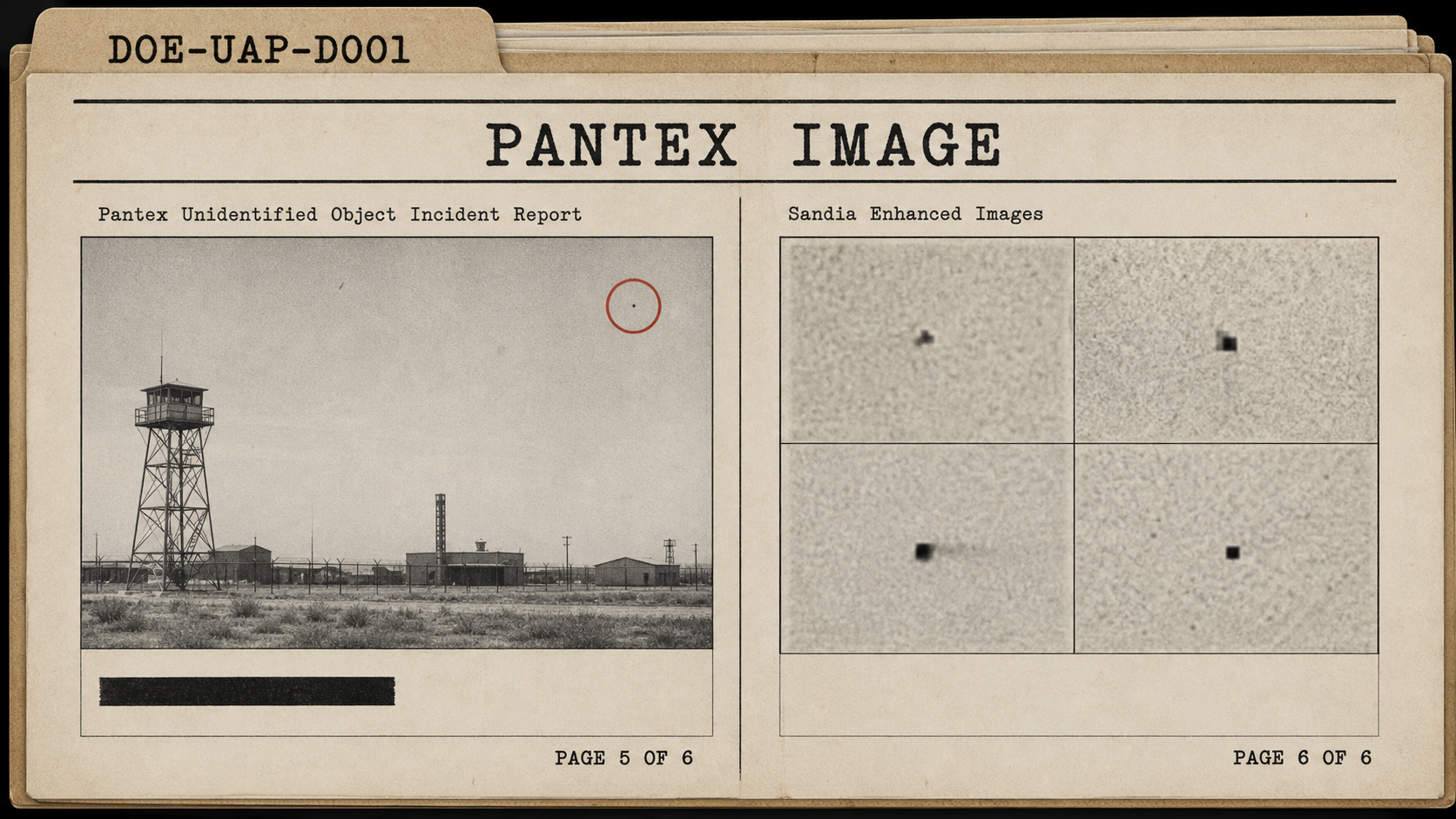
DOE-UAP-D001 is two pages long, but the labels carry the weight: a Pantex incident report, a ground surveillance radar tower image, and Sandia enhanced images of the object.
The image fragment
DOE-UAP-D001 is the rare item in PURSUE Release 02 that comes with actual images. It is a two-page fragment from a file labeled as a Pantex unidentified object incident report, not a written account, but the tail end of an image chain.
The first released page, page 5 of 6, shows a frame from a ground surveillance radar tower with a small object circled in red. The second, page 6 of 6, refers to Sandia enhanced images of the same object. The earlier pages of the report have not been released.
What the public pages show
The first released page carries Pantex incident-report labeling and a mostly blank surveillance frame with a small object marked by a red circle. A large block of the page is withheld under a UCNI marking and a b(3) notation.
Its title identifies the source as a ground surveillance radar tower. The visible page number reads page 5 of 6.
The second released page sits in the same incident-report sequence. Its visible label points to Sandia National Labs enhanced images of the object. The visible page number reads page 6 of 6.
The public identifier on the fragment is DOE-UAP-D001. I did not find a separate incident number in the two released pages; the fragment shows the document label and page sequence, not the front matter of the incident report.
What the public file shows, then, is a chain, original surveillance image followed by Sandia enhanced images, but only the tail end of it.
Why Pantex makes this sensitive
Pantex is tied to the U.S. nuclear weapons enterprise, not a generic facility. That does not make the object extraordinary on its own, but it does explain the UCNI and b(3) markings, and it is why an unidentified object image linked to a nuclear weapons site reads as a more sensitive document than a routine UAP sighting photo.
The released pages do not say what the object was, how it moved, how far away it was, how long it was observed, or whether the incident was resolved. They show that an object image existed inside an incident-report chain that involved both Pantex and Sandia enhancement work.
What the released pages establish
DOE-UAP-D001 is a fragment, not a case file. The public record is narrow:
- the file is identified as DOE-UAP-D001;
- no separate Pantex incident number is visible in the released two-page fragment;
- the PDF title metadata identifies it as a Pantex item;
- the released pages are marked page 5 of 6 and page 6 of 6;
- one page is labeled as a ground surveillance radar tower image;
- one page is labeled as Sandia enhanced images of the object;
- the visible object is small in the public image.
The pages imply a fuller incident report, but the release only publishes the image end of the record.
What would complete the file
Pages 1 through 4 of the incident report, or a release note explaining why only pages 5 and 6 were made public, would answer most of the open questions.
The basics are still missing: date, time, camera position, object path, distance estimate, environmental conditions, facility response, and final assessment. Without that context, the public file is a lead with images, not an explanation.
Sources
- PURSUE UAP portal, accessed May 22, 2026.
- Department of War: second PURSUE UAP file release announcement, published May 22, 2026.
- PURSUE Release 02 document bundle, DOE-UAP-D001_PANTEX_Image.pdf, downloaded May 22, 2026.