News / May 22, 2026
ODNI-UAP-D001: the 2025 orange orb narrative in PURSUE Release 02
ODNI-UAP-D001 is a late-2025 orange orb UFO/UAP narrative from PURSUE Release 02: test range, radar tasking, FLIR, NVG, and fighter jets.
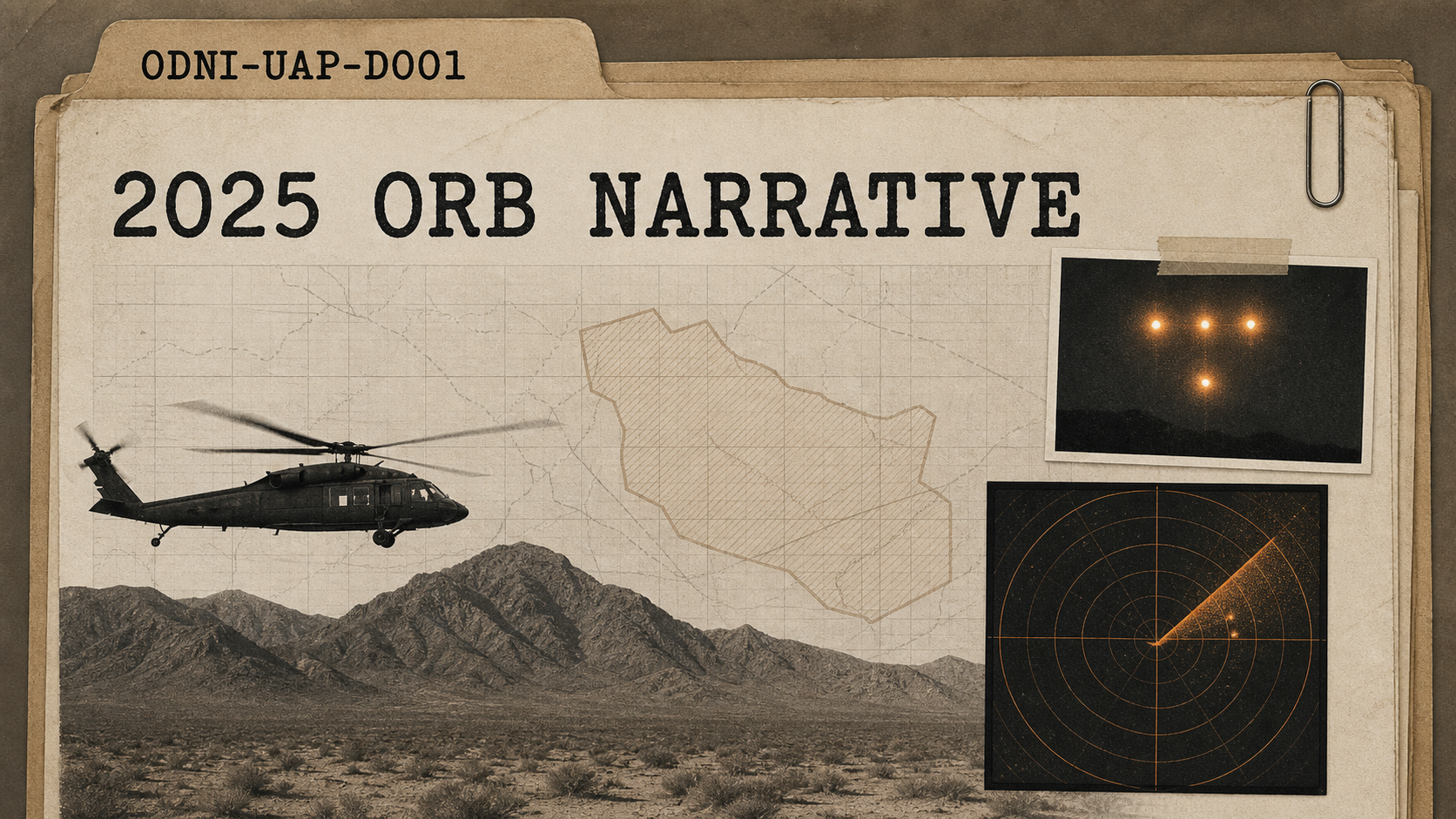
The two-page file
ODNI-UAP-D001 is a two-page narrative by a senior U.S. intelligence officer describing a late-2025 helicopter mission on a test range. The account includes loud thuds in nearby mountains, prior UAP reports from recent nights, ground-team FLIR observations, radar tasking from a Joint Operations Center, helicopter crew sightings through NVG and unaided sight, and orange orbs seen near both the helicopter and fighter jets.
One narrative, several observation channels, and a military test-range setting, all in two pages.
What the mission was
According to the narrative, the officer, a colleague, and two pilots departed a Joint Operations Center in a helicopter during daylight in late 2025. Their initial mission was practical: investigate loud thuds heard in mountains on the test range and look for debris or objects that might explain recent orb-like sightings.
The crew flew low through the mountain range for several hours. They inspected debris more than once and identified it as remnants from rockets and other projectiles left by years of weapons testing on the range.
The report opens on a mundane control point: some objects were ordinary range debris.
The first turn
The mission shifted after the Joint Operations Center tasked the helicopter toward radar detections in the same area where prior UAP activity had been reported.
Ground teams reported a low, hot object on FLIR: moving fast, changing direction, and splitting into two. The helicopter crew searched using NVG, FLIR, and unaided sight.
One object rose from the ground, approached within roughly ten feet of the helicopter, dropped below it, and sped away. The pilots saw it through NVGs and watched a smaller object emerge before the main object accelerated out of sight.
The close orb episode
The helicopter later took up a hover at about 700 feet above ground level. The crew saw numerous orange orbs against the mountain backdrop.
After another radar-directed intercept, two larger orange-white orbs appeared near the helicopter: stationary, just above rotor-disk height to the right. A third orb flared below the pair, then a fourth below that, forming a brief T-shaped arrangement.
The formation held for 10 to 15 seconds before dimming in reverse order. The crew considered landing because of the objects' proximity, then stayed on station to keep watching.
The fighter-jet portion
Fighter jets entered visual range during the same episode. The officer reports similar orange orbs appearing above the fighters, flaring one at a time in a horizontal formation, matching the jets' speed and flight path, then dimming and disappearing.
This repeated several times as the jets transited the airspace and eventually landed. The officer then reports more orange orbs flaring around the helicopter and briefly forming a triangle before vanishing.
What sets this case apart
ODNI-UAP-D001 is not a typical witness anecdote. Four details set it apart:
- The reported witness is a senior U.S. intelligence officer.
- The setting is an active test range, not a casual civilian viewing location.
- The narrative covers multiple observation channels: radar tasking, ground-team FLIR, NVG, and unaided sight.
- The event reportedly involved more than one aircraft and more than one observer group.
Those details do not prove what the objects were. They make the file more useful than a typical sighting post.
What the file gives us
The public file lays out a clear sequence:
- a test-range search mission after unusual reports;
- ordinary debris found and identified as range material;
- radar tasking from the Joint Operations Center;
- ground-team FLIR reports;
- helicopter crew observation through NVG and unaided sight;
- a close orange-orb formation near the helicopter;
- a later fighter-jet portion described by the same officer.
That is why ODNI-UAP-D001 gets its own note here rather than being folded into a release summary.
What is still missing
The released file currently provides a first-person operational narrative. It does not publish the radar tracks, FLIR clips, NVG imagery, cockpit video, exact coordinates, aircraft identifiers, range logs, or debrief packet.
The visible public identifier is ODNI-UAP-D001. No separate case number appears in the released two-page narrative.
That leaves a narrative lead, not the full evidence package.
The officer also states that no photos were taken during the close encounter, because attention stayed on assessing the situation and whether it posed a threat.
Sources
- PURSUE UAP portal, accessed May 22, 2026.
- Department of War: second PURSUE UAP file release announcement, published May 22, 2026.
- PURSUE Release 02 document bundle, ODNI-UAP-D001_USPER_Narrative_Senior_USIC.pdf, downloaded May 22, 2026.