News / Jul 10, 2026
Wilbert Smith put UFOs in a Canadian memo
Wilbert Smith wrote one of the bluntest Cold War UFO memos in any Western archive. It is also a clean window into a real, brief, official Canadian UFO project that almost nobody outside Canada remembers.
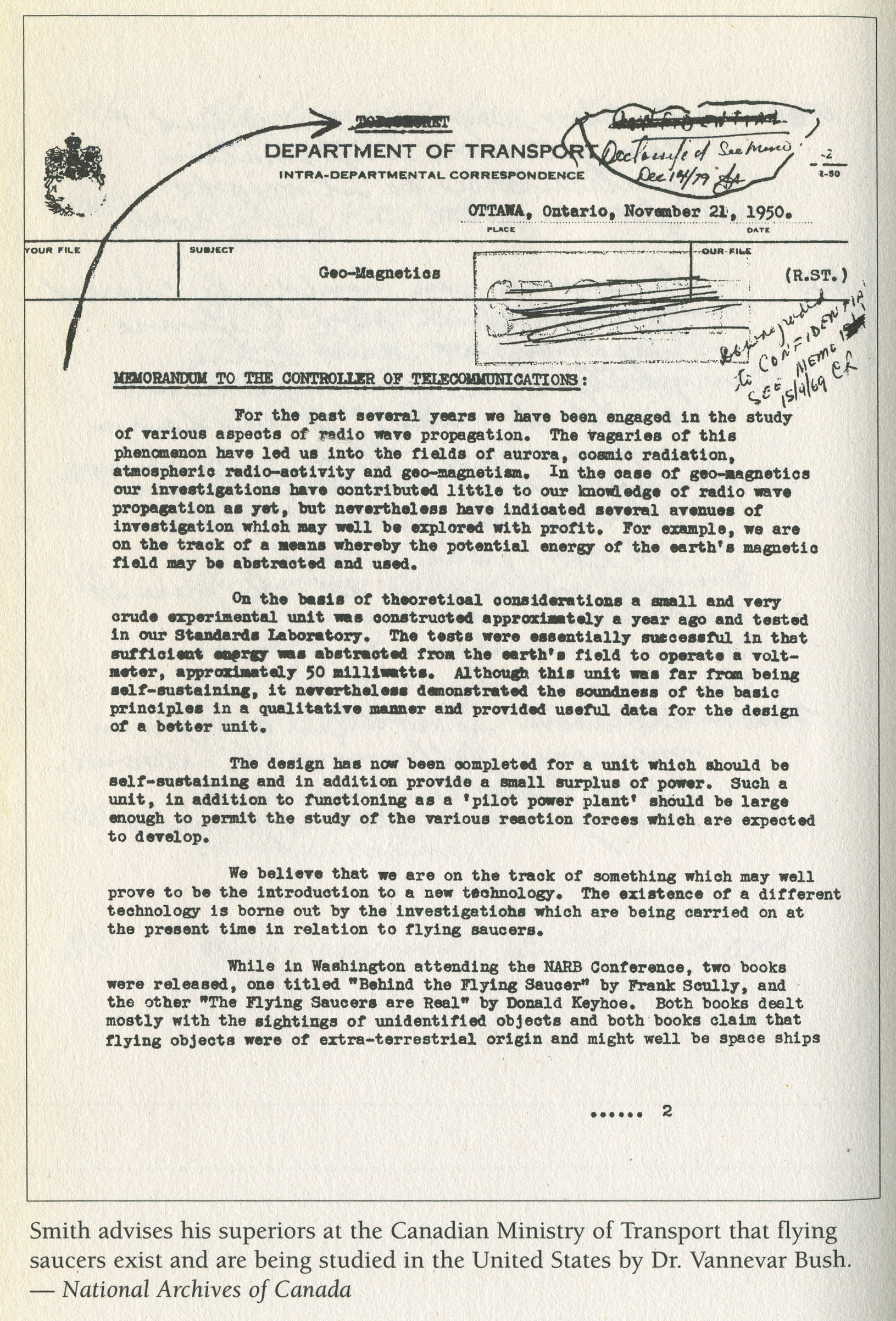
On 21 November 1950, a senior radio engineer in the Canadian Department of Transport put four sentences in a memo to his superior that would keep UFO researchers arguing about them for the next seventy-five years.
Wilbert Brockhouse Smith, the engineer, wrote a short, classified note asking permission to set up a small project inside the Department's Broadcast and Measurements Section. His reason: an American physicist had told him the United States government classified flying saucers higher than the hydrogen bomb.
The memo ran two pages. The first, the one usually circulated, lays out Smith's geomagnetic work. The famous four-point block sits further down — the American had told him flying saucers exist, that a small group led by Dr. Vannevar Bush was working on the problem, and that the subject was "the most highly classified subject in the United States Government."
Two weeks later, on 2 December 1950, Commander C.P. Edwards, Deputy Minister of Transport for Air Services, approved Smith's proposal. The project was called Magnet. It had a name, a desk, instruments, a report, and eventually a shut-down date — the first official Canadian government UFO study, and a real one in the unglamorous sense.
The memo itself
The memo sits on Department of Transport letterhead, marked "Geo-Magnetics" as subject, addressed to the Controller of Telecommunications. It opens with Smith's standing work on radio propagation, the aurora, cosmic radiation, and geomagnetism, and only then turns to the UFO angle. It reads like a technical note that wandered into a different subject.
The four-point block is short enough to reproduce in full:
a. The matter is the most highly classified subject in the United States Government, rating higher even than the H-bomb.
b. Flying saucers exist.
c. Their modus operandi is unknown but concentrated effort is being made by a small group headed by Doctor Vannevar Bush.
d. The entire matter is considered by the United States authorities to be of tremendous significance.
The original is held at Library and Archives Canada. The handwritten declassification stamp reads "Declassified" with a December 1969 date — the year the memo dropped from Top Secret to Confidential.
Where the four points came from
The memo cites two books Smith picked up at the 1950 NARBA conference in Washington: Frank Scully's Behind the Flying Saucers and Donald Keyhoe's The Flying Saucers Are Real. Both claimed an extraterrestrial origin. Smith wanted to know how much of Scully's version was true.
The four points didn't come from the books. They came from a 15 September 1950 meeting in Washington, arranged through the Canadian embassy, with Dr. Robert I. Sarbacher, then President of the Washington Institute of Technology and a former Manhattan Project scientist. The handwritten transcript survives in the Grant Cameron / Arthur Bray archives:
WBS: Then the saucers do exist?
RIS: Yes they exist.
WBS: Do they come from some other planet?
RIS: All we know is, we didn't make them, and it's pretty certain they didn't originate on the earth.
WBS: I understand the whole subject of saucers is classified.
RIS: Yes, it is classified two points higher even than the H-bomb. In fact it is the most highly classified subject in the US Government at the present time.
Sarbacher doesn't name Vannevar Bush in that transcript. He doesn't claim to have personally seen a saucer either. He speaks as someone with knowledge of an American program, not as someone reciting a briefing document. Smith's memo, written two months later, adds the Bush detail and tightens Sarbacher's conversational tone into something closer to a finding.
Sarbacher himself resurfaced decades later, in interviews conducted in the 1980s, and stuck to a similar story — he said he'd heard of a project involving Bush along with John von Neumann and Robert Oppenheimer, and that he'd been invited to related Air Force briefings. He never produced documentation. That's worth noting alongside the memo, because it means the Bush claim isn't purely Smith's invention — it's an unverified claim Sarbacher kept repeating for over thirty years, just never with paperwork attached.
The interview transcript and the memo tell slightly different stories. Reading them side by side is useful precisely because of that gap.
What Project Magnet actually was
Project Magnet ran from 2 December 1950 to mid-1954, with Smith at the centre. It sat formally inside the Department of Transport, not as a separately funded program — Smith got permission to use DoT facilities and equipment, and did much of the work on his own time.
The team was small: Dr. James Watt of the Defence Research Board, John Thompson of the Department of Transport, Prof. J.T. Wilson of the University of Toronto, and Dr. G.D. Garland of the Dominion Observatory. The project also had backing from Dr. Omond Solandt, head of the Defence Research Board, who had agreed — according to Smith's own memo — that the work should proceed quickly, with full DRB cooperation. That mattered later, because it meant Magnet wasn't just one engineer's side project; it had a senior official's sign-off from the start.
In April 1952, Canada also stood up a parallel effort called Project Second Storey — a standing group of scientists and military officers who met periodically to weigh the UFO question and recommend government action. Smith briefed Second Storey on some of Magnet's findings, which means Canada was running two connected UFO channels at once, not just one lone engineer's initiative.
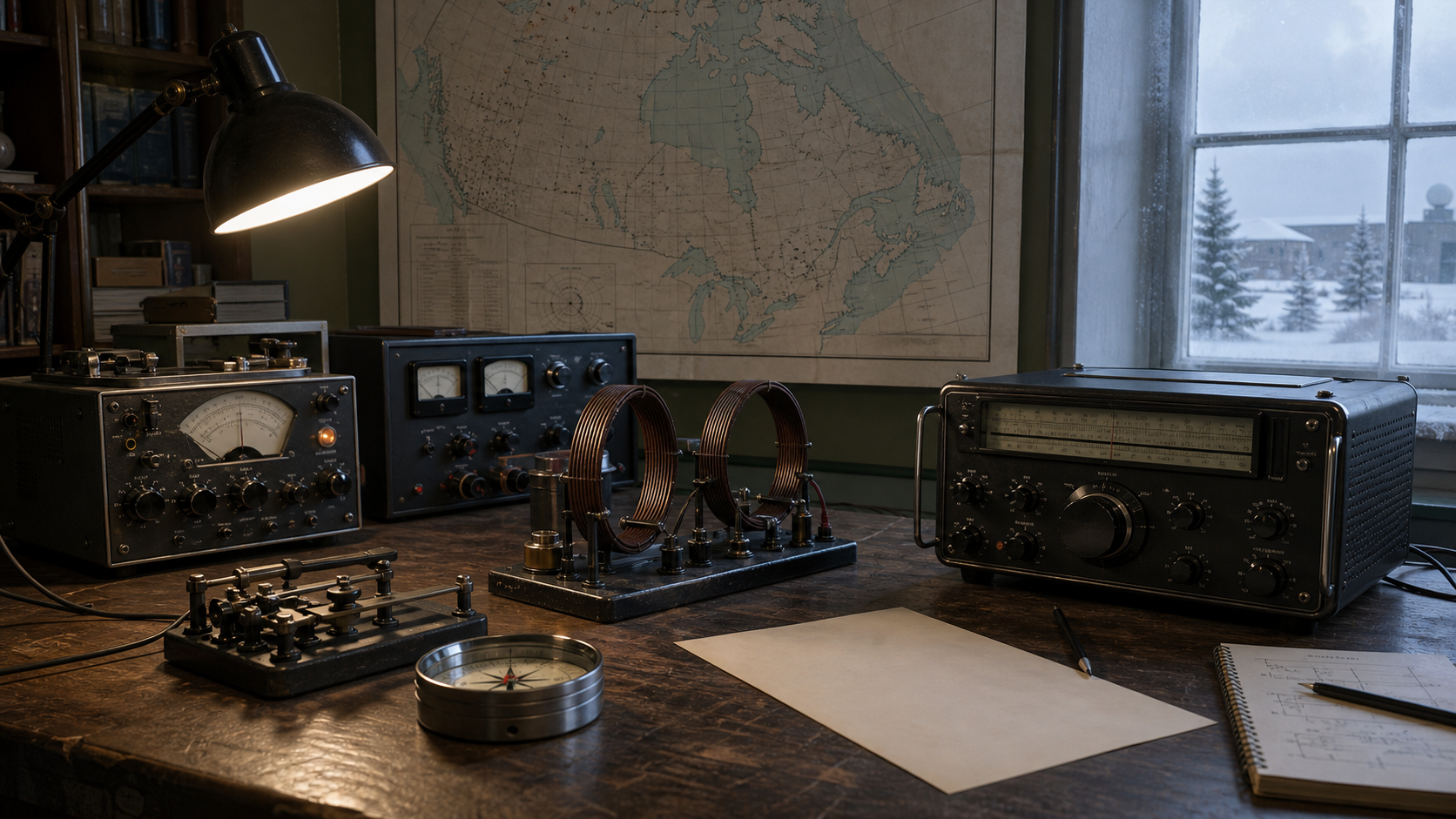
In October 1952, Smith set up the better-known piece: a small UFO detection observatory at Shirley's Bay, west of Ottawa, on a restricted military site. Contemporary press described it as "a complicated jumble of electronic gear" — a magnetometer, a gamma-ray detector, a radio receiver, a gravimeter, and recording equipment, all built on the assumption that a real flying saucer would leave an electromagnetic, gravitational, or radioactive trace.
Late in 1952, the team ran a deliberate test: they released a weather balloon rigged with a bright magnesium flare, to see whether the public or the press would report it as a UFO. Nobody did — a small, concrete data point suggesting at least some of the "unexplained lights" circulating at the time had mundane explanations, even if this particular test never fully clarified what all the other reports were.
The Ottawa Journal covered the observatory on 11 November 1953. After that, press pressure on the Department of Transport grew, and official patience thinned.
What the Project Magnet reports actually said
Magnet produced more than one written conclusion — a preliminary report in June 1952, another later that year, and a further one in 1953 — all reaching similar territory. The best-known version, held at Library and Archives Canada, is the report that gave the project its public afterlife, because its conclusions are easy to quote out of context.
Smith's own summary:
"[I]t is difficult to reconcile this performance with the capabilities of our technologies, and unless the technology of some terrestrial nation is much more advanced than is generally known, we are forced to the conclusion that the vehicles are probably extra-terrestrial, in spite of our prejudices to the contrary."
And the recommended next step:
"[T]he next step in this investigation should be a substantial effort towards the acquisition of as much as possible of this technology, which would without doubt be of great value to us."
Read cold, this is a 1952 internal engineering note doing what internal engineering notes do: hypothesis, instrument readings, gaps, next steps. Read as a UFO document, it's one of the few official Cold War files that puts an extraterrestrial hypothesis directly into its conclusions, with the engineer's own signature underneath. The bold conclusion survived in later retellings; the underlying data mostly didn't.
How it ended
By 1954, the Department of Transport had run out of patience. The project was terminated in June. The Department's public statement, on 10 August 1954, acknowledged "considerable data had been collected" but said "no definite conclusions had been reached."
On 17 May 1955, Smith told the Canadian House of Commons' Special Committee on Broadcasting that no UFOs had been detected at Shirley's Bay — a statement that sits oddly next to his own 1952 report. It reads more sensibly as a government witness giving a public, institutionally cautious answer than as a private retraction.
Smith kept the Shirley's Bay equipment on his own account and used it until he died of cancer on 27 December 1962. The government didn't extend funding. The project was never reopened.
What survives in the archive
Smith's papers went to his widow, then to retired Canadian military pilot Arthur Bray, who held them privately for two decades before donating the collection to the University of Ottawa in the 1990s. The Arthur Bray Fonds now holds Project Magnet correspondence, the original reports, instrument notes, and photographs of Shirley's Bay (file series F8 and F9).
Grant Cameron's 2003 CD-ROM release added roughly a thousand pages of additional Smith documents to the public record. David Crawford's 2008 book 38 Messages from Space is built from those scans.
Smith left a stranger trail too. After the official project ended, he kept writing for Topside, the newsletter of the Ottawa New Sciences Club he'd founded. Those pieces were collected posthumously in 1969 as The Boys from Topside, published by Saucerian Books — the same small press behind several early contactee-era UFO titles. By the end of his life, Smith believed he was in telepathic contact with extraterrestrials and had been building an anti-gravity device, which he disassembled shortly before his death, telling his wife the world wasn't ready for it.
Most retellings skip that second half. The 1950 memo is a clean, brief, official Canadian document. What Smith became in the 1960s is a private, much stranger story, and the two don't read the same way.
What the public record does and doesn't support
Project Magnet was real: a Department of Transport line, a small staff, instruments, multiple reports, a 1954 shutdown, and a publicly archived paper trail at Library and Archives Canada and the University of Ottawa. On those points the file holds up.
What it doesn't support:
- That Vannevar Bush actually led a US flying-saucer program. Smith attributed the claim to Sarbacher, who repeated it for decades without ever producing documentation. No declassified US program has surfaced matching that structure.
- That any Shirley's Bay instrument recorded a confirmed UAP trace. The 1955 Commons testimony says nothing was detected; the underlying instrument logs behind the 1952 report have not been republished.
- That the four-point block is a US government finding. It's a Canadian engineer's write-up of what one American physicist told him in an undocumented conversation, reconstructed from memory afterward.
The 1950 memo is worth reading for exactly what it is: a short, plain, classified-until-1969 note from one government radio engineer to his boss, asking to study something the Americans wouldn't discuss. That's already a useful piece of UAP history on its own. Everything added on top of it came later, from people who liked the memo more than they liked the interview it was based on.
Why Smith still matters for the file
Smith is the earliest clean international hook for the post-1947 UAP story. France had GEIPAN from 1977, the UK had the Flying Saucer Working Party in 1950–51, Brazil had Operação Prato in 1977. Canada had Project Magnet — and Second Storey alongside it — starting in 1950.
It's also one of the few cases where a researcher, a project, a memo, multiple reports, instruments, an observatory, a press cycle, a shutdown, an archive donation, and a posthumous book all live on the public record at once. That combination is rare enough to keep him on the working list.
The shape of the story repeats, too: a government engineer, a foreign physicist, a classified memo, a small instrumented station, a media leak, an internal review, a quiet termination, a long archive afterlife. Most of the post-2017 UAP story runs on the same ingredients, just in different proportions.
Sources
- Library and Archives Canada: Canada's UFOs
- Library and Archives Canada: UFO records database
- Library and Archives Canada: Project Magnet Report (PDF)
- Wikipedia: Project Magnet (Canada)
- Wikipedia: Wilbert Brockhouse Smith
- Wikipedia: Project Second Storey
- University of Ottawa Archives: Arthur Bray Fonds, Project Magnet
- Literary Review of Canada, Hayes, "Eyes Like Saucers," July 2022
- Hayes, "A History of Canada's UFO Investigation, 1950-1995," Trent University dissertation
- HowStuffWorks/History.com: "Robert Sarbacher Confirms UFO Crash Rumors"
- Mysteries of Canada: Project Magnet, Wilbert Smith
- Canada UFO History: Project Magnet