Short Note / Jun 15, 2026
FBI-UAP-D011: The pastor who sent Hoover four beams over the Cascades
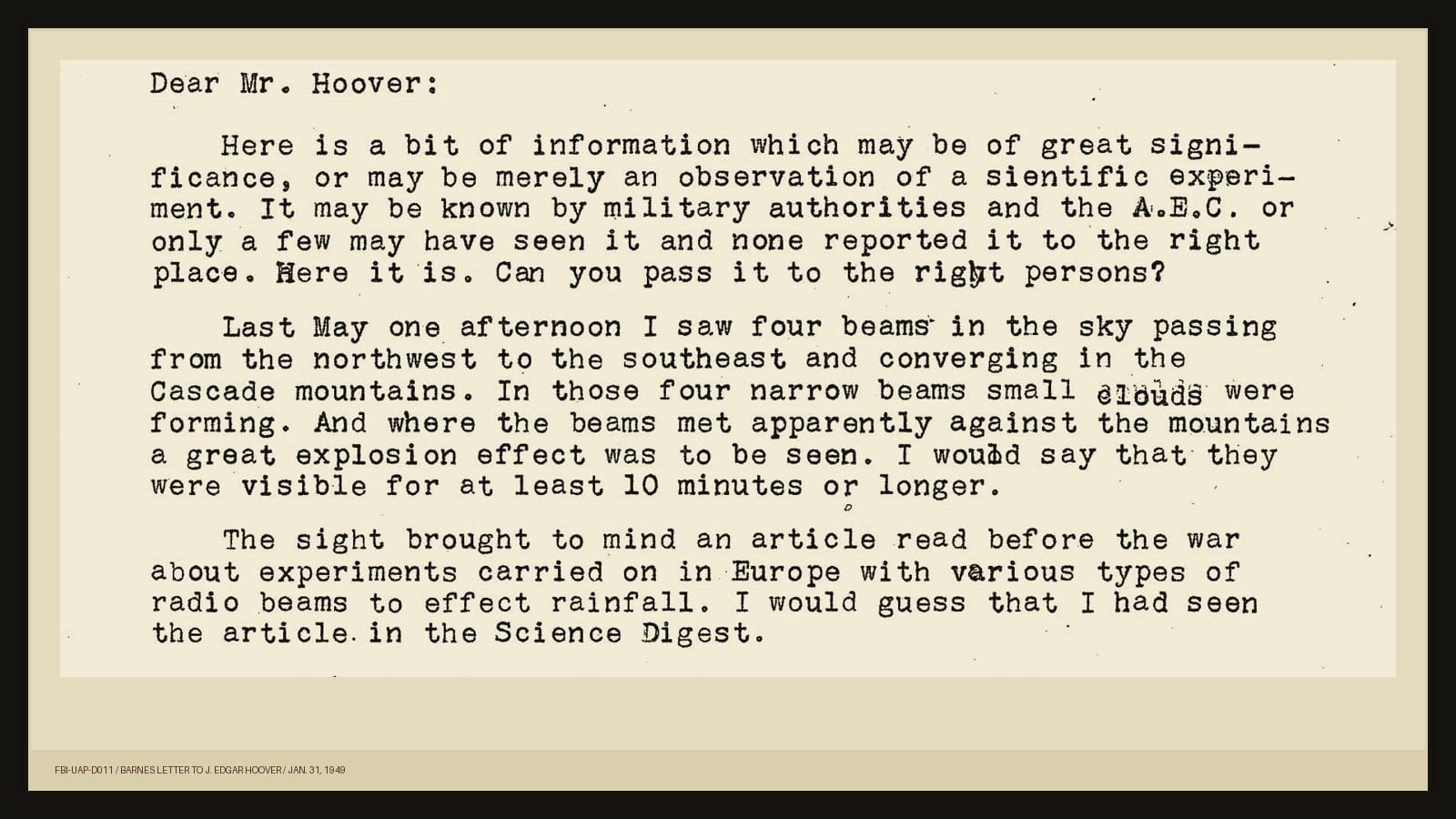
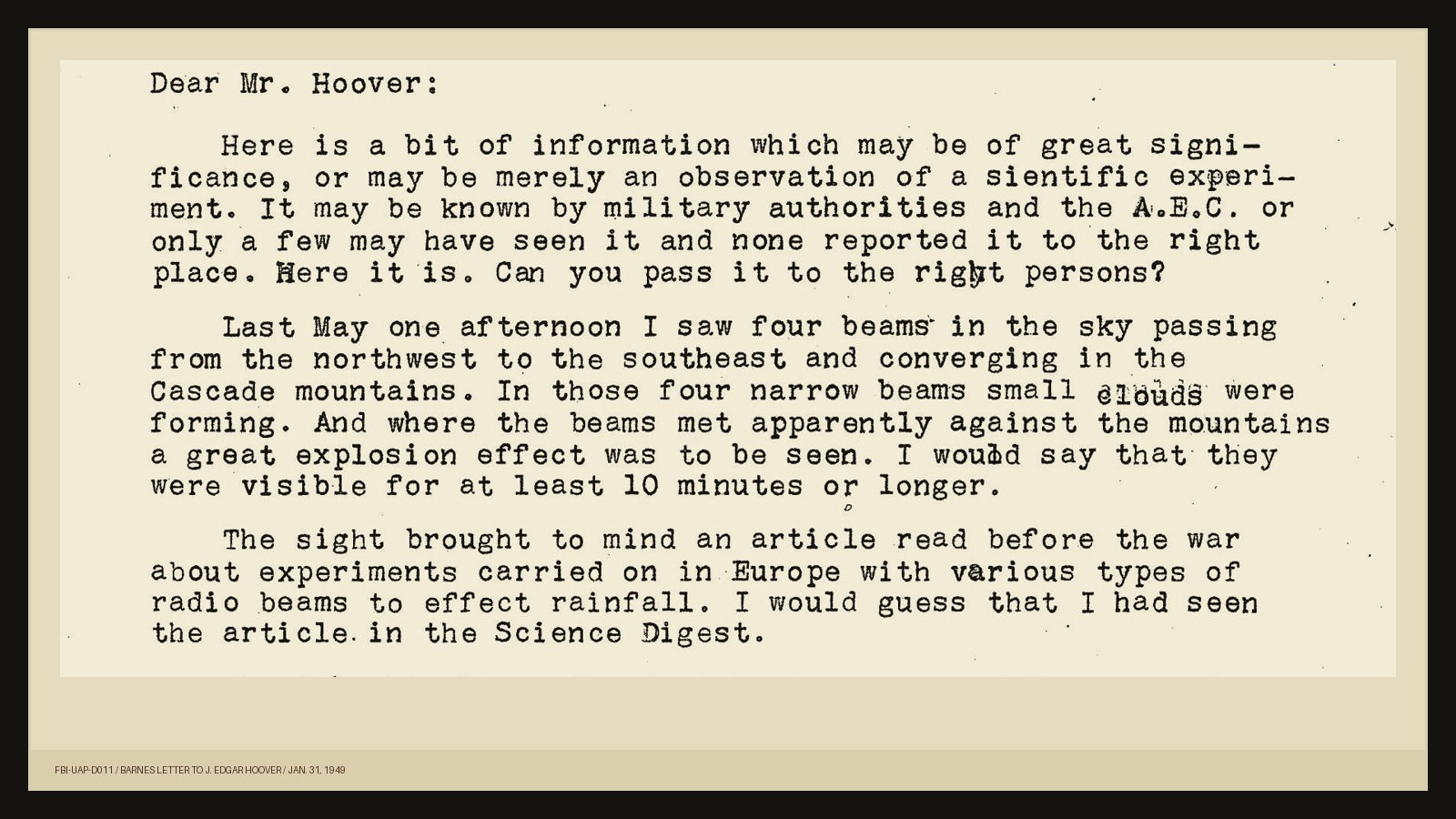
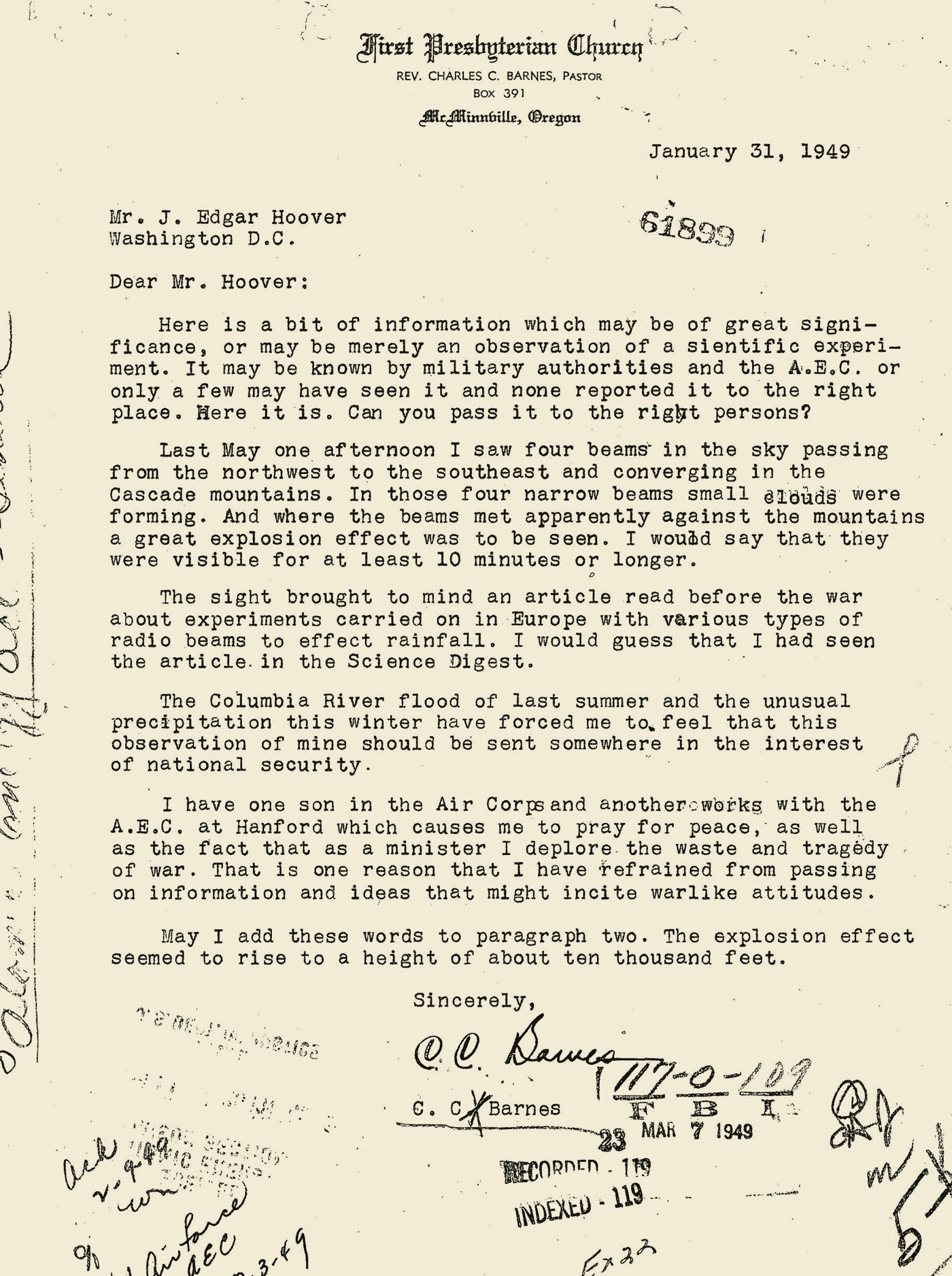
A 1949 FBI file in PURSUE Release 03 starts with a pastor writing to J. Edgar Hoover about four beams over the Cascade Mountains, small clouds forming in the beams, and an explosion-like effect where they met.
An Oregon pastor wrote directly to J. Edgar Hoover in January 1949 with a strange sky report, and the FBI moved it along.
Rev. Charles C. Barnes had seen something he could not easily explain: four narrow beams of light stretching across the Cascade Mountains, small clouds forming inside them, and a powerful explosion-like effect where the beams converged. The whole thing hung in the sky for at least 10 minutes.
The file is FBI-UAP-D011, released June 12, 2026, as part of PURSUE Release 03. It is only a few pages, but it captures the uneasy mood of 1949: flying saucers in the headlines, Cold War tension, and atomic projects just up the river.
What the pastor saw
Barnes said the sighting happened one afternoon the previous May. Four beams moved from northwest to southeast, meeting over the mountains. In the beams, small clouds were visibly forming. At the point of convergence, he described "a great explosion effect" that seemed to rise as high as 10,000 feet.
He did not immediately jump to flying saucers. His first thought went back to an old article he had read about pre-war European experiments using radio beams to influence rainfall.
Why he contacted Hoover
Barnes was not writing just to share a curious sight. He linked the event to the Columbia River flood the summer before and unusual winter rains. In the interest of "national security," he felt the information should reach the right people.
He had skin in the game, too. One son was in the Air Corps. Another worked at the Atomic Energy Commission's Hanford site. That personal connection made him both more observant and more cautious about feeding any war hysteria.
Hoover's response
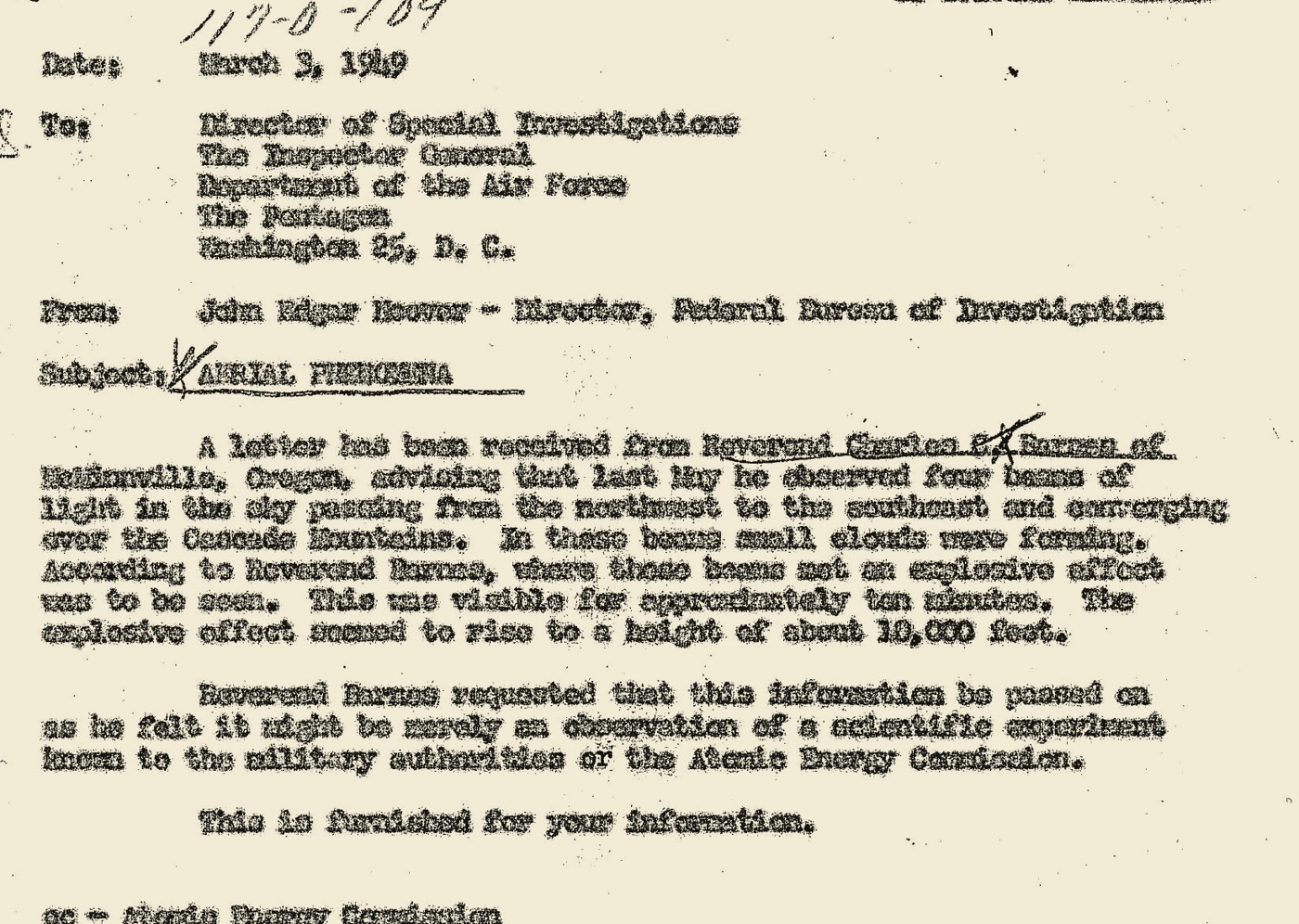
Hoover replied on Feb. 9, thanking Barnes for the letter. A few weeks later, on March 3, the FBI forwarded the report to the Atomic Energy Commission.
The memo summarized the report as "aerial phenomena" and noted that Barnes believed it might be some kind of known scientific or military experiment.
The file ends there. No reply from the AEC, no investigation summary, no photos, no weather data. Just the paper trail: pastor to Hoover, Hoover to AEC.
Why this quiet file stands out
In a release full of orb videos and dramatic cases, FBI-UAP-D011 is pure paperwork. That is exactly why it feels useful.
It shows how ordinary citizens, even ministers, were scanning the sky in 1949 and wondering whether what they saw was nature, a secret American project, or something potentially threatening.
The language in Barnes's letter is precise and vivid: four beams, clouds forming inside them, the explosion effect. You can picture a man standing outside, looking up, and deciding this was important enough to write the director of the FBI.
It is a small window into a moment when "flying saucers" were new, the atomic age was young, and strange things in the sky could still get routed straight to the top.
Related UAP Logbook notes
- PURSUE Release 03: CIA files, FBI orbs, and a 1949 flying saucer study
- The 1949 Army flying saucer study asked the Russia question
- The 1949 Kodiak UFO case in the Navy file
- AARO and PURSUE UAP files topic hub
Sources
- FBI-UAP-D011: D/FBI Correspondence Referral, 1949, released in PURSUE Release 03.
- PURSUE Release 03 data CSV.