News / Jun 12, 2026
The old paintings that keep turning into UFO evidence
Old paintings are still shared as UFO evidence, from Madonna with Saint Giovannino to Crivelli, De Gelder, Masolino, Dečani, and Salimbeni. The image trail is stranger than the meme.
Scroll through any UFO forum and you will find them: old paintings cropped to show glowing disks, mysterious beams, and little figures that look like pilots in capsules.
The images travel fast across YouTube, Reddit, search results, and social media. The context almost never moves as quickly.
Most of the standard explanations are not exotic. But the modern UAP conversation keeps pulling these pictures back because old images carry a powerful message: this story has always been here.
Here is what the most-shared paintings actually show, and what gets cut out before the screenshot starts moving.
The Madonna with the "UFO"
The most famous example is a painting commonly called the Madonna with Saint Giovannino. Online, it has a better nickname: the Madonna dell'UFO.
The hook is easy to see. Behind the Virgin Mary, high in the right-hand sky, a small dark oval appears to hang over the landscape. Lower down, a background figure seems to look toward the same sky.
Crop tightly enough, and the scene reads like a witness report: object in the sky, observer on the ground, something happening above the landscape.
That is why it travels.
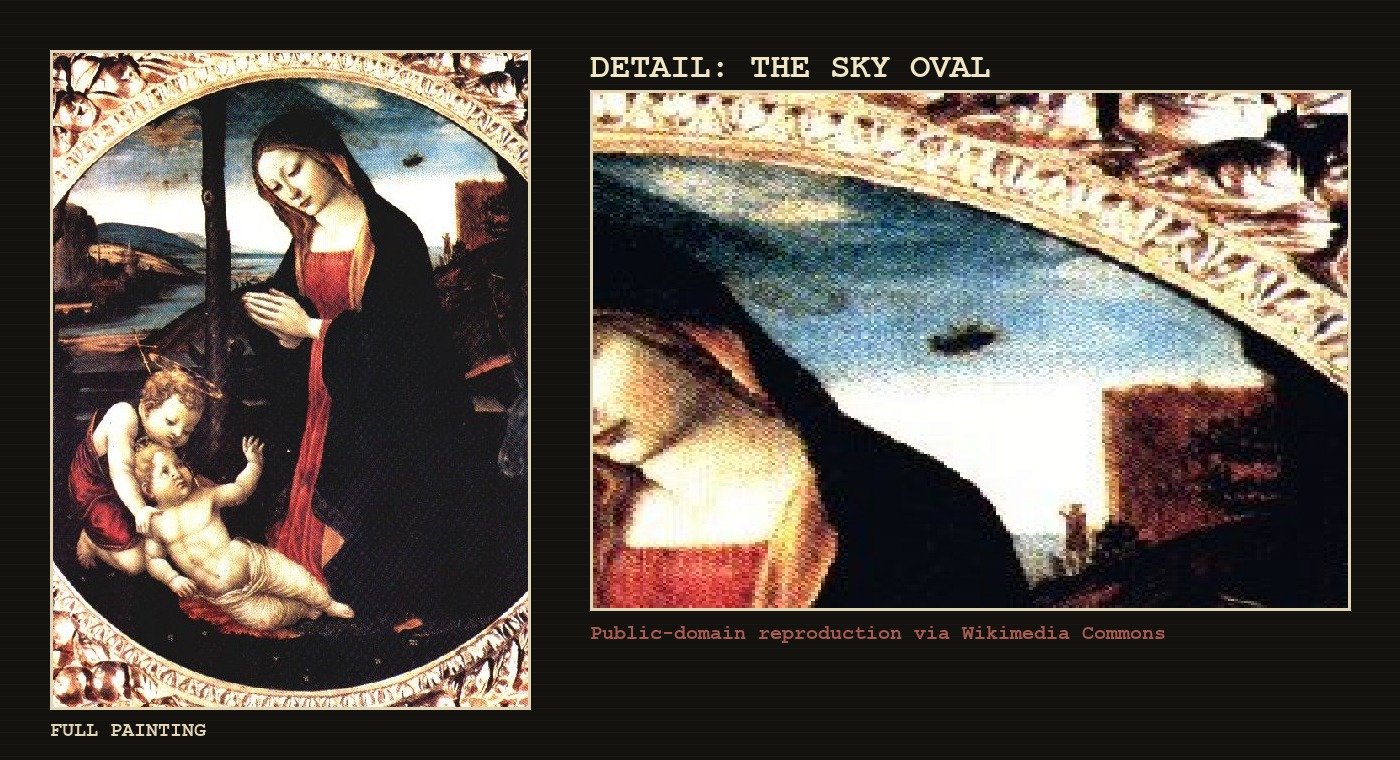
The painting's source trail is less clean than the meme. It is usually linked to the Loeser Collection in Florence's Palazzo Vecchio and attributed online to Domenico Ghirlandaio or his circle. Other attributions circulate too.
The conventional art-history reading is less dramatic: a background figure reacts to a heavenly sign. In devotional painting, people in the background regularly look toward angels, divine light, clouds, or signs that carry the story forward.
The oval is small and oddly dark. But the UFO label is doing most of the work.
Crivelli's beam
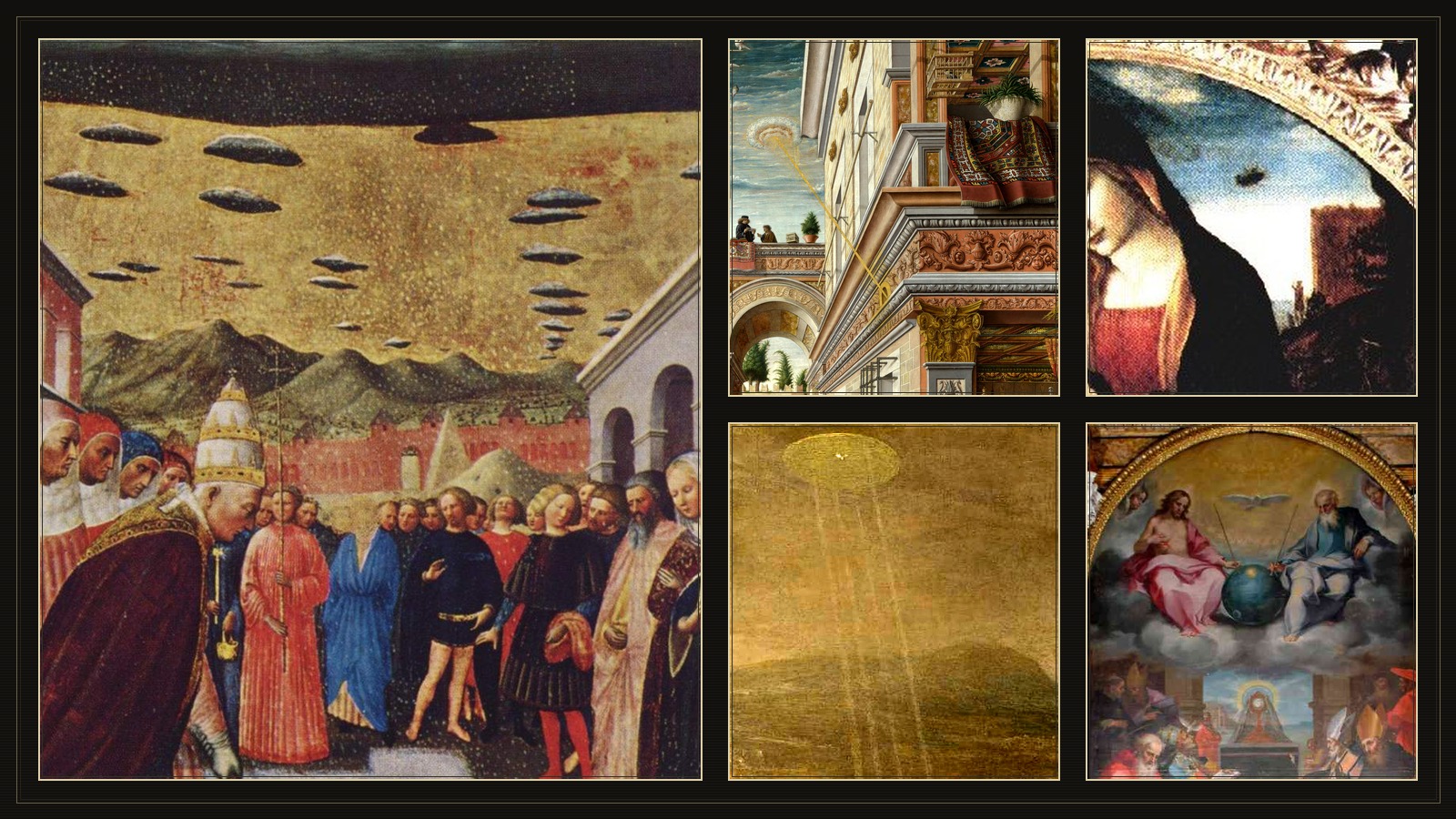
Carlo Crivelli's The Annunciation, with Saint Emidius is the cleaner museum case.
The National Gallery in London dates it to 1486 and identifies the subject plainly: the Annunciation. Mary is inside a room. The angel is outside. A line of light enters the scene from the sky and reaches her.
In the UFO version, the cloud above the street becomes an object. The beam becomes technology.
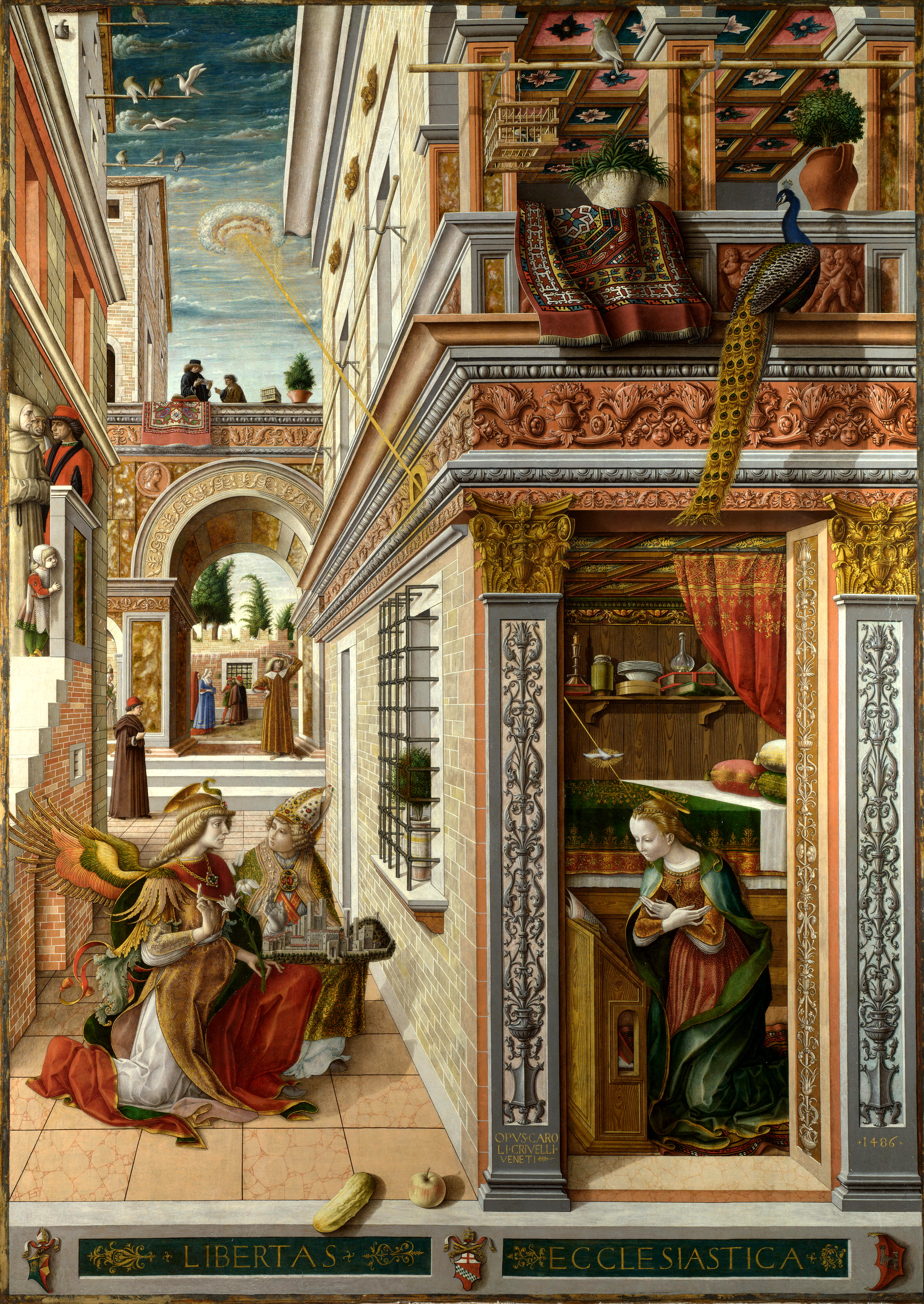
The full painting changes the crop fast. There are peacocks, architecture, saints, civic symbolism, and the dove of the Holy Spirit riding the beam. The light is not a background detail. It is the engine of the scene.
Crivelli's painting is still useful. It shows how a religious symbol can become a machine once the visual grammar around it is removed.
The baptism disk
Aert de Gelder's Baptism of Christ, painted around 1710, may be the most saucer-shaped image in the set.
At the top of the image, a circular glow opens above the landscape. Beams come down toward the baptism below. The Fitzwilliam Museum identifies the subject as Christ's baptism by John the Baptist. Modern image metadata and UFO roundups have also given it a second life as a flying-saucer picture.
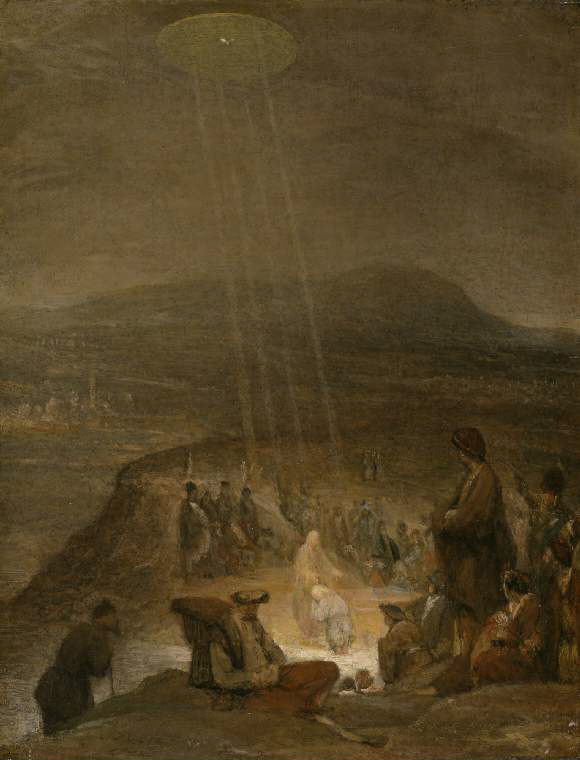
The modern eye barely has to work. A glowing disk shines beams downward. The shape is simple. The background is dark. The scene is already staged like a reveal.
But the source title does not vanish because the shape is suggestive. The light comes from heaven because the story requires heaven to open.
That is not a clue hidden in the frame. It is the frame itself.
The snow that became a fleet
Masolino da Panicale's Miracle of the Snow, also known as the Foundation of Santa Maria Maggiore, may be the strongest case in the genre.
Not because it proves anything. Because it gives UFO readers the most to work with.
The legend is strange before any UFO reading touches it. Mary appears in a dream and asks for a church. Snow falls in Rome in August. The outline of the church site is marked on the Esquiline Hill.
In Masolino's painting, the falling snow and cloud forms appear as dark, separated disks across the sky. Crop that upper half and it becomes almost irresistible: a formation of small dark objects over a city.
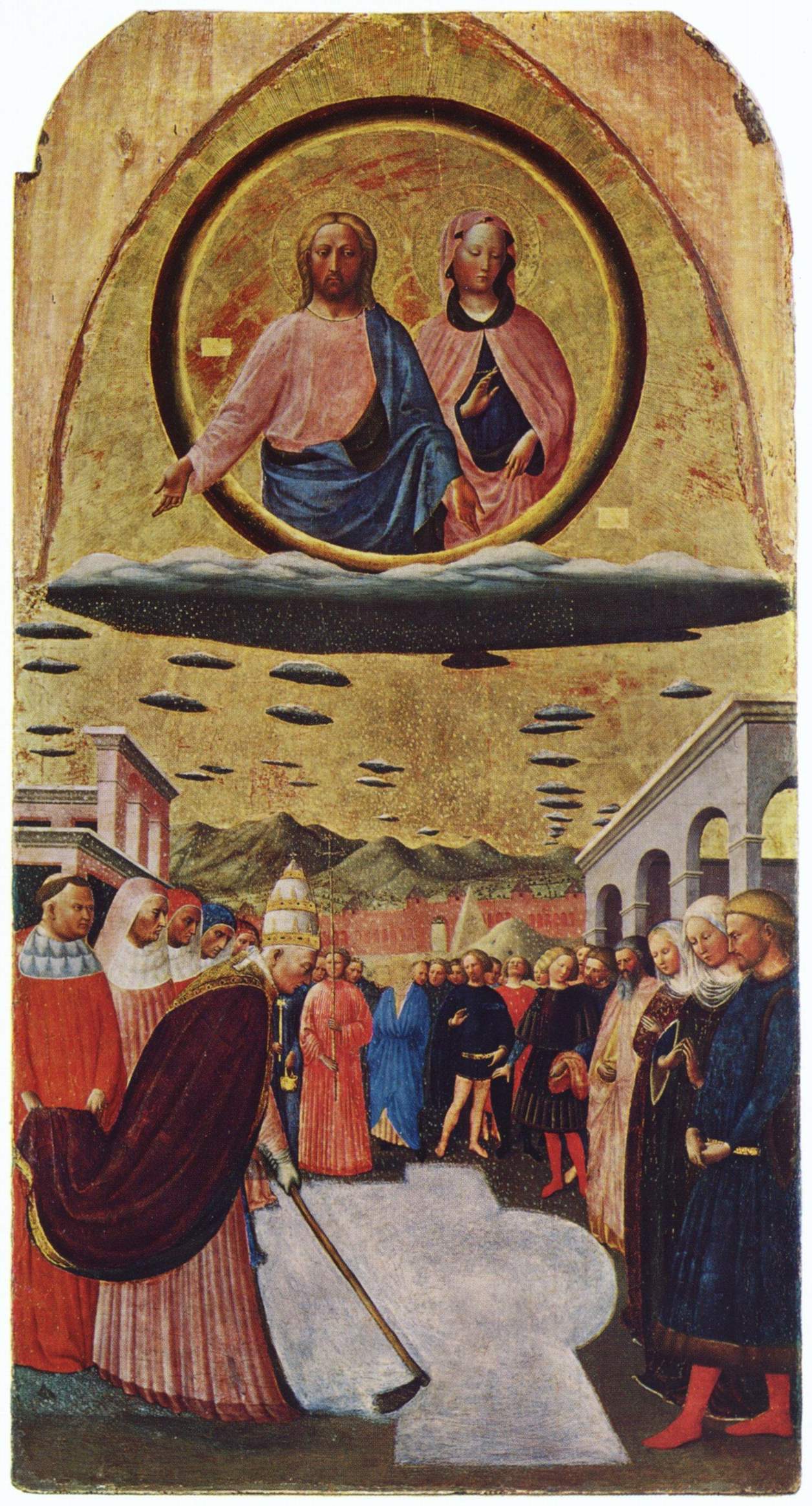
Here the old-painting genre gets slippery. The shapes are genuinely disk-like. The question is what those shapes are doing inside the story.
They are not aircraft entering the historical record. They are part of a Marian miracle image about snow, divine instruction, and the founding legend of a church.
The UFO reading works because the painting offers enough surface detail to grab. But the original story already provides an explanation sitting in the frame.
The "pilots" at Dečani
The Crucifixion fresco at Visoki Dečani monastery in Kosovo is another recurring example, and one of the few that crossed into formal UFO literature.
Two small figures appear inside bright celestial forms in the upper corners of the fresco. In tight crops, the faces look placed inside vehicles. The claim almost writes itself.
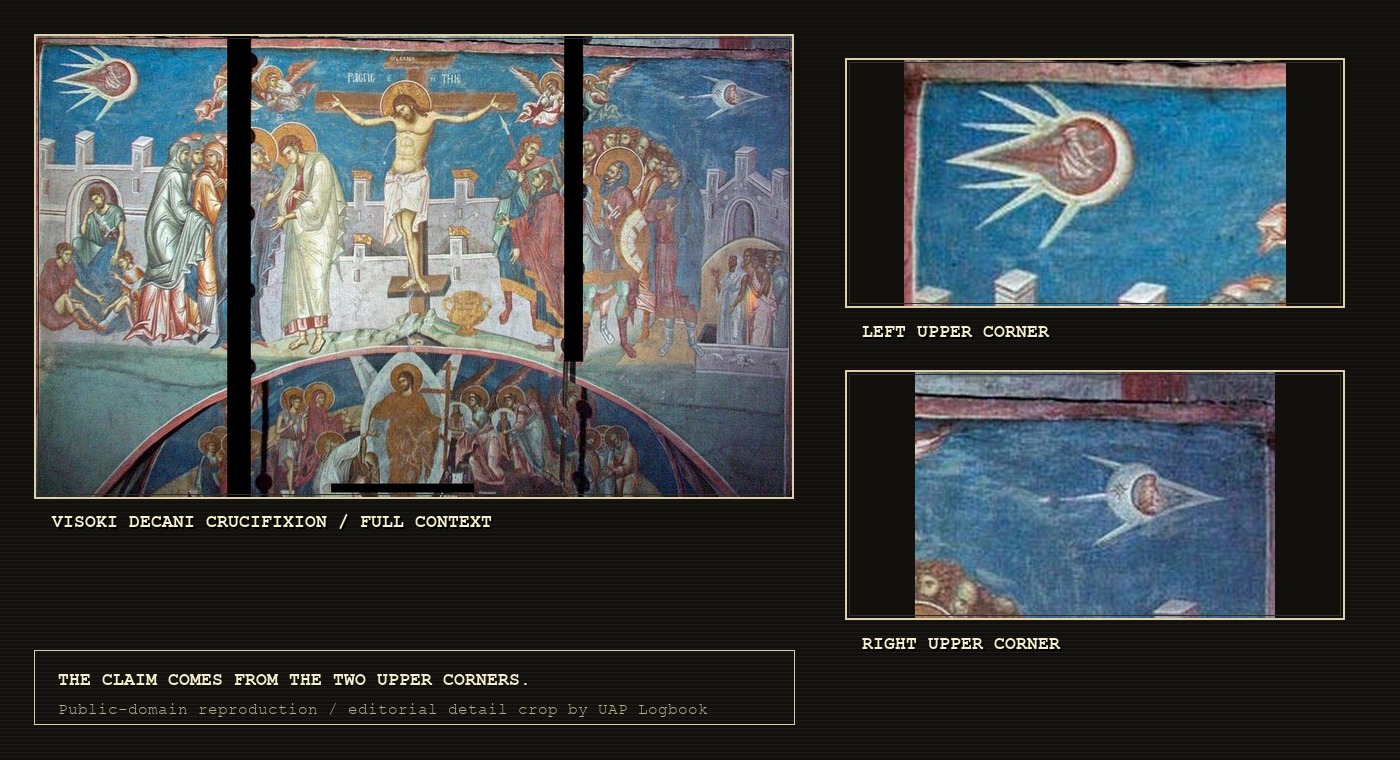
A modern UFO timeline included in the French COMETA-linked report UFOs and Defense: What Should We Prepare For? cites Dečani alongside Nuremberg and Basel as historical examples. That puts the fresco on a documented path from church wall to modern UAP file.
Art-historical work on the fresco points the other way: personifications of the Sun and Moon, part of a wider medieval visual language. The figures are not random pilots. They are the sky, painted as people.
Again, the crop changes the object.
The "Sputnik" in the church
Ventura Salimbeni's Glorification of the Eucharist does not usually get called a flying saucer. Its nickname is more specific: the Sputnik of Montalcino.
At the top of the painting, two divine figures hold rods that meet at a dark blue sphere. To a modern viewer, the object can look like an early satellite: round body, protruding rods, something technical sitting in a sacred scene.
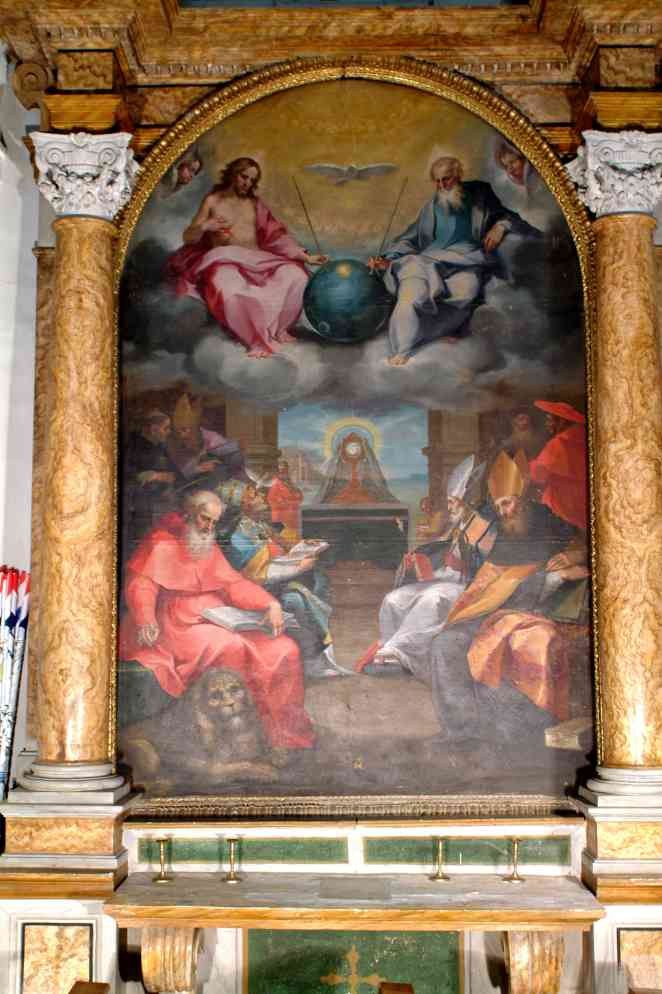
The object is a globe or celestial sphere, a visual device in Christian iconography for the cosmos under divine order. The rods are not antennas in the original language of the image.
But after Sputnik launched in 1957, a sphere with protruding rods acquired a new silhouette in the global imagination. Salimbeni did not paint a satellite. Modern technology gave his symbol a new name.
Why these images keep working
The internet loves a tight crop. Old art gives it plenty.
The crop removes the church, the saint, the room, the legend, the dove, the whole visual system that tells the viewer what the image is doing. What remains is a shape in the sky. A disk. A beam. A little body inside a glowing form.
That is enough for a UFO claim to start moving.
It also explains why these images resurface whenever the modern UAP story gets hot. Congressional testimony, declassified sensor footage, and military language are complicated. Old paintings offer something simpler: a visual shock, and the implication that the story has always been here.
Sometimes UFO literature makes that move directly. The COMETA-linked report's historical timeline mentions Dečani, Nuremberg, and Basel. UAP Logbook has already covered the 1561 Nuremberg sky battle and the 1665 Stralsund air battle. Those are not paintings; they are printed sky stories. But they belong to the same modern shelf because the images are vivid and old enough to feel like evidence from another world.
That is the pull.
Old images do not need to prove aliens to matter. They show how a culture reads the sky, and how another culture later reads the image. A cloud becomes a craft. A ray becomes a beam. A globe becomes Sputnik. A personified moon becomes a pilot.
The object changes when the crop gets smaller.
Sources
- National Gallery: Carlo Crivelli, The Annunciation, with Saint Emidius.
- National Gallery research: Crivelli's Annunciation.
- Fitzwilliam Museum: Aert de Gelder, The Baptism of Christ.
- Icons & Imagery: The Miracle of the Snow / Foundation of Santa Maria Maggiore.
- Italy Magazine: Madonna with Saint Giovannino and the UFO reading.
- Walks Inside Florence: the Palazzo Vecchio "Madonna and the UFO" story.
- Dragana Van de moortel-Ilić: examination of the Sun and Moon images in Visoki Dečani.
- UAP Logbook: the 1561 Nuremberg sky battle.
- UAP Logbook: the 1665 Stralsund air battle.