Main Article / Jul 28, 2026
The splash, the sea and the missing track: what the public underwater UAP record actually shows
A dark Navy video appears to show a sphere enter the Pacific. A Puerto Rico infrared clip seemed to show an object dive into the Atlantic. One has no released underwater track; the other is AARO's sky-lantern reconstruction, which has drawn specific technical questions from SCU.
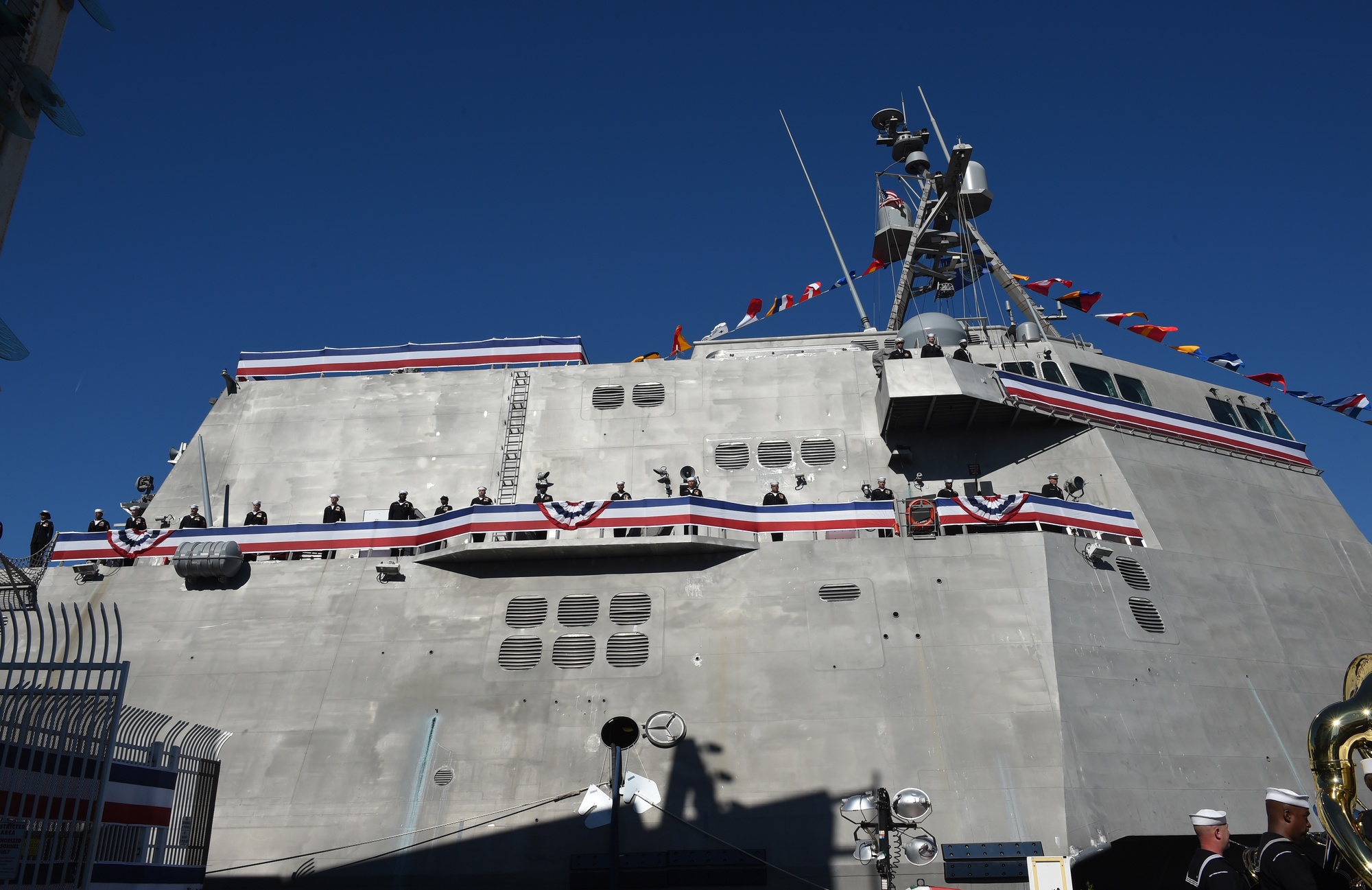
The object is a small bright shape on a black screen. It moves toward the horizon, pauses, then seems to drop into the Pacific. The clip is associated with the USS Omaha, a Navy littoral combat ship operating off California in 2019. It is the image most often used when people say the government has video of an object going from air to sea.
The public record supports part of that story. A Pentagon spokesperson told The Debrief in 2021 that Navy personnel took the video and that the UAP Task Force included it in its examinations. The Pentagon did not publicly release an assessment of the object, a sonar record, a recovery report or a continuous track below the waterline.
That distinction is where the underwater-UAP story lives. There are real military recordings, real reports near the ocean, and a government category that includes submerged and “transmedium” objects. There is not, in the material released to the public, a continuous, independently checkable record of one unidentified object being tracked from the air, through the surface and underwater.
What “transmedium” means — and what it does not
“Transmedium” is an official term, not a conclusion. AARO’s FY2023 report defines it as a source of anomalous detections that transits more than one domain. The domains include air, sea, space and water. Congress also wrote submerged and transmedium objects into the UAP definition used for the office.
The label tells analysts what kind of report they may receive. It does not certify that a particular object crossed from air to water, let alone that it did so without the drag, splash, noise or disturbance expected from known technology. To establish that claim, the record needs more than an infrared clip with ocean in the background.
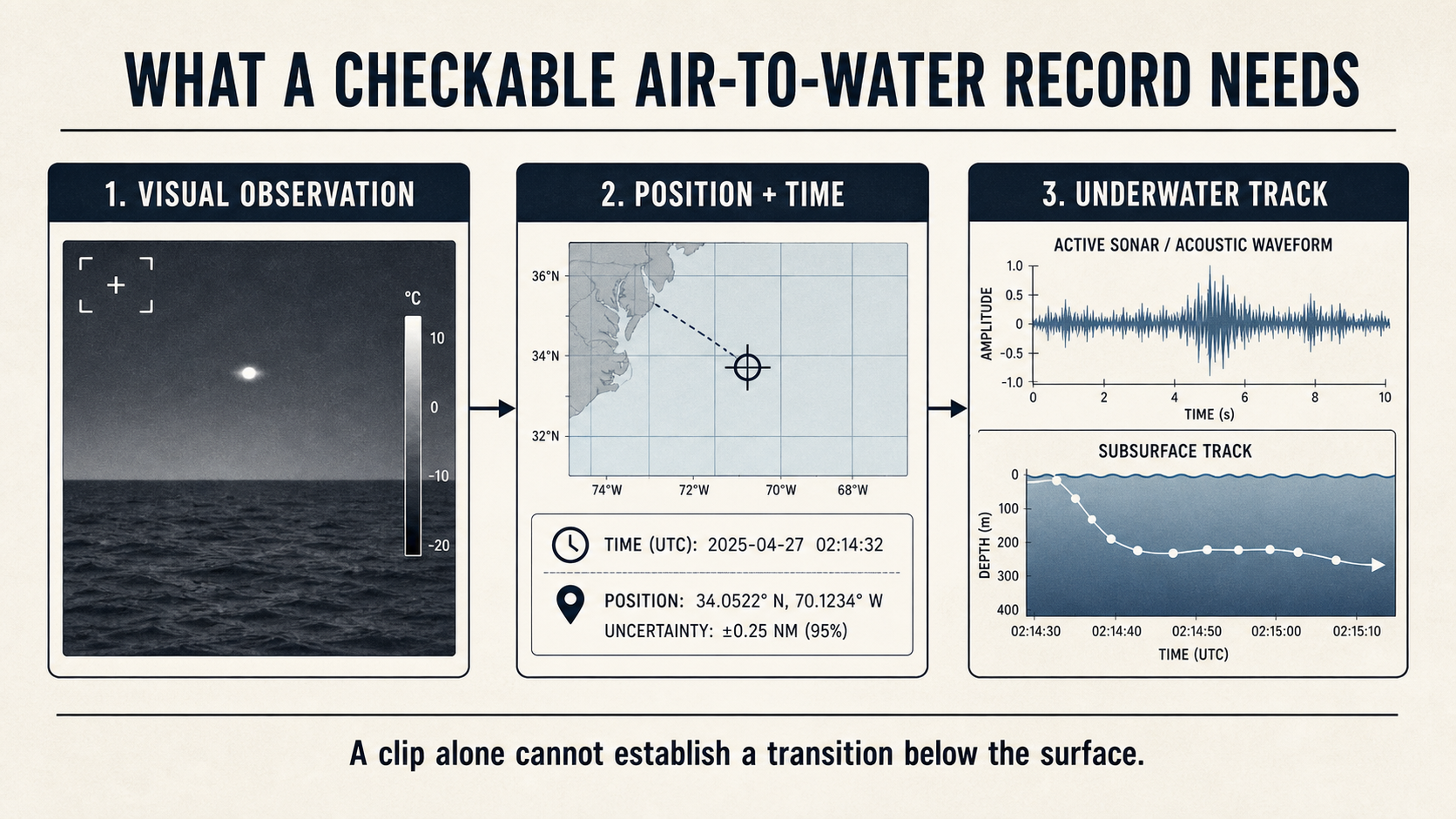
A public, checkable air-to-water record needs three things: a visual observation, position-and-time data at the waterline, and a continuing underwater track. The missing third stage is not a pedantic detail. An object can vanish from an optical or infrared sensor for ordinary reasons: a changing look angle, clouds, low thermal contrast, a camera losing lock, or the object simply leaving the field of view. Water makes the handoff harder. A credible transition claim needs the timing and geometry of the surface crossing, then an independent record below it.
Case one: USS Omaha, 2019
The Omaha clip has the strongest public provenance of the cases usually grouped under “underwater UAP.” The Pentagon confirmation establishes that Navy personnel recorded it and that the UAP Task Force examined it. The image itself appears to show a spherical or bright object descending toward the sea at night.
That is the part that is documented. The rest of the familiar online account is not available for independent checking. No publicly released Navy package ties the clip to a named radar track, gives the sensor’s range and settings, shows a surface impact from a second angle, or follows the object underwater. Reports of a later submarine search circulate with the clip, but they trace to retellings rather than a released Navy record. No public Navy report establishes the object, a search target or a recovery.
The case is therefore neither empty nor complete. It is a Navy-recorded clip whose public story ends at the surface. “It went into the ocean” is a reasonable description of what the short image appears to show. “It operated underwater” is a stronger claim than the released material can carry.
Case two: Aguadilla, Puerto Rico, 2013
For years, the Aguadilla infrared video was the cleaner-looking transmedium case. A U.S. Customs and Border Protection aircraft recorded two small heat signatures near Rafael Hernández Airport on April 26, 2013. In the popular reading, one object accelerates across the airport, enters the Atlantic, travels underwater and splits into two.
In March 2025, AARO published a seven-page reconstruction that reverses every one of those dramatic steps. Using the aircraft position, sensor angles and a model of the line of sight, the office assessed with high confidence that the two objects remained over land and moved with the wind at roughly 8 mph. It assessed with high confidence that the recording showed two objects travelling near one another rather than one object splitting. It assessed with moderate confidence that they were sky lanterns.
AARO also tested a familiar reading of the footage: that the objects passed behind a utility pole, which would imply a different height and speed. Its pixel analysis found that they did not pass behind the pole. The office says the thermal signatures became indistinguishable against the background near the coastline rather than entering the water.
The Scientific Coalition for UAP Studies, which had earlier analysed the case, says AARO’s answer is not yet fully checkable from the material released. In April 2025, SCU published the technical questions it sent to AARO, including requests for the reconstructed three-dimensional flight path, the source for cloud-layer data and the underlying pixel-analysis results. SCU said AARO acknowledged the inquiry but was not then prepared to answer it. That is an open methodological challenge to the sky-lantern assessment, not evidence that the video shows an underwater object.
Case three: objects near the water are not underwater objects
AARO’s current public video table contains several water-adjacent reports. One 2023 report describes a small circular object moving near the ocean surface toward land; another describes an object making apparent turns above the water. The office explicitly says those narrative descriptions are informational and should not be read as analytical conclusions about the objects’ nature or significance.
That caution matters because a low-contrast infrared target against water can look more coherent than it is. Zoom changes, panning, a reticle’s movement and a changing thermal background can all create an impression of speed or manoeuvre. A frame with waves underneath it is still an aerial-sensor frame unless another instrument picks up the track below the surface.
What AARO says about unresolved cases
At a Senate hearing in April 2023, then-AARO director Sean Kirkpatrick said that only “a very small percentage” of reports displayed signatures that could reasonably be called anomalous. He said most reports showed mundane characteristics such as balloons, unmanned aerial systems, clutter or natural phenomena. In the same prepared remarks, he said many cases remained technically unresolved because the available data could not support a defensible conclusion. That is the useful limit on both sides of this debate: a mundane assessment needs a method that can be inspected, and an unresolved video is not automatically evidence of a submerged craft.
Where the record actually stands
The public file contains one Navy-origin clip that appears to end at the Pacific, one famous infrared case now resolved by AARO without a water crossing, and a growing set of official videos recorded over water. It also contains a legal vocabulary broad enough to include the sea.
What it does not contain is the clean chain that would make a submerged-object claim testable: synchronized optical or infrared data, location and timing at the surface, and a continuous sonar or acoustic track afterward. That is not a demand for a perfect movie. It is the minimum needed to distinguish a physical transition from a sensor loss at the most visually deceptive boundary in the story.
The ocean remains in these cases as a setting, a vanishing point and an invitation to imagine what the camera did not capture. For now, it is not a public answer.
Sources
- DVIDS, “USS Omaha (LCS 12) Commissioning Ceremony,” 3 February 2018. Feature image; public domain.
- Micah Hanks, The Debrief, “Pentagon Confirms Leaked Video Showing ‘Transmedium’ UFO is Authentic,” 14 May 2021. Reports Susan Gough’s confirmation of the USS Omaha video’s Navy provenance and UAPTF examination.
- All-domain Anomaly Resolution Office, FY2023 Consolidated Annual Report on UAP, October 2023. Glossary definition of “transmedium.”
- All-domain Anomaly Resolution Office, Puerto Rico UAP Case Resolution, 20 March 2025.
- Scientific Coalition for UAP Studies, “SCU Announcement on the AARO Investigation of the Aguadilla Video,” 28 April 2025. SCU’s published technical questions and its account of AARO’s response.
- Sean M. Kirkpatrick, prepared remarks to the Senate Armed Services Subcommittee on Emerging Threats and Capabilities, 19 April 2023.
- All-domain Anomaly Resolution Office, public UAP report documents table, accessed 27 July 2026. Descriptions for PR-034, PR-035 and PR-038.
- All-domain Anomaly Resolution Office, “Introduction to UAP,” accessed 27 July 2026. Statutory definition including airborne, transmedium and submerged objects.