Main Article / Jul 27, 2026
Three lights appeared on a 1952 sky plate. The Washington UFO case was happening that night
A 50-minute Palomar exposure from 19 July 1952 contains three star-like points absent from the next plate and from decades of later observations. It shares a date with the Washington UFO case. That is an intriguing correlation, not a demonstrated link.
Three small points of light appear together on a 50-minute sky-survey exposure made at Mount Palomar on 19 July 1952. They are absent from a blue exposure of the same field taken immediately afterward. They are absent again from plates made two months later, and from modern follow-up imaging.
The image has travelled far beyond astronomy because the first Washington weekend began later that night. Reports of unknown radar targets and lights over the capital ran from 19 into 20 July; a second weekend followed on 26–27 July. The Palomar plate and the Washington reports share a calendar date. No public record shows that they observed the same thing.
The plate anomaly is a published astronomical observation. The Washington events are a documented Cold War UAP case. The proposed bridge between them is a chronology, not a demonstrated physical connection.
What appeared on the plate
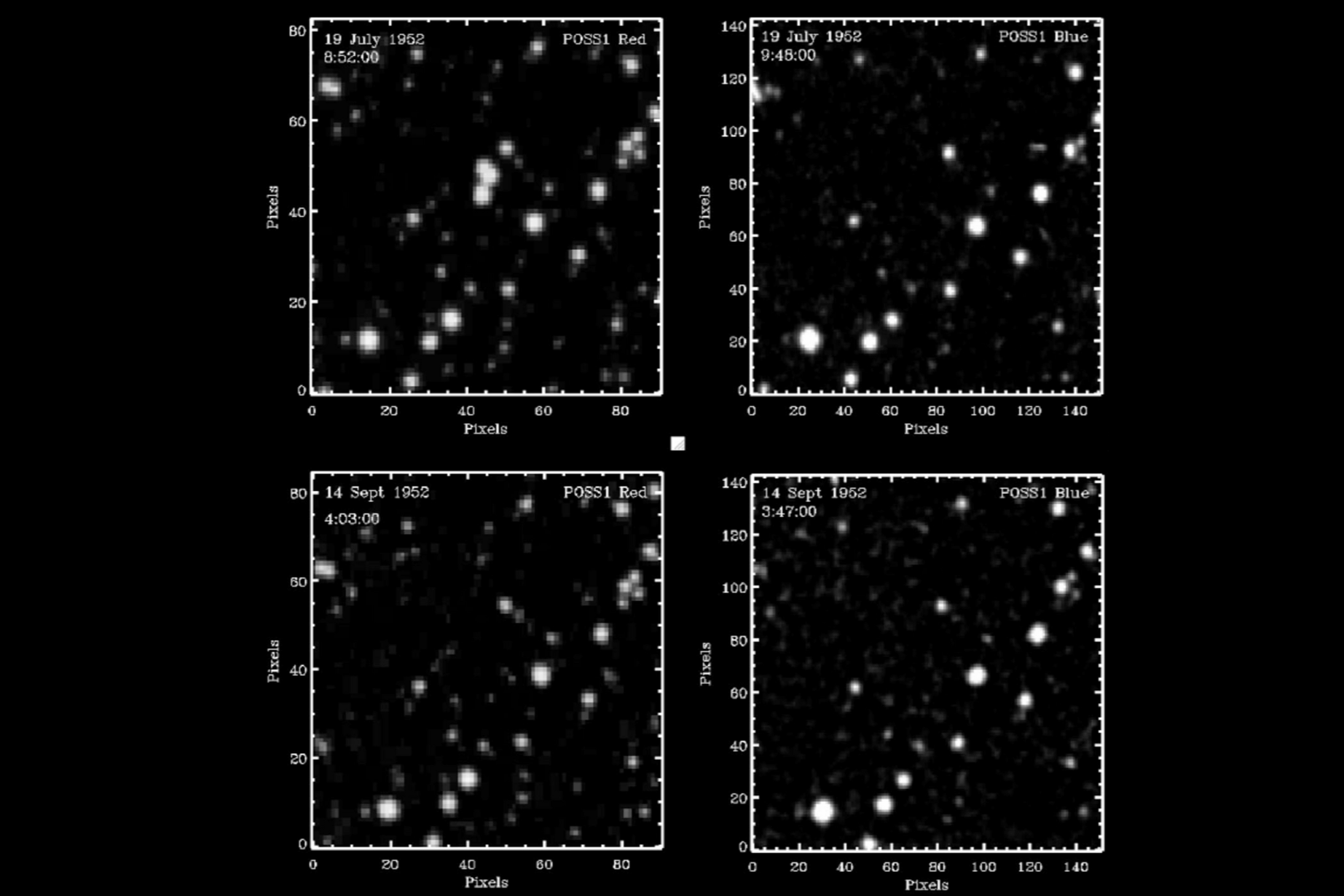
A team led by Enrique Solano reported the triple transient in Monthly Notices of the Royal Astronomical Society. The red-sensitive POSS-I plate was exposed on 19 July 1952 at 08:52 UT. It shows three approximately 15th-magnitude, point-like sources within ten arcseconds of one another. The next image, a ten-minute blue exposure, shows none of them.
The authors later checked the same coordinates against plates from September 1952, POSS-II, Pan-STARRS, ZTF and deep observations with the 10.4-metre Gran Telescopio Canarias. The sources remained absent. The paper says the “explanation … remains unclear.” It reports a drop of more than six magnitudes during the plate interval; the actual flash could have been shorter because the first exposure lasted 50 minutes.
“Vanishing stars” is an easy label, but it is not what the evidence establishes. These were transient, star-like points on a photographic plate. They were not identified as stars, satellites, aircraft or objects in Earth orbit.
Why Washington 1952 enters the picture
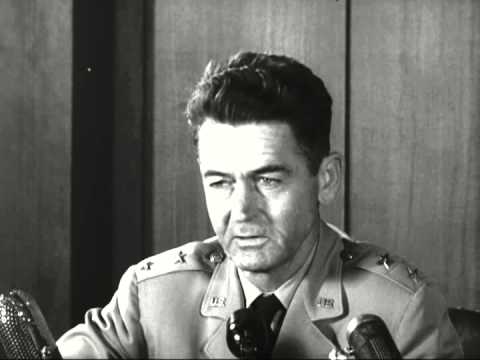
Washington's first well-known weekend of reports began later on 19 July and ran into 20 July. A second series followed on 26–27 July. The Air Force responded publicly on 31 July. In an archived National Archives film, Maj. Gen. John A. Samford said the service had received between 1,000 and 2,000 reports since 1947; most had explanations, while a remaining group came from “credible observers of relatively incredible things.”
The date overlap was noticed only after the Palomar work had begun. A separate 2025 Publications of the Astronomical Society of the Pacific study led by Villarroel and colleagues describes an aligned multiple-transient candidate dated 27 July 1952. That falls inside Washington's second weekend. It is an inviting coincidence, not a result that establishes a connection.
Scale matters here. The triple-transient team began with 5,399 candidate point-source transients in digitised POSS-I red images. Their later work describes 83 multiple-transient cases. Two dates landing on Washington's famous weekends warrant scrutiny, but they also come from a large archival search rather than a two-event experiment designed around Washington.
In a 2025 Scientific Reports paper, Stephen Bruehl and Villarroel used a larger daily dataset to test whether POSS-I transients were associated with nuclear-test dates and UAP-report dates across 1949–57. They reported statistical associations. The paper describes the UAP interpretation as speculative and says the historical sources cannot now be directly tested.
The study does not show that a Washington sighting caused a Palomar transient, that a Palomar transient caused a Washington sighting, or that either event was an object in orbit. It also does not turn a calendar match into evidence of extraterrestrial activity.
The competing explanation is in the plate itself
The debate is not only about exotic hypotheses. Nigel Hambly and Adam Blair examined a different set of apparent POSS-I transients and argued in a 2024 preprint that many were probably spurious photographic-emulsion artefacts, potentially introduced in the copying process used to distribute the glass survey plates. Their analysis did not test the 19 July triple transient. It is relevant background on how this archive can produce false point sources, not a direct finding about those three points.
Villarroel, Solano and Geoffrey Marcy replied in a 2025 preprint that short optical flashes should look narrower and rounder than stars on long exposures, because the stars are broadened by seeing and tracking. That response is an argument for the transient interpretation; it is not an independent replication. The triple-transient authors argue that its profile resembles neighbouring stars. The disagreement remains open.
The three points are visible on the historical material and absent from the comparison exposures. The mechanism behind them is unresolved. Emulsion holes or flaws in intermediate copy plates are a live explanation for some POSS-I candidates. A short astronomical flash, a foreground reflection or another physical process remain possibilities for the triple transient. “Alien probes” is a hypothesis raised around this literature, not a result of the plate analysis.
What this record can actually add
The Washington case already has its own archive: contemporary reports, radar accounts, interviews and the Air Force's public response. The Palomar image adds a separate, oddly timed observational record that can be inspected, dated and compared. The two records have no shared location, trajectory, instrument or identified object.
Two questions remain. What produced three brief, star-like points on a 1952 plate? And why do two multiple-transient dates fall on Washington's two famous July weekends? The public evidence has not connected the answers.
Sources
- Mystery Wire / YouTube discussion that prompted this review
- Solano et al., “A bright triple transient that vanished within 50 minutes,” Monthly Notices of the Royal Astronomical Society, 2024
- Villarroel et al., “Aligned, Multiple-transient Events in the First Palomar Sky Survey,” Publications of the Astronomical Society of the Pacific, 2025
- Solano et al. preprint and open manuscript version, including the 1952 plate sequence
- Bruehl and Villarroel, “Transients in the Palomar Observatory Sky Survey (POSS-I) may be associated with nuclear testing and reports of unidentified anomalous phenomena,” Scientific Reports, 2025
- Hambly and Blair, “On the nature of apparent transient sources on the National Geographic Society–Palomar Observatory Sky Survey glass copy plates,” preprint, 2024
- Villarroel, Solano and Marcy, “On the Image Profiles of Transients in the Palomar Sky Survey,” preprint, 2025
- National Archives, “Project Blue Book: Spotting UFOs in the Film Record,” including the 31 July 1952 Samford/Keyhoe film record