News / May 24, 2026
Joe Rogan and the Giza "underground city" claim: what is actually known
The Giza claim may turn out to matter. For now, it has become a bigger media event than a confirmed excavation.
The Giza "underground city" claim is still moving.
One of its biggest stops was a podcast studio.
In March 2025, the claim was already everywhere: satellite radar, hidden chambers, giant shafts, structures under the pyramids, maybe even a lost city beneath the Giza plateau. Sabine Hossenfelder covered the wave in a video titled "Huge Structures Discovered Under Pyramids?". The question mark was the useful part.
Then, in January 2026, the story got its second life on The Joe Rogan Experience.
Episode #2443 featured Filippo Biondi, one of the researchers behind the radar-tomography claims. For a claim like this, Rogan is not just another stop. It gives the story time, scale, and a very large audience. A technical dispute becomes a long, watchable narrative: the pyramids were not just tombs, the scans may show something enormous, established archaeology is cautious, and the old history may be incomplete.
That is a more compelling story than "remote-sensing interpretation awaits independent confirmation."
It is also where reporting has to keep the layers separate.
What Biondi is claiming
Biondi and Corrado Malanga published a 2022 paper in Remote Sensing arguing that synthetic aperture radar Doppler tomography could reveal internal and subsurface structures around the Great Pyramid of Giza.
That earlier paper is real. It is the anchor that makes the later story worth following.
The later claim is much larger.
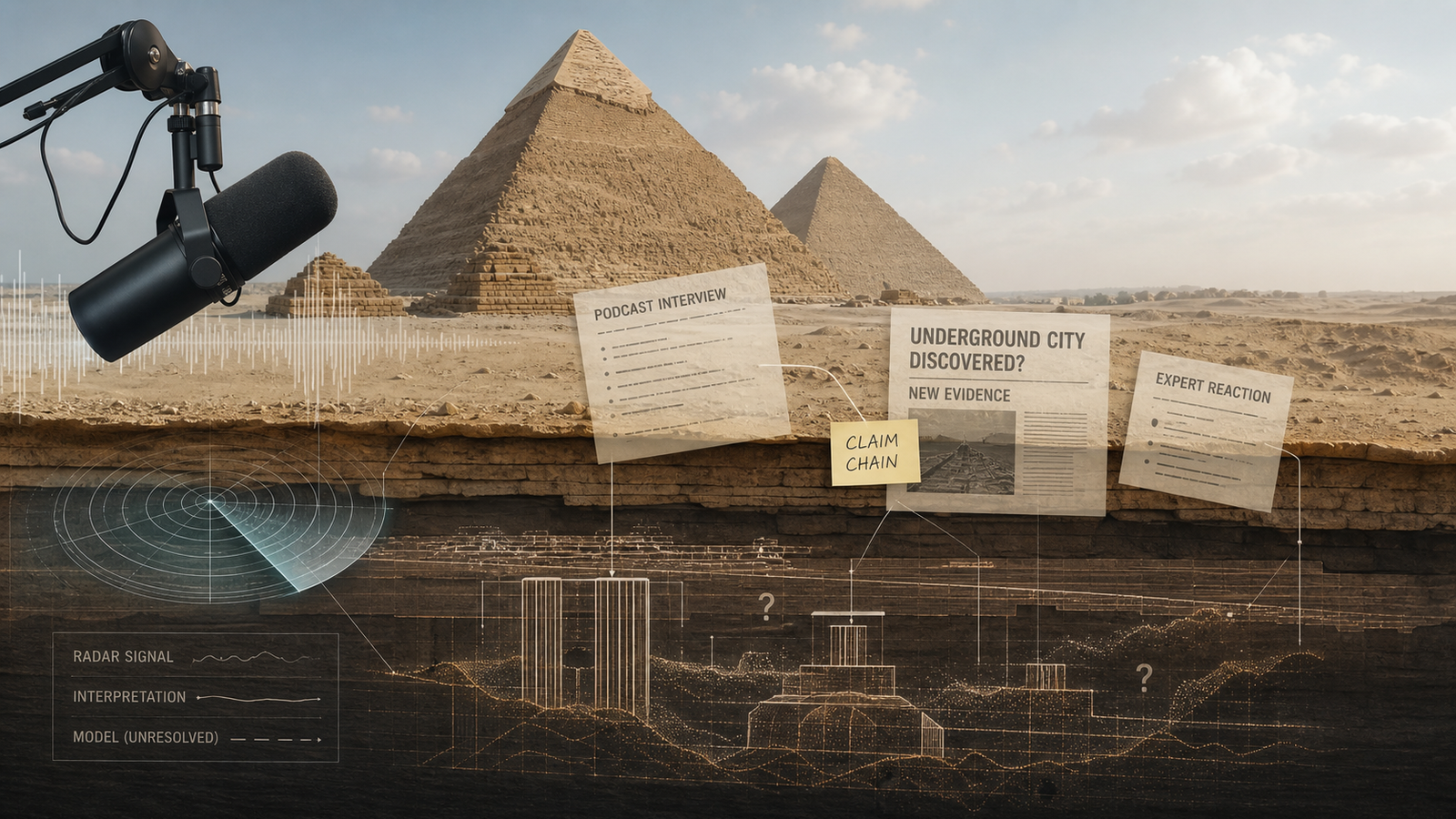
The Khafre Project claims that radar analysis found major underground structures beneath the Giza plateau: columns, shafts, corridors, chambers, and deep features that would change how people talk about the site.
On Rogan, Biondi described the radar method, said the team first tested it against known features in the Great Pyramid, then expanded the work toward Khafre and the wider plateau. He also framed the resistance as a familiar pattern: new method, old institutions, uncomfortable result.
That framing is powerful.
It is also exactly where the public record has to do more work.
What changed after Rogan
Before Rogan, the story was a viral archaeology claim.
After Rogan, it became a larger public story about archaeology, institutions, and what counts as evidence before anyone digs.
The episode pulled the claim into a much larger lane: ancient advanced knowledge, the Younger Dryas, lost technology, Graham Hancock-adjacent ideas, and the possibility that established history may be missing something important.
That does not settle the claim either way.
It does make the claim easier to outrun the evidence.
The public version now has several layers:
- the 2022 radar paper;
- the 2025 Khafre / Giza plateau presentation;
- viral headlines about a hidden underground city;
- pushback from Egyptologists and archaeologists;
- the Rogan episode, where the claim became longer, warmer, and more persuasive to a huge audience.
That last layer matters because it changes the social life of the claim. A paper can be technical. A press conference can be checked. A headline can be corrected. A three-hour podcast lets people sit with the story and imagine its implications.
People do not just hear the claim. They spend time with it.
What is still unresolved
The hard part has not moved much in public.
There is still no public excavation confirming a city under Giza.
There is still no widely accepted independent replication of the larger 2025 claim.
There is still no public Egyptian archaeological confirmation that these deep structures are real built features.
There is still a large gap between "radar interpretation" and "underground city discovered."
National Geographic's 2025 review made the basic problem clear: the newer claim had not passed through the kind of peer review and field confirmation that would normally be needed for a discovery this big. Egyptian coverage also recorded strong objections from Zahi Hawass and other Egyptologists, including objections that the work was not authorized around Khafre and was not scientifically established as presented.
That is not as viral as a giant underground structure.
It is the part that decides what the story is.
The useful comparison
There are real underground anomalies at Giza.
That is why the story works.
Smithsonian covered a separate Egyptian-Japanese project in 2024 that found a shallow L-shaped anomaly and a deeper anomaly in Giza's Western Cemetery using ground-penetrating radar and electrical resistivity tomography.
That was interesting. It was also limited, cautious, and unresolved.
The researchers did not announce a hidden civilization.
They identified a target and said excavation would be needed.
That is a useful contrast, not a verdict.
The clean version
Filippo Biondi and collaborators claim that satellite radar tomography reveals large hidden structures beneath Giza. The claim became viral in 2025, drew expert criticism and public fascination, and then reached a much larger audience through Joe Rogan in January 2026. As of now, it remains an open remote-sensing claim, not a confirmed archaeological discovery.
That is still worth covering.
The story is not only about pyramids. It is about how technical claims travel once they hit the podcast layer.
Anyone who follows UAP stories should recognize the pattern.
A sensor method becomes a dramatic object. An interpretation becomes a public claim. Criticism becomes part of the story. The missing step is boring, expensive, and decisive:
ground truth.
For Giza, that means on-site confirmation, independent replication, and eventually a hole in the ground.
Until then, the right posture is open, but not sold.
Related notes
Sources
- Sabine Hossenfelder: "Huge Structures Discovered Under Pyramids?"
- JRE Wiki: Filippo Biondi, JRE #2443
- JRE Database: #2443 - Filippo Biondi
- JRE Podcast clip: radar scans and Giza structures
- Biondi and Malanga, Remote Sensing 2022 paper
- arXiv version of the 2022 paper
- National Geographic: Is there really a secret city under Egypt's pyramids?
- Egyptian Streets: Egyptian expert objections to the underground-city claim
- Smithsonian Magazine: Giza Western Cemetery anomaly