
News / Jun 24, 2026
The doctor who put the UFO file in a medical journal
A 28-page DIA paper, a forensic neuroradiologist, a patient list that does not exist, and a program that is not named. Kit Green's paper is the closest the UFO and UAP file has to a medical record. It is also the clearest example of what that file is missing.
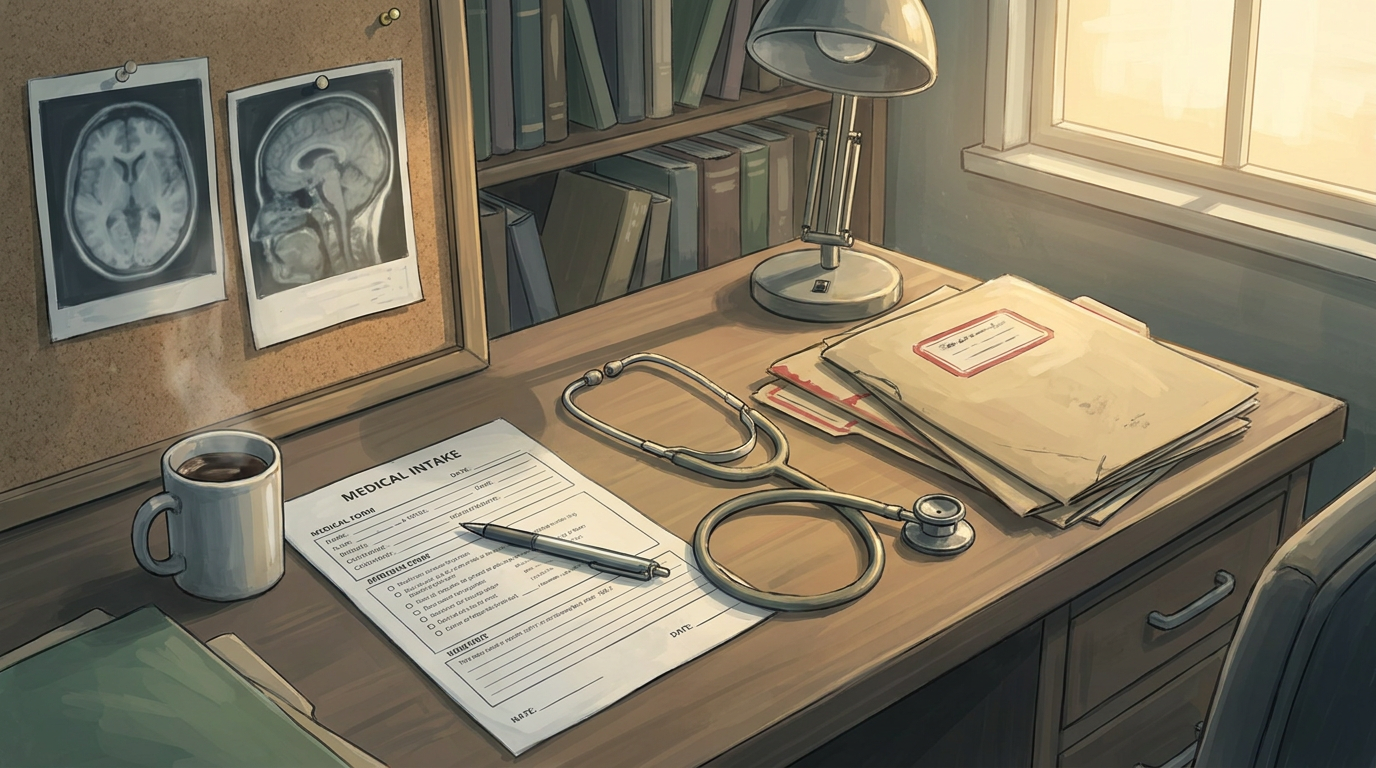
A PDF with a 28-page body and a clinical title sits in The Black Vault's document archive. The first line credits Christopher Green, M.D., Ph.D., F.A.A.F.S., "Fellow, Neuroimaging." The header above the title says Defense Intelligence Reference Document. The file is dated 2010. The author of the PDF is the Defense Intelligence Agency. The agency that paid for it is not named in the PDF.
That gap is the story.
The paper is called "Clinical Medical Acute & Subacute Field Effects on Human Dermal & Neurological Tissues." The author is the physician and former CIA analyst usually called Kit Green. The work sits inside the AAWSAP document set — the same DIA contract family that paid Bigelow Aerospace to study anomalous aerospace threats. It is the one document in that set that is, on its surface, a medical paper. It reads like a forensic report. The patients it describes are not in it.
What the paper says happened to the body
Green's report does not name a single patient. It describes a pattern.
Witnesses, the paper says, presented with neurological and dermatological symptoms after close encounters with what the document calls "anomalous aerospace vehicles." The findings include:
- Persistent dermal lesions and burns consistent with high-power, modulated microwave exposure.
- Neurological deficits, including cognitive disruption and sensory loss.
- "Sclerosis-like" hardening of tissue in some patients.
- Progressive decline in a subset of cases.
Green told TweakTown in 2024 that he had treated "hundreds" of patients through his defense-sector neurology practice. He said roughly one in ten had died within seven years of the initial reported encounter. The patients, he said, came from Special Forces, intelligence agencies, aerospace contractors, and uniformed military units. None of those patients is identified in the public DIRD. The program that referred them to him is not identified in the DIRD either.
The paper's own conclusion, frequently left out of the way the document is described online, is the cautious one. Green wrote that the injuries were consistent with exposure to "subtle, high-power, modulated microwave" effects, and that the data could be used to support "reverse engineering" of an advanced propulsion system. He also said, in the TweakTown interview, that the injuries were "fully possibly" caused by advanced human technology rather than anything non-human.
The non-human part is what the document gets cited for. The human-tech part is what the document actually says.
How the file got from the CIA desk to the Black Vault
Green is a Wayne State University School of Medicine professor in Detroit with a specialty in forensic neuroimaging. He has worked with the Central Intelligence Agency, by his own and others' account, since the late 1960s. The 2010 DIRD was produced during the period when the Defense Intelligence Agency was funding AAWSAP, the Advanced Aerospace Weapon Systems Application Program, with Robert Bigelow's NIDS-era research ecosystem as the lead subcontractor.
The 2010 DIRD is one of the technical products the AAWSAP contract tree paid for. It sits in the same FOIA-released set as the other Bigelow-funded papers — the theoretical physics work on metric engineering, the spacetime-modulation reports, the "Warp Drive" papers that now read as background reading for a program whose mission statement, on paper, was exotic propulsion.
Green's medical paper is the outlier in that set. The others are physics. This one is a forensic pattern, on a body, after a claimed encounter, written under a defense-intelligence contract.
The Skinwalker, the Skinwalker doctor, and the backdoor claim
Green's name also shows up in the Skinwalker Ranch orbit. The 2017 documentary Hunt for the Skinwalker identifies him as a medical and intelligence consultant to the NIDS-era team. The Spreaker interview series The Tempest Universe, in a 2024 episode, has a guest describe Green as an ex-CIA analyst who "allegedly created a backdoor to access DNA data" while inside the agency. That claim is in circulation; the underlying record is not.
It is a useful test case for how the medical-effects lane travels. The DIRD is on the public record. The diagnostic imaging, the patient list, the program identifier, and the CIA backdoor claim are not. The name moves through interviews, podcasts, and conference panels. The body of evidence does not move with it.
What the public file contains
- The 2010 DIRD PDF on The Black Vault, released through DIA FOIA processes. It is the primary document.
- The AAWSAP original bid solicitation and DIA contract file pages, also via The Black Vault archive, which put the DIRD inside the AAWSAP funding chain.
- The CIA's online Reading Room search results for "Kit Green" and "Christopher Green," which list any declassified records the agency has released under that name.
- The 2017 documentary Hunt for the Skinwalker, which names Green as a NIDS medical and intelligence consultant.
- The 2024 TweakTown interview, where Green names patient numbers, mortality figures, and the "fully possibly human technology" hedge.
What is not in the public file
- No patient name, ID, or imaging file.
- No program name, contract task order, or referral chain from the named defense-sector program to Green's clinic.
- No published peer-reviewed forensic-neuroimaging study of an "anomalous aerospace vehicle" injury case.
- No independent medical verification of the pattern Green describes.
- No public record of the "backdoor" claim that travels with his name on UFO podcasts.
The pattern travels. The supporting records do not.
The lane this opens
Kit Green is one of a small set of names that turn the UAP file from lights and craft into bodies. He is not the only one. Colonel John Alexander, also linked to NIDS-era research and to non-lethal-weapons studies, has talked about the same handoff. The NIDS medical side of Bigelow's operation has surfaced, in fragments, in the AAWSAP document set. The Grusch-era claims about biologics and UAP-related injuries have re-energized the medical lane without adding new public records to it.
What makes Green useful as a starting point is the same thing that limits him. The DIRD is the rare piece of paper in the UAP archive that is, by form, a medical document. It is the kind of artifact a reporter can put on the desk and say: this is the shape of the claim. The rest of the claim — the patients, the program, the imaging, the cause — is not on the desk. It is described, in interviews, in fragments, and in conference panels. The medical-effects lane has a name, a paper, and a Black Vault URL. It does not have a case file.
Related UAP Logbook reading
- Hal Puthoff's UFO paper trail runs from SRI to To The Stars
- Robert Bigelow's UFO machine had a contract number
- David Grusch's "sentient plasmoid life" line, explained
- The UFO control panel in Lyn Buchanan's story
- The CIA archive has a UFO and psi problem
Sources
- Defense Intelligence Reference Document: "Clinical Medical Acute & Subacute Field Effects on Human Dermal & Neurological Tissues," Christopher Green, M.D., Ph.D., F.A.A.F.S. (via The Black Vault)
- DIA / AAWSAP contract file (The Black Vault)
- AAWSAP original bid solicitation (The Black Vault)
- CIA Reading Room: Kit Green
- CIA Reading Room: Christopher Green
- TweakTown / GameSky translation: Christopher "Kit" Green interview on UAP-related injuries, patient numbers, and the "human technology" hedge
- UFOs Scientific Research blog: Kit Green DIRD release note (Feb. 2020)