News / May 23, 2026
NewsNation panel sorts PURSUE Release 02: Syria, Lake Huron, submarine orbs, PR59, Sandia, and Pantex
In a live Reality Check panel, Ross Coulthart and guests walked through the second PURSUE UAP file release. The useful part is not a single conclusion. It is the sorting: some files were treated as interesting, some as weak, and several as impossible to judge without metadata.
NewsNation's live Reality Check panel on the second PURSUE release did not treat the file drop as one clean story.
Ross Coulthart called the release underwhelming as disclosure, while several guests said the files still matter because they put government-origin records, videos, and reports into public view.
That makes the segment useful as a sorting exercise.
The panel moved through several Release 02 items: the late-2025 ODNI orb narrative, the Syrian "instant acceleration" video, a metallic/spherical clip labeled by the panel as PR83, the Lake Huron shootdown video, a submarine/orb video, PR59, the Sandia green-fireball files, Apollo-era audio, the CIA Sary Shagan report, and the DOE/Pantex image fragment.
What Coulthart said up front
Coulthart said the second tranche added roughly 40 files to the Department of War UAP site.
He described the release as a mixture of videos, documents, PDFs, photos, and testimony spanning decades, including Sandia-era green fireball records, videos showing apparent sudden acceleration, and unresolved cases.
His main complaint was that the release does not answer the larger question he keeps returning to: what conclusions, if any, are held inside classified government channels.
In his framing, the file drop shows that government bodies studied, recorded, and stored UAP-related material. It does not settle what the strongest internal assessments say.
Tim Gallaudet: not a smoking gun, but not nothing
Retired Rear Admiral Tim Gallaudet disagreed with treating the release as a "nothing burger."
He said the files lack metadata and therefore cannot support the kind of quantitative analysis he would want. Still, he singled out the late-2025 intelligence-specialist report as one of the strongest items in the set.
That report is the ODNI narrative already logged by UAP Logbook: a late-2025 account involving a national test or training range, observers in a helicopter and on the ground, radar tasking, FLIR, night-vision goggles, and multiple orange-orb observations.
Gallaudet's strongest point was not that the report proves an origin. It was that trained observers, multiple sensors, and sworn-style reporting should not be dismissed as casual UFO talk.
He also argued that the fact these files were released may indicate the government does not recognize the objects as U.S. or adversary technology. That is his inference, not a stated conclusion in the files themselves.
Hunt Willis: lawyers need facts first
Hunt Willis of the U.S. Disclosure Foundation gave the legal-process version of the same point.
He said the value of the release is that it builds a baseline of facts: documents, authenticated files, and government-released material that can be argued over later.
He also tied the ODNI orb narrative to the need for a formal UAP Disclosure Act review process. His argument was that a review board would matter because it would create a mechanism for handling non-prosaic cases, definitions, and declassification decisions.
Willis also discussed whistleblower protection and congressional access. That portion of the panel moved beyond the individual files and into oversight: whether Congress can receive testimony and records about alleged legacy retrieval or reverse-engineering programs without agencies blocking the process.
The Syrian "instant acceleration" video
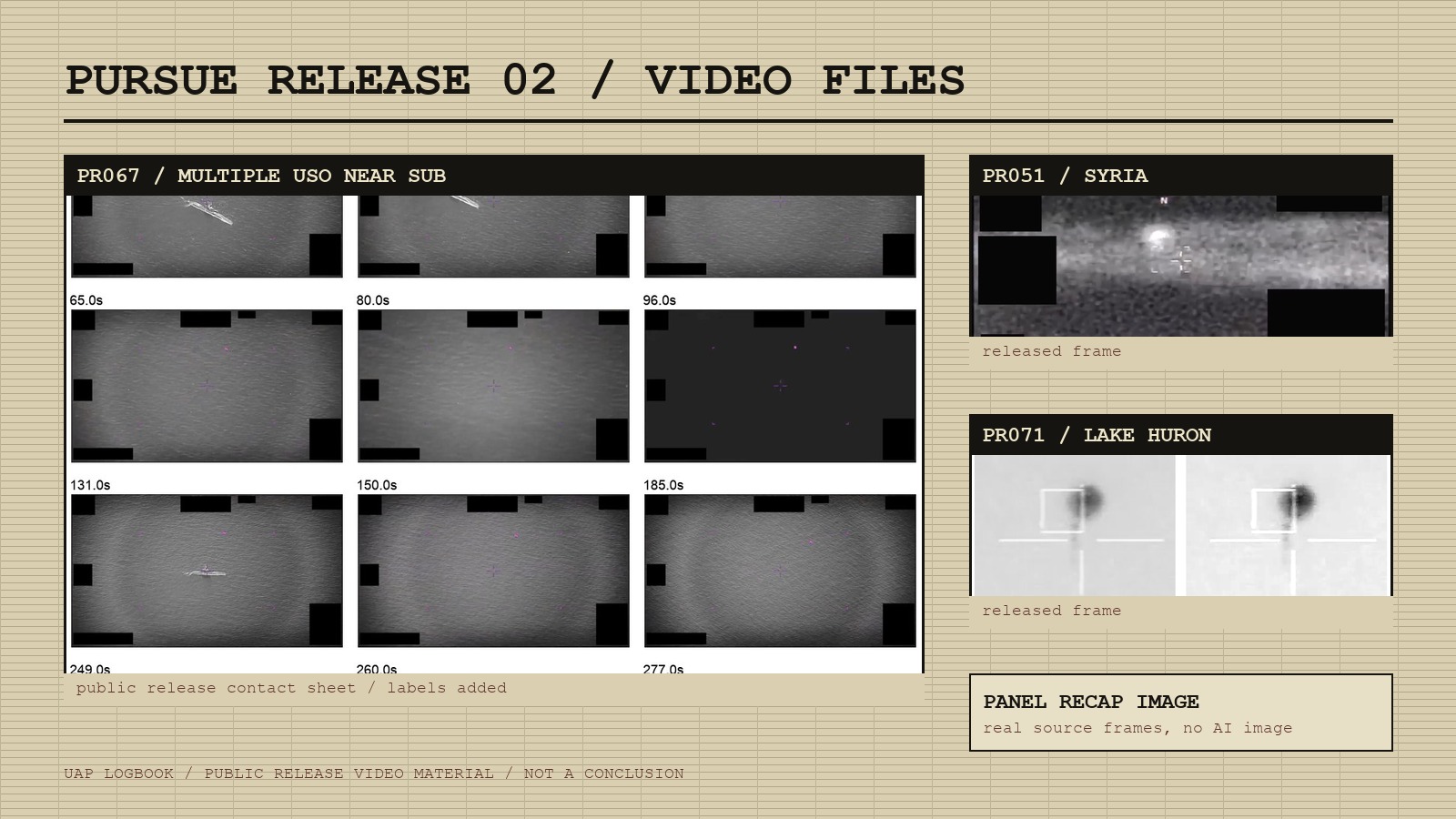
The panel then moved to the 2021 Syria video, the same file UAP Logbook has treated as DOW-UAP-PR051.
Dave Falch said the footage looked good to him at first glance and described the sensor track as struggling before losing the object. Sarah Gamm said that at face value, without metadata or weather context, the clip looked anomalous to her.
Billy Kryzac gave the useful caution.
His frame-by-frame read was that the sensor may lose lock, stop following the object, and then the target continues out of frame while the platform or camera motion changes the background. In that reading, the video may look like instant acceleration without proving instant acceleration.
That matches the narrow public-record problem: the label is strong, but the released video and description are not enough to calculate speed or settle what the object did.
PR83: metallic-looking object, possible balloon
The panel also discussed a clip they identified as PR83.
Kryzac described it as a metallic or spherical object and noted that it appears more visible in infrared or thermal imagery than in visible spectrum footage. He treated that as possible low observability.
Falch and Gamm both raised a simpler possibility: a mylar balloon.
Coulthart effectively moved that item into the weak bucket during the discussion. The panel did not resolve it, but the exchange is useful because it shows the analysts were not treating every clip as exotic.
Lake Huron: probably the prosaic lane
The panel then discussed the Lake Huron shootdown video.
Gamm said the object looked like a balloon and mentioned a visible dangling payload. Coulthart's question was why such imagery stayed secret for years if the object was that plainly balloon-like.
Kryzac added a caveat about a shape he sees in the surface of the object and compared it to higher-quality imagery he has seen elsewhere. That was not a conclusion. It was a reason he did not want to close the file completely from a single public clip.
The basic public point remains: the Lake Huron release appears compatible with a balloon-like target, and the more interesting question is why it remained in the UAP bucket so long.
Submarine orbs and PR59 drew more interest
The submarine/orb footage received more interest from the panel.
Kryzac argued that the clip may show objects near water, possibly moving in and out of the water, and that birds visible elsewhere in the footage provide a useful comparison. Falch was more cautious, saying he needed a deeper look at the sensor characteristics and footage.
The panel also discussed PR59, which Kryzac called "plasma man" in shorthand.
He said the object reminded him of two civilian videos he had previously seen from separate sources. Gamm connected the shape to the "Jetpackman" category from earlier task-force discussions and public sightings.
Neither discussion produced a firm conclusion. The important point is narrower: the panel treated PR59 and the submarine/orb footage as candidates for further review, not as settled evidence.
Historical files: Sandia, Apollo, Sary Shagan, and Pantex
The panel also moved through several historical or document-heavy items.
Coulthart described the Sandia material as a 1948-1950 file set involving roughly 209 sightings near sensitive nuclear-era facilities, with green orbs, fireballs, discs, and calculations by technical figures trying to model what was being reported.
Gamm said the Sandia material stood out to her because of her nuclear background and because it shows historical government interest in the subject.
The panel also mentioned Apollo 12 medical debriefing audio, a CIA report from Sary Shagan in Kazakhstan involving a reported green circular object or mass in 1973, and the DOE/Pantex image fragment.
The Pantex item came up near the end. The guests described it cautiously. Some said it resembled "jellyfish" or "jetpack" imagery, but no one on the panel treated the image as resolved.
What they said is still missing
Coulthart closed by listing material he still thinks should be released.
That included Representative Anna Paulina Luna's request for 46 specific UAP video files, a submarine or USO-related video described in a March letter, Representative Eric Burlison's request around a 1952 MIT Lincoln Laboratory "flying saucer" briefing or recording, additional Apollo-era material, and higher-quality imagery that public figures claim exists.
The panel also returned several times to the same limitation: metadata.
Without original files, sensor data, platform data, weather context, and chain of custody, the videos can be discussed but not fully tested.
Why this panel is worth logging
The panel is useful because it did not land on one simple answer.
It produced a rough sorting table:
- the ODNI 2025 orb narrative was treated as one of the stronger written records;
- the Syrian "instant acceleration" video remained interesting but vulnerable to a track-loss explanation;
- PR83 was treated as possibly balloon-like;
- Lake Huron stayed in the prosaic lane for several guests;
- the submarine/orb video and PR59 were flagged for closer review;
- Sandia, Sary Shagan, Apollo, and Pantex show how broad the Release 02 bundle is.
That is enough for a log entry.
It is not enough for a conclusion.
Sources
- NewsNation: Ross Coulthart LIVE: UFO Files (2nd Drop) Analysis and Reaction, YouTube video POD4iAL4teM. https://www.youtube.com/watch?v=POD4iAL4teM
- UAP Logbook: PURSUE Release 02 adds a 2025 orb narrative and old Sandia green-fireball files. https://uaplogbook.com/pursue-release-02-uap-files/
- UAP Logbook: The Syrian "instant acceleration" UAP video is messier than the label. https://uaplogbook.com/syrian-uap-instant-acceleration-video/
- UAP Logbook: The Lake Huron shootdown video raises a basic question: why is this still a UAP? https://uaplogbook.com/lake-huron-uap-shootdown-video/
- UAP Logbook: DOE-UAP-D001: the Pantex unidentified object image in PURSUE Release 02. https://uaplogbook.com/doe-uap-d001-pantex-unidentified-object-image/