Main Article / Jul 31, 2026
The Nimitz Tic Tac UFO case, told by the people who were there
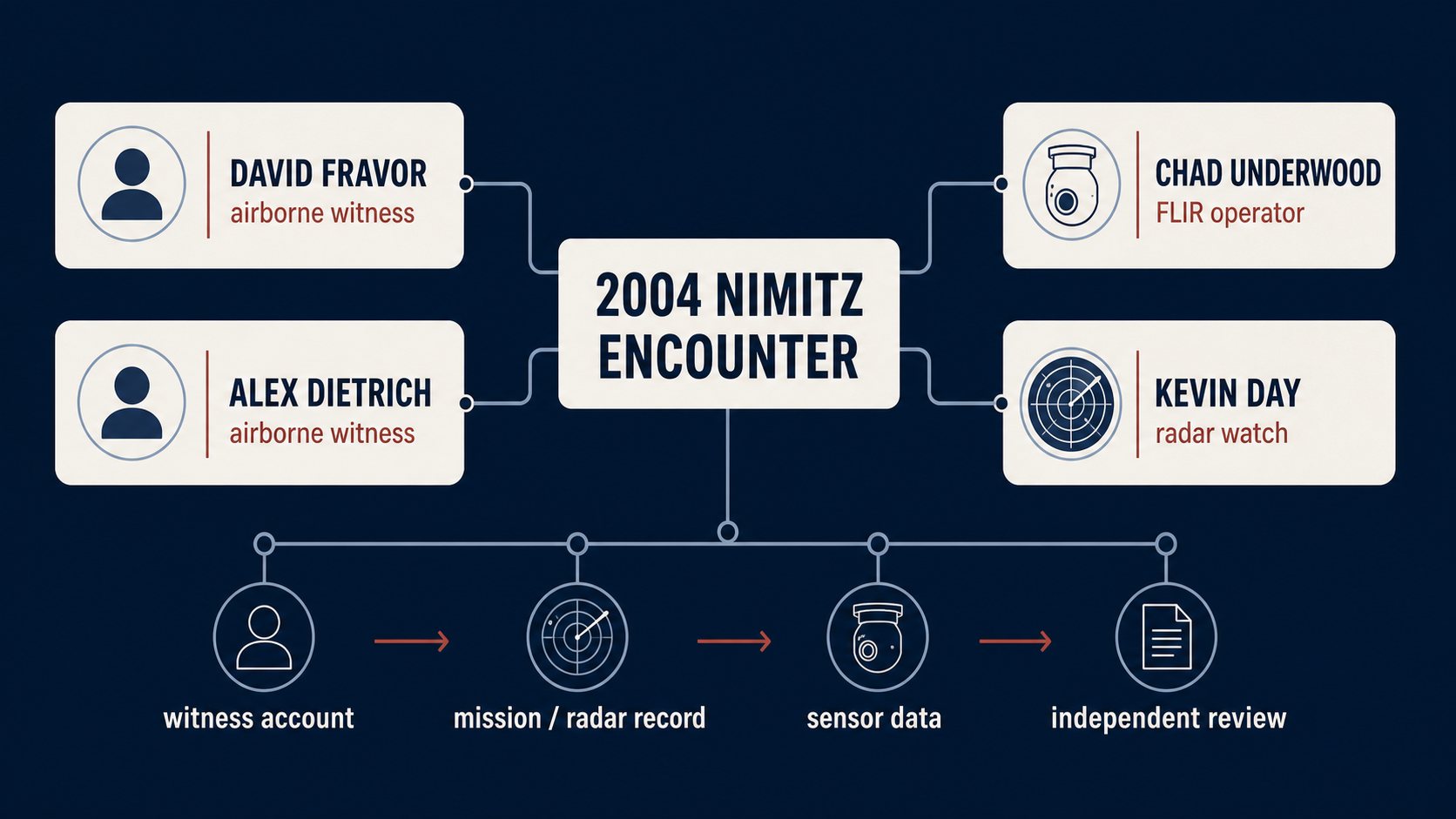
David Fravor, Alex Dietrich, Chad Underwood and Kevin Day occupied different stations in the 2004 Nimitz UFO encounter. Their accounts explain why this one Navy incident never went away.
David Fravor was flying a routine training sortie from USS Nimitz when the controller aboard USS Princeton called. Training was off. There was a real-world tasking to the west.
Fravor, then the commanding officer of VFA-41, joined up with the other F/A-18F in his flight and headed toward the contact. The pilots had not been told what they were looking for. In his 2023 statement to the House Oversight Committee, Fravor later recalled: “we had nothing on our radars and were unaware of what we were going to see.”
What they found over the Pacific on 14 November 2004 became the U.S. Navy’s most durable UAP story. Not because one video settled it. The famous FLIR1 clip came later. What endured was the way separate people, in separate places, kept describing different pieces of the same strange afternoon.
Kevin Day had been watching the screen
Before the aircraft turned west, Kevin Day was on USS Princeton. He was a senior chief petty officer and air-intercept supervisor, working the ship’s SPY-1 radar picture. In later interviews, Day said contacts had been appearing for several days. He dates that run of reports to “three or four days” in the extended interview embedded below.
That account is the beginning of the Nimitz story as the public knows it. The ship’s controllers were not looking at a viral clip or a newspaper account. They had a problem on the display and aircraft available to investigate it. No full SPY-1 archive has been released; the shipboard chapter rests on the people who worked there.
Two Hornets over white water
Fravor’s aircraft arrived at the reported area with the second jet above it. The weather was calm. Then the crews saw white water below: a patch of disturbed sea where no ship should have been. Above it, Fravor has said, was a small white object, oblong in shape, moving abruptly.
There were four people in the two jets. Fravor had Lieutenant Commander Jim Slaight in the back seat as his weapons systems officer. Lieutenant Commander Alex Dietrich flew the second F/A-18F; her weapons systems officer has not been consistently identified in the main public reporting. The familiar “four names” in the Nimitz story are therefore not the complete cast of the flight. They are the people whose accounts later became most visible.
Fravor descended to get closer. Dietrich’s aircraft remained higher. Fravor says the white object turned and climbed as he approached, then disappeared. When his aircraft turned back toward the disturbance, he says, the white water was gone as well.
Dietrich saw the scene from the other jet. Her account has a different texture from Fravor’s: it is less a story of a close manoeuvre than a second pilot trying to describe an object and a patch of water that did not fit the briefing they had received. That difference is part of the value of the pair. She is not there to repeat Fravor’s story line for line.
Fravor’s written statement says that, after the object vanished, the controller told the flight it had reappeared at the Combat Air Patrol point roughly 60 miles away. The radio call is preserved in Fravor’s account; the underlying radar track has not been made public.
The video came after the visual encounter
Back on USS Nimitz, Fravor told another crew what had happened. That crew included Chad Underwood, a VFA-41 weapons systems officer. Underwood later flew the sensor sortie that produced the 76-second infrared clip known as FLIR1.
FLIR1 belongs to the Nimitz episode, but it came from another F/A-18F on the later sortie. Fravor’s close approach over the white water was already over.
Underwood has said in filmed interviews that he was trying to bring back as much information as the targeting pod could give him. “Every single mode and zoom,” he told Jeremy Corbell. It was a practical answer from a weapons systems officer preparing for a debrief.
The Department of Defense authorized the release of FLIR1 and two later Navy videos in April 2020. DVIDS now hosts the Nimitz clip through Naval Air Systems Command. The file made the episode visible to millions. It did not replace the pilots’ earlier visual encounter or Day’s account from USS Princeton.
What is still out of sight
The Nimitz story has no shortage of voices. Its harder-to-see pieces are the mission logs, sensor settings, full video sequence and radar data that would let outsiders put every chapter on one clock. AARO’s 2025 workshop paper names weak retention practices as a reason critical records can be lost, citing Nimitz as the well-known example.
The record trails off there. The missing material remains part of why the 2004 Nimitz encounter is still being argued over more than two decades later.
Sources
- Congress.gov: July 2023 House UAP hearing record, including David Fravor’s statement and testimony.
- DVIDS: FLIR – UAP, Naval Air Systems Command, Video ID 955825.
- Department of Defense: statement on release of historical Navy videos, April 2020.
- 60 Minutes: Navy pilots recall “unsettling” 2004 UAP sighting, 2021, with David Fravor and Alex Dietrich.
- Chad Underwood interview with Jeremy Corbell, on the FLIR1 sortie and targeting-pod capture.
- Kevin Day interview, on the USS Princeton radar reports.
- AARO: 2025 UAP Workshop — Narrative Data, Infrastructures, and Analysis, on record-retention limits, including Nimitz.
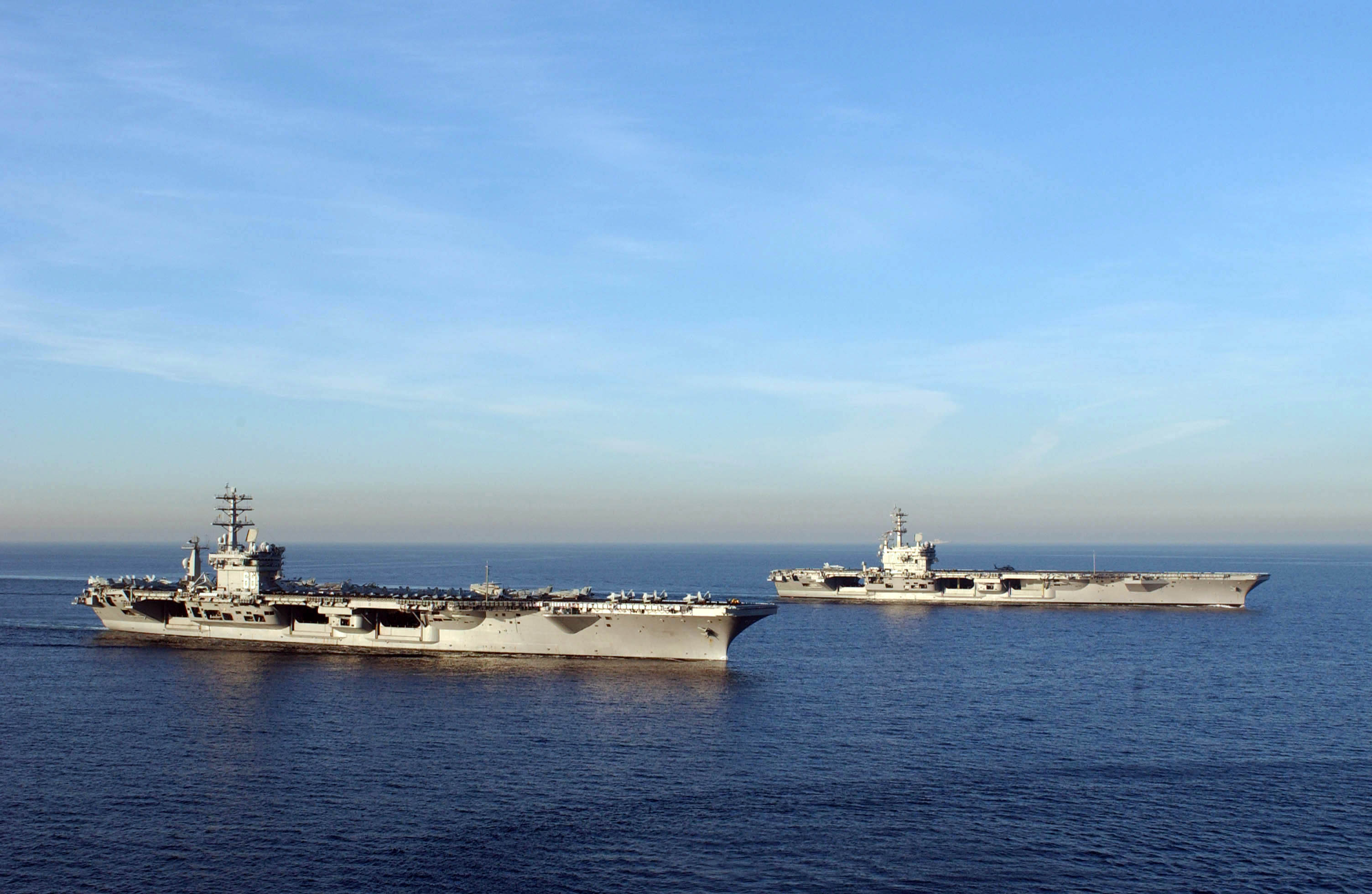
- U.S. Navy photo 041116-N-6536T-188 via Wikimedia Commons, public domain.