Main Article / Jul 31, 2026
The Phoenix Lights: one night, two events, and a lasting UAP memory
On the night of March 13, 1997, two aerial events were reported across Arizona and Nevada. The first was a slow, silent V-shaped formation of lights. The second, two hours later, was a row of stationary orange lights over the south Phoenix mountains. Ten years on, the sitting governor said he had been one of the witnesses.
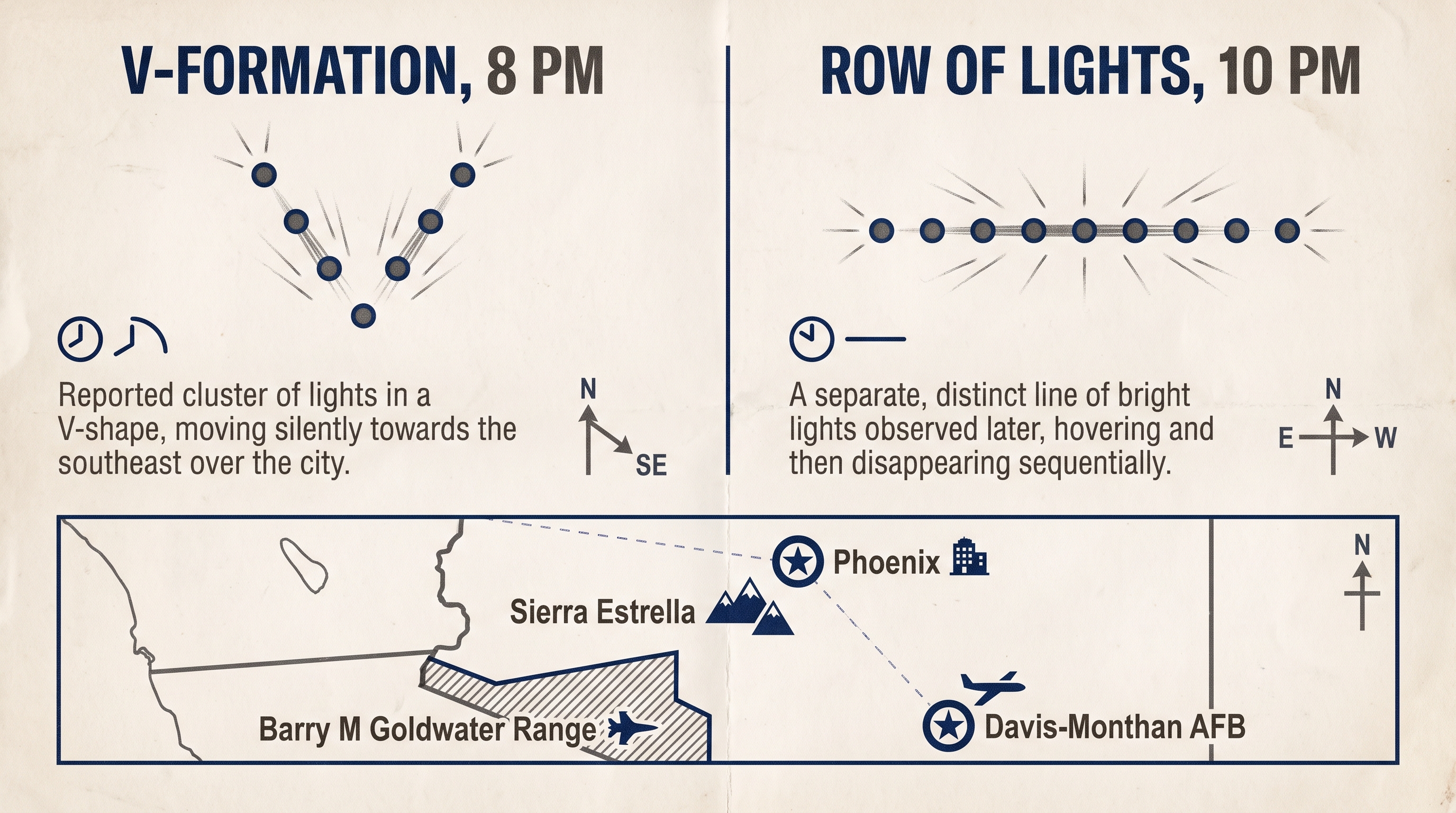
On the night of Thursday, March 13, 1997, two aerial events were reported across central and southern Arizona. They were visually and geographically distinct, and they would become the Phoenix Lights. The first, starting around 8 p.m., was a slow, silent V-shaped formation of lights crossing 300 miles of sky from the Nevada line to the edge of Tucson. The second, around 10 p.m., was a row of stationary orange lights hanging over the mountains south of Phoenix. Ten years on, the sitting governor said he had been one of the witnesses; twenty years on, the pilot who first reported the lights to air traffic control revealed himself as the actor Kurt Russell.
The two events share a name but split cleanly into two cases with very different evidentiary weight. Skeptical Inquirer writer Robert Sheaffer and Tucson astronomer James McGaha, a retired Air Force pilot who investigated both sightings on the ground, made the split early in the public discussion, and the framing has held. McGaha put it in 2007: "It was clearly aircraft in formation, flying at two different times and then dropping flares, and it's clear to any rational person that's what it was."
The geography behind the lights
Phoenix sits in the Salt River valley. Southwest of the city, the Sierra Estrella range rises to about 4,500 feet, and behind that ridge lies the Barry M. Goldwater Air Force Range — a military training complex used for live fire and night illumination drops. Davis-Monthan Air Force Base, the operational hub for A-10s rotating into southern Arizona under the Air National Guard's winter Operation Snowbird, sits roughly 110 miles southeast of Phoenix near Tucson.
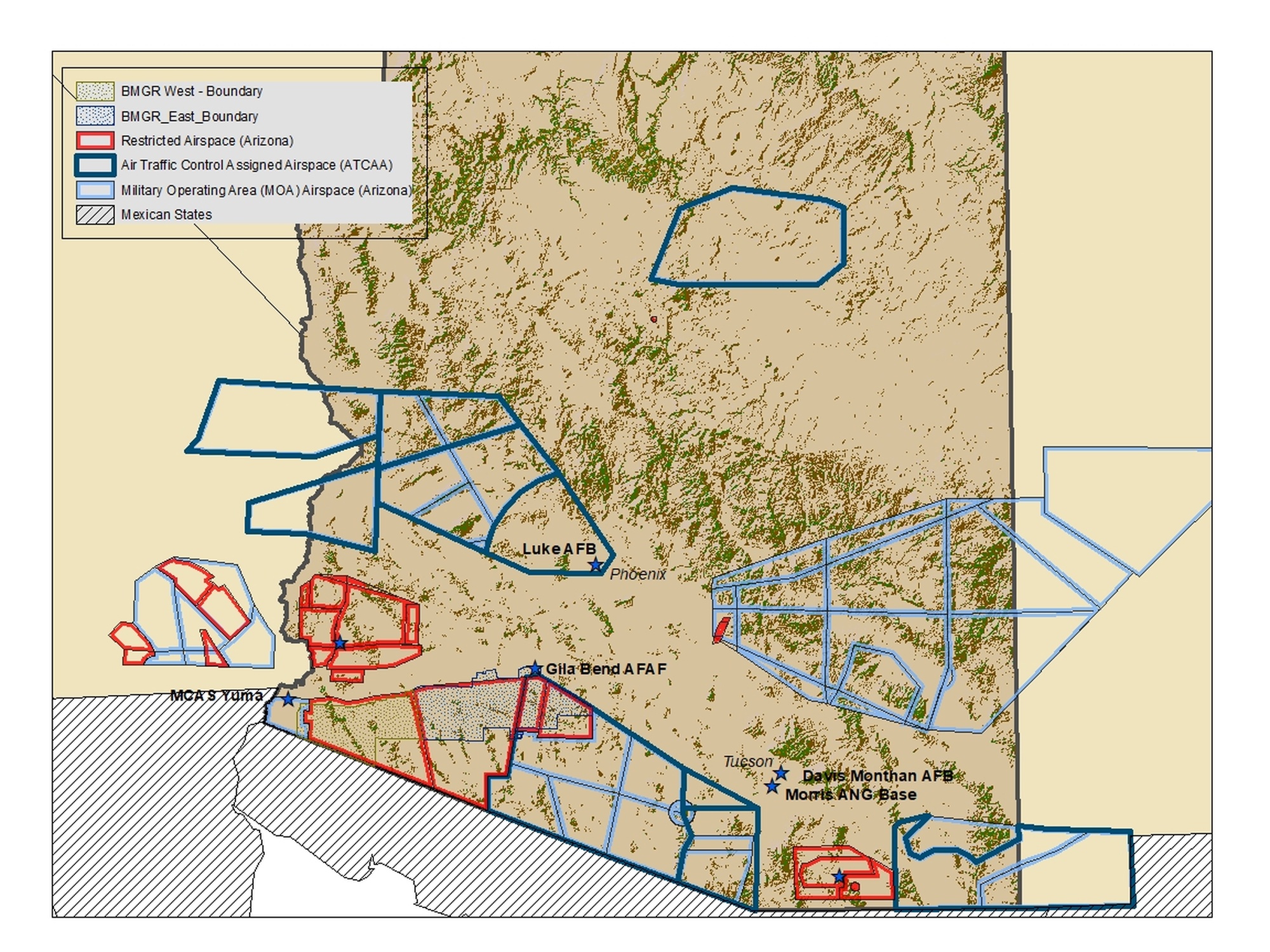
That geography explains both events. A-10s returning to Davis-Monthan from a Goldwater Range sortie along the I-17 corridor would pass directly over the Phoenix metro at altitude. And any illumination drop south of the Sierra Estrella would not become visible to Phoenix viewers until the burning flares descended low enough to clear the ridge — at which point they would appear to switch on, hang for several minutes, then go dark one by one as their parachutes carried them below the skyline.
The 8 p.m. V-formation
The first reports came in around 7:55 p.m. from Henderson, Nevada, where a witness described a large, dark V-shape with five or six amber lights moving southeast. Over the next hour, similar descriptions came in from Paulden, from Prescott, from north Phoenix and Glendale, and from the corridor between Phoenix and Tucson. The lights moved slowly, made no sound the witnesses could agree on, and crossed roughly 300 miles of state.
The most detailed published account comes from the Ley family. Tim Ley, a former Air Force pilot, with his wife Bobbi, his son Hal, and his grandson Damien Turnidge, first spotted the lights about 65 miles out near the north edge of the Phoenix valley. The five amber points separated over ten to twelve minutes as the formation came closer, and the family described resolving the shape into a 60-degree carpenter's square — one light at the leading tip, two evenly spaced on each arm. Ley later estimated the object's wingspan at nearly a mile and said it passed directly over their house at roughly the altitude of a commercial airliner on final approach.
Only one home video of the 8 p.m. event has surfaced publicly: a 42-second clip shot by Terry Proctor near 56th Street and Carefree Highway, showing five faint lights in a loose V. Everything else comes from witness memory, including the surveys that Phoenix physician Lynne Kitei compiled over more than a decade. The pilot who first reported the lights from the air stayed anonymous for twenty years. In a 2017 BBC interview with Gyles Brandreth, the actor Kurt Russell said he had been on approach to Phoenix Sky Harbor that night with his son Oliver Hudson, that his son had asked "Pa, what are those lights?", and that he had radioed the tower to report "six lights over the airport, in absolute uniform in a V shape" — and been told their scopes were clear. Russell confirmed the date against his own logbooks after his wife, Goldie Hawn, watched a UFO documentary two years later and he realized the pilot being discussed was him.
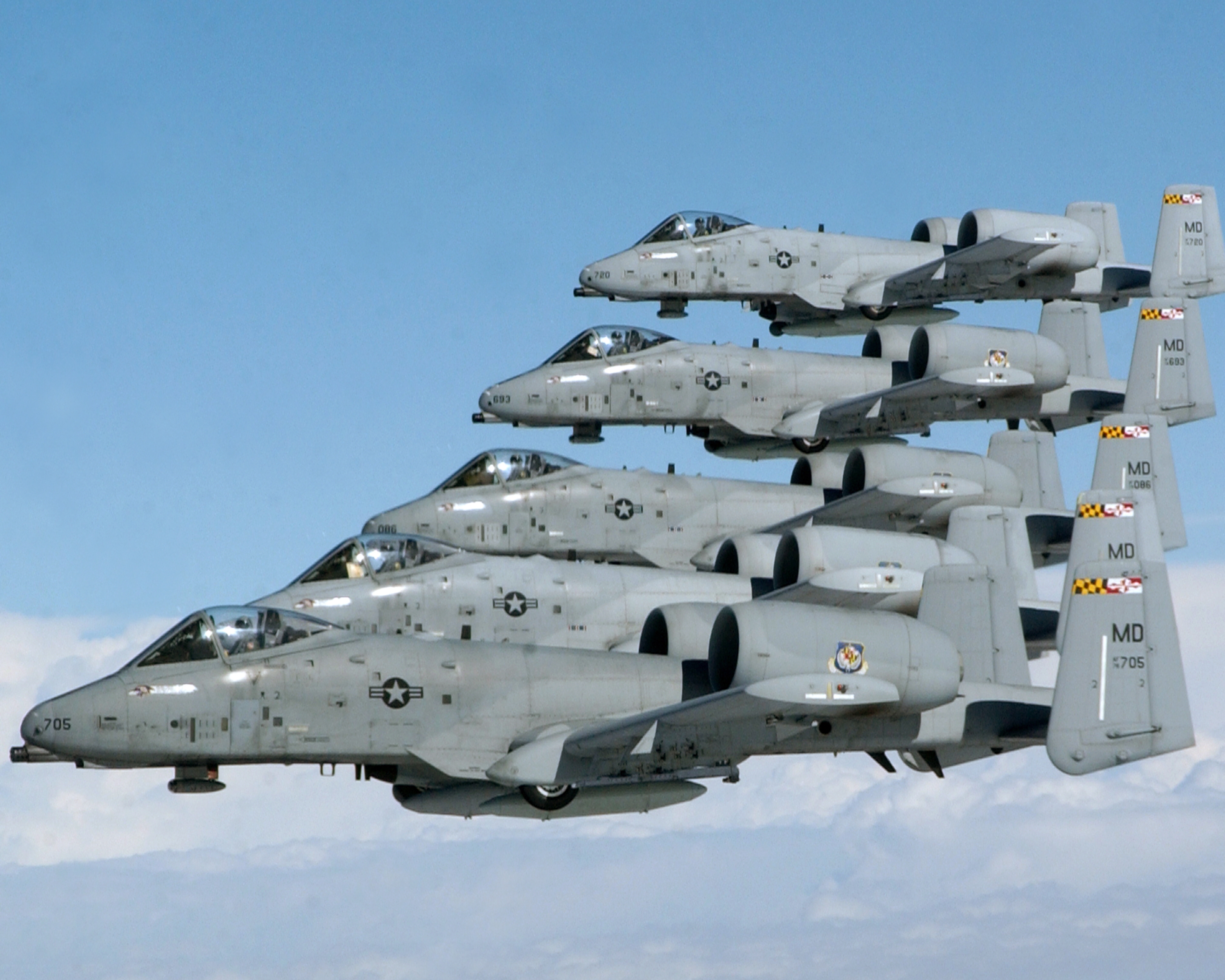
The Air Force's explanation for the 8 p.m. event is thin: five A-10s from Operation Snowbird, returning to Davis-Monthan under visual flight rules, on a heading consistent with the witness path. The statement puts aircraft in the right place at the right time. It does not account for why so many witnesses described something low, slow, silent and structured, and no flight plan, radar track or radio log has ever been released to settle the question either way.
The 10 p.m. row of lights
The second event is the one the cameras caught. Beginning around 10 p.m., residents across the Phoenix metro reported a row of seven to nine bright orange lights, evenly spaced, hanging in a near-horizontal line over the Sierra Estrella ridge. The lights stayed lit for several minutes, then went dark one after another, end to end. People in south Phoenix, Scottsdale, Tempe and Mesa filmed the display from multiple angles the same night.
Two and a half weeks after the event, Davis-Monthan Air Force Base told the press that no military exercises had taken place at the Barry M. Goldwater Range the night of March 13, blaming the omission on a logbook error by the duty officer. The Air National Guard's account of the flares did not come until July 25, 1997, more than four months after the sighting. Captain Drew Sullins, a Maryland Air National Guard spokesman, then told the Associated Press that eight A-10s from his unit had been flying training missions out of Davis-Monthan that night and had dropped high-intensity LUU-2B/B parachute illumination flares from about 15,000 feet on the Barry M. Goldwater Range before returning to base. "Before returning to Davis-Monthan Air Force Base in Tucson that night, the planes dumped all their remaining flares at high altitude, which would have created what one pilot called 'one hell of a light show,'" Sullins said. Lieutenant Colonel Ed Jones of the 104th Fighter Squadron later confirmed his flight had dropped the flares on a timeline matching the 10 p.m. sightings.
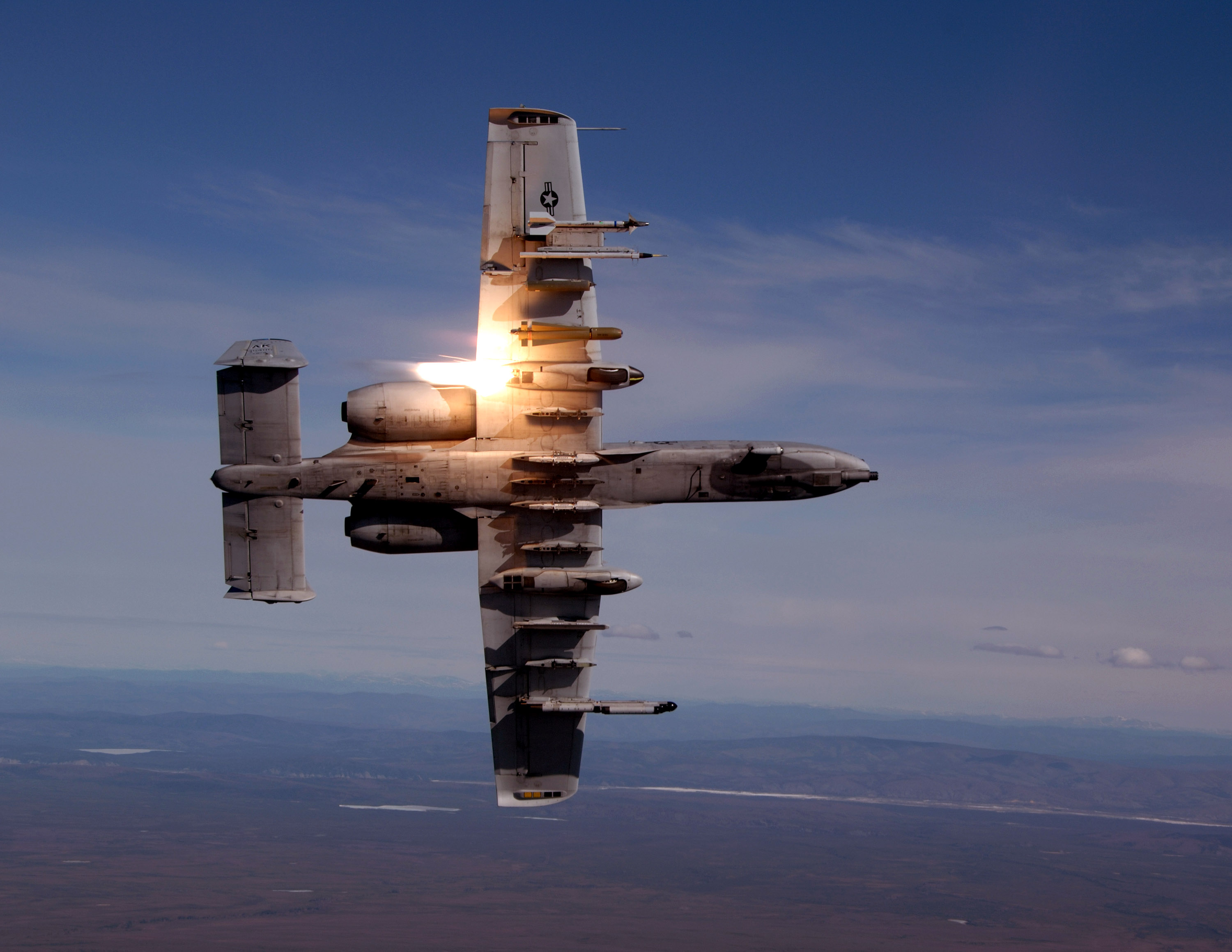
The LUU-2B/B is a 30-pound magnesium flare that burns at high candlepower for about five minutes and drifts down under a parachute. From the air, or from dozens of miles away on the ground, a single burning flare reads as a stationary, high-intensity light. Drop eight or ten of them in sequence south of a mountain ridge and the descending flares vanish behind the horizon one by one — the pattern captured on the home videos from that night. A 1997 Fox television special matched the disappearance timing on multiple witness recordings against the actual Sierra Estrella skyline. The fits were exact.
Symington's costume, and his reversal
On the morning of June 19, 1997, Governor Fife Symington III called a televised press conference and announced a "break" in the case. His chief of staff, Jay Heiler, walked out in a silver alien costume, escorted by state troopers as a joke. "This just goes to show that you guys are entirely too serious," Symington told reporters. Phoenix councilwoman Frances Emma Barwood had spent the previous two months fielding roughly 700 constituent calls about the lights and pushing for a formal investigation; she had written to Senator John McCain asking for a military inquiry. The costume press conference effectively closed that door. The Arizona Republic ran a political cartoon mocking Barwood for asking the question; she lost her council seat within a year.
Ten years on, in March 2007, Symington told the Arizona Daily Star and CNN that he had been one of the witnesses that night, and that he had believed from the start the lights were not conventional aircraft. "I'm a pilot and I know just about every machine that flies," he said. "It was bigger than anything that I've ever seen. It remains a great mystery. Other people saw it, responsible people. I don't know why people would ridicule it." He described the costume as crowd control, saying Arizona had been "on the brink of hysteria," and that he had not felt able to say what he really thought while still in office. Barwood, in the same period, told a Showtime documentary that city staff had put signs in the council chamber with her picture reading "talk into the tin foil and she will hear you."
The Maryland Air National Guard's 104th Fighter Squadron — the unit identified in the 1997 USAF account — flew its last A-10 sortie in September 2025 before the wing's inactivation, and the aircraft were transferred to the Michigan Air National Guard. McCain's office had not, by that point, produced the military inquiry Barwood had asked for. The 1997 Fox special that matched the disappearance timing on multiple witness recordings against the actual Sierra Estrella skyline is the closest the case has to a settled finding on the 10 p.m. event.
Related UAP Logbook notes
- What did David Grusch mean by "sentient plasmoid life"?
- Belgium's UFO wave: the reports, the F-16 intercepts, and the famous triangle image
- The Hessdalen lights: the scientific record
- Historical UFO files: archives, hearings, and the public record
- U.S. domestic UAP: military, FAA, and the case files
Sources
- Wikipedia: Phoenix Lights — case overview, including the 7:55–10:30 p.m. event timeline, witness geography, and the Robert Sheaffer / James McGaha two-event framing; verify quoted numbers and dates against the underlying sources listed in the article before publication.
- Deseret News (AP, July 26, 1997): "Flares, not UFOs, caused light show, military says" — Captain Drew Sullins, Maryland Air National Guard, on the eight A-10s and the LUU-2B/B flare drop on the Barry M. Goldwater Range on the night of March 13, 1997.
- UAP Globe: Phoenix Lights case file — Lieutenant Colonel Ed Jones (104th Fighter Squadron, Maryland Air National Guard) on the LUU-2 flare drop on the North Tac range at the Barry M. Goldwater Range; secondary compilation.
- Deseret News (AP, March 25, 2007): "Former governor says he saw UFO" — Symington's 10-year reversal, the 1997 costume press conference, and his 2007 statements to the Arizona Daily Star and CNN; includes the McGaha quote on the two-event split.
- Los Angeles Times (June 20, 1997): "Tapping UFO Flap to Bait the Hook, Ariz. Governor Reels in Reporters" — primary contemporaneous account of the June 19, 1997 press conference and the Heiler costume stunt.
- Skeptoid Podcast: "The Alien Invasion of Phoenix, Arizona" — secondary analysis of the 10 p.m. event, the LUU-2B/B flare mechanics, and the Sierra Estrella horizon match.
- Flying Magazine: "Kurt Russell Claims to be the Pilot Who Reported the Phoenix Lights" — transcript of the 2017 BBC interview with Gyles Brandreth, in which Russell identified himself as the anonymous pilot who had reported the V-formation to Phoenix Sky Harbor approach.
- Phoenix New Times: "The Phoenix Lights UFO sightings in 1997: An oral history" — Frances Emma Barwood interview and oral-history account of the post-March 13 political reaction in Phoenix.
- Wikipedia: 104th Fighter Squadron — unit history and A-10C assignment of the Maryland Air National Guard squadron identified in the USAF account.
- DVIDS: 104th Fighter Squadron, Family Range Day (August 9, 2025) — U.S. Air National Guard public photo record for the Maryland ANG A-10C unit, the last operator of the type before its 2025 inactivation.