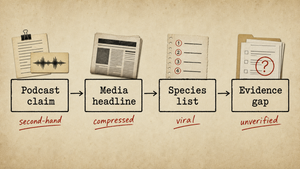
News / Jul 06, 2026
The alien signal may already be in the archive
The old SETI picture was a radio hello from another star. The newer search is stranger and more technical: optical and infrared beams, archived spectra, Rubin Observatory alert streams, and anomaly detection at survey scale.
In 1960, Frank Drake pointed the Green Bank telescope at Tau Ceti and Epsilon Eridani, listening for a signal that would stand out from the sky's background noise. That image stuck: a radio dish, a narrow frequency band, maybe something near the "water hole" between hydrogen and hydroxyl emission lines, waiting for a deliberate hello from another star.
A new PBS Space Time episode starts with that history, then walks somewhere far less cinematic — into old spectra, live sky surveys, optical and infrared detectors, alert-filtering software, and astronomical archives that were never built with SETI in mind.
Sixty-five years after Drake's first listen, the central question has shifted. Researchers no longer just ask whether anyone out there is transmitting. They're starting to ask whether a signal could already be sitting in data nobody looked at closely enough.
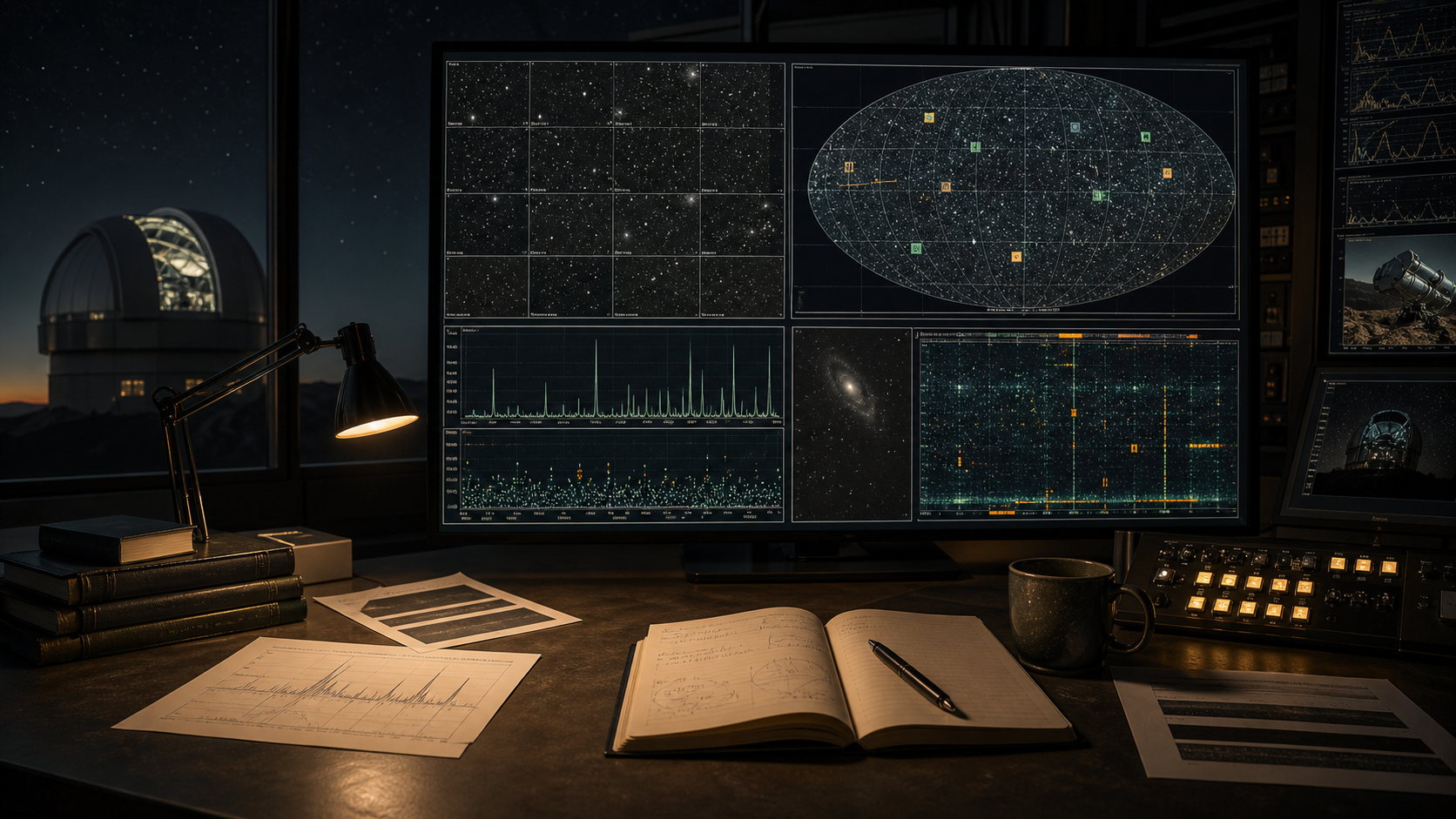
The PBS frame
Host Matt O'Dowd builds the episode around a recent paper by UCLA astronomer Ben Zuckerman, titled "Broadband SETI: a New Strategy To Find Nearby Alien Civilizations" and published in The Astrophysical Journal in early 2026. Zuckerman argues for a broader search shaped less by 1960s radio assumptions and more by what astronomers now know about exoplanets, laser technology, and modern survey capabilities.
Radio made sense in Drake's era: the equipment was practical, radio waves travel well through dusty space, and a narrow spike stands out against background noise. But radio beams spread out. PBS lays out the physics — the tighter a beam, the less energy gets wasted lighting up empty space, so a civilization with better instruments and more precise knowledge of nearby planets could aim far more narrowly than the old broadcast model ever assumed.
That reshapes what a detectable signal might look like. It might be optical or infrared rather than radio, broadband instead of a clean tone, or aimed at one specific planet already flagged as capable of supporting life rather than broadcast indiscriminately.
The target list changed
Drake had no idea whether planets were common around other stars — Kepler settled that question decades later. The episode leans on this shift because it changes who the imagined sender might be and how they'd behave.
If Earth-like worlds turn out to be common, and if future instruments can spot biosignatures or even image nearby exo-Earths directly, an older civilization wouldn't need to broadcast into the void. They could just pick their targets. Zuckerman's paper runs with that logic, proposing a search focused on Sun-like stars within a defined local volume, treating Earth-like planets as the realistic target set rather than the whole sky. PBS frames that range around 650 light-years and traces a rough path from countless possible worlds down to a much smaller list of plausible Earth analogs.

The paper's real payload, though, is what it does with the absence of a detection so far. Zuckerman argues that non-detections in existing radio and optical surveys already set meaningful limits on how many communicative civilizations exist in the galaxy — his estimate puts the number below 100,000, and possibly below 10,000. He extends the same logic to physical probes: the lack of any evidence for an alien probe in the solar system suggests no civilization has passed within 100 light-years of Earth in the past several billion years. The exact numbers matter less than what they represent — a shift from "we haven't found anything yet" to "the absence of a find is itself data."
The archive problem
The word that carries the most weight in this episode isn't "signal." It's archive.
PBS highlights HARPS, the high-resolution spectrograph at the European Southern Observatory in Chile. In a 2025 study (arXiv:2508.08628), Benjamin Fields and Jason Goodman combed through archived HARPS observations of 2,821 stars looking for narrow-band laser emissions. Their automated search flagged 285 initial spectral peaks. After filtering out cosmic rays, calibration lamp artifacts, and airglow, three candidates remained — two M-type stars and one oscillating red giant — with unexplained emission lines that still need follow-up.
A SETI search, in other words, doesn't need its own dedicated telescope time anymore. It can ride inside data collected for entirely different astronomical purposes.
These archives aren't a shortcut to certainty. They come with selection effects, instrument limits, false positives, and the oldest unsolved problem in the field: nobody actually knows what an extraterrestrial technological signal is supposed to look like. What they do change is scale — the sky has already been measured in ways earlier SETI programs couldn't access.
Rubin and the alert stream
The next stage of this search isn't stored data sitting on a hard drive. It's a live, constant stream, and it's already running.
The Vera C. Rubin Observatory issued its first real-time alerts in February 2026, and its Legacy Survey of Space and Time formally began its ten-year run from Cerro Pachón, Chile, on June 30, 2026. Its 3,200-megapixel camera images the entire southern sky every few nights, producing roughly 10 terabytes of data nightly and generating up to seven million alerts per night once fully operational. Seven full-stream alert brokers — including ALeRCE, AMPEL, ANTARES, and Fink — now process that flood in real time so researchers can flag the events worth chasing.

A 2025 paper by Eleanor Gallay, James Davenport, and Steve Croft, published in the Astronomical Journal, explores how that kind of infrastructure could serve technosignature research directly. Working with the smaller ZTF survey, they showed that alert brokers can already be configured to scan up to a million alerts per night, looking for patterns like the "SETI Ellipsoid" or high-amplitude stellar "dippers" that might point to something artificial. Rubin's stream is roughly seven times larger, which is what makes the approach interesting at scale rather than just in principle.
The vocabulary here trades romance for mechanics: alert packets, brokers, filters, variability classifiers, follow-up windows. An anomaly isn't a shortcut to intelligence — it's the starting point of the actual work, which involves ruling out instrumentation errors, known astrophysics, satellites, artifacts, and plain human pattern-hunting before anything gets taken seriously.
What makes a signal technological
The episode lists a few possible tells: unusual frequency structure, unexpected spikes, timing patterns, sudden or periodic changes, and Doppler shifts consistent with a planet orbiting a star.
This is where the search gets genuinely hard. Space isn't simple or quiet. Pulsars once looked artificial enough to earn the nickname "LGM," for little green men, before astronomers understood what they actually were. The Wow! signal still gets discussed decades later because a single clean detection can take on a life of its own culturally, even without a repeatable source ever showing up.
Modern SETI has to live with that tension. More data, more wavelengths, and better algorithms mean more real leads — but also more false candidates and more chances to mistake an instrumental quirk for something cosmic. None of this proves aliens have been found. It shows that the machinery of the search itself is changing, and that the absence of a find is starting to carry statistical weight of its own.
Sorting through the archive
SETI is heading in a different direction than the public UFO conversation usually wants. There's no leaked video here, no congressional hearing, no whistleblower — just a long, methodical audit of existing sky data: old spectra, live surveys, alert brokers, unexplained variability, and the unglamorous work of ruling out everything ordinary first.
If a signal is eventually confirmed, the challenge probably won't be secrecy. It'll be sorting through everything else the sky has already recorded.
Sources
- PBS Space Time: "We've Been Searching for Aliens the Wrong Way. That's All About To Change...", YouTube video, 2026.
- Ben Zuckerman: "Broadband SETI: a New Strategy To Find Nearby Alien Civilizations", *The Astrophysical Journal*, 2026 (arXiv:2603.07333).
- UCLA Physical Sciences: "New SETI strategy suggests alien signals could be hiding in plain sight in existing astronomy data".
- Benjamin Fields and Jason C. Goodman: "A 2821 Star Optical SETI Survey using ESO HARPS archival data", arXiv:2508.08628, 2025.
- Eleanor M. Gallay, James R. A. Davenport, and Steve Croft: "Technosignature Searches with Real-time Alert Brokers", *The Astronomical Journal*, 170:95, 2025 (arXiv:2506.14744).
- Vera C. Rubin Observatory: alerts overview.
- Vera C. Rubin Observatory: alerts and brokers.