Main Article / Jul 06, 2026
Area 52 was a name in a phone book before it was a meme
Area 52 was not a joke first. The name was in an April 1965 Atomic Energy Commission directory, on a classified Nevada range that the Department of Energy still runs through Sandia. The cartoon, the bands, and the cannabis market all came later.
I think a lot of people have played off of the name Area 52 thinking it's a clever joke.
Cannabis, gummies, there are bands that are named after it. There are video games, it's all over the place, cartoons that we're going to see a little bit later, and a podcast.
There's a guy named Chris Ramsey who's a friend of mine, and I think people use that term thinking they're being clever playing off Area 51, but it's a real place.
That is George Knapp, on the 3 July 2026 edition of Mystery Wire, setting up the segment's premise. The place the meme is playing off is the Tonopah Test Range. The meme is younger than the documents that already named the place. Knapp is on camera holding an Atomic Energy Commission Nevada Operations Office telephone directory from April 1965, with the entry pointing to a phone number for "Area 52."
"Don't ask me how I came across it," Knapp says, "but it's got phone numbers for Area 51 and Area 52. That's what they called it. It's a real place, and that was a real name for it."
Sixty-one years later, the name is still on classified maps, the place it names is still operating, and most of what goes on there is still not on the public record. What follows is what the public record does say — and where it stops.
What Area 52 actually is
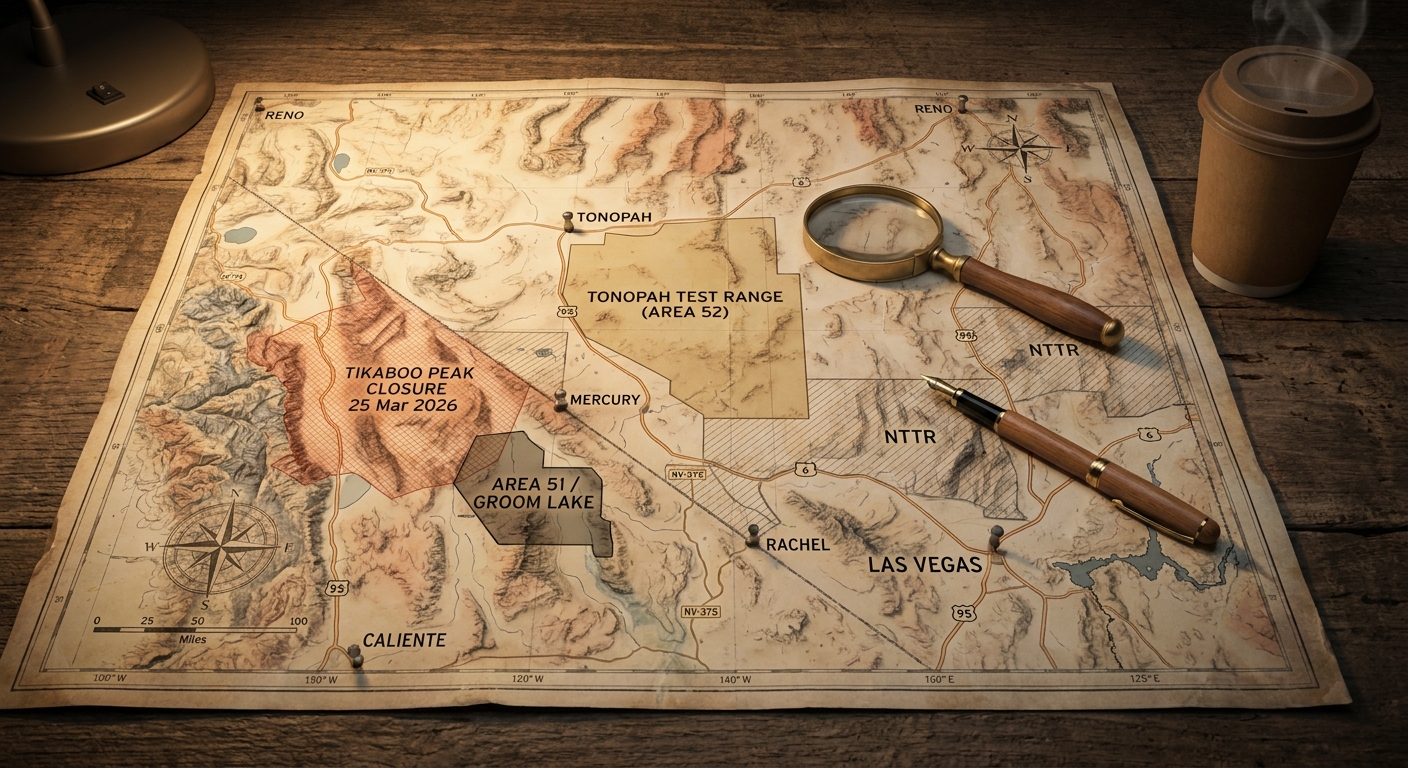
The Tonopah Test Range covers 525 square miles on the northern fringe of the Nevada Test and Training Range, about 30 miles southeast of the town of Tonopah and roughly 70 miles northwest of Groom Lake, the home of Area 51. In a 1976 environmental assessment the range's size was given as 624 square miles. The modern figure used by Sandia National Laboratories is 525. Both numbers refer to the same place.
The base is owned by the Department of Energy. It is managed by Sandia National Laboratories, a wholly owned subsidiary of Honeywell International (a structure inherited from when Sandia was a Lockheed Martin subsidiary), under an Air Force permit with the National Nuclear Security Administration. Sandia's own locations page describes the range's function plainly: it is "the testing range of choice for all national security missions," with terrain "ideal for rockets and low-altitude, high-speed aircraft operations," and the "remote location and restricted airspace" needed to keep tests both safe and quiet.
Sandia's visitor-directions page splits operations on the ground into named areas. Area 3 is the Sandia compound at the heart of the base, housing the operations control center, the range safety officer, the test director, and the key engineers for any weapons test running that day. Two public-facing entry points are listed by name: Able Gate is the main entrance on the road in from Tonopah. Cedar Gate is the alternate access for charter flights from Las Vegas. The numbering scheme is internal; the names, Knapp notes on the segment, are not.
Unlike Area 51, TTR is on most maps. The paved road leading to its main gate is not. At the main gate, armed security stops any unauthorized visitor.
The handoff: Plant 42 → Edwards → Area 51 → Area 52
The clearest part of the segment is Knapp's tour of how secret programs physically move between sites.
"Top secret projects get built at Plant 42, and then get flown for the first time at Edwards, and then they go to Area 51 where they're really developed, and after they become operational, they go to Area 52, Tonopah."
That pipeline is documented in pieces. The U-2 and A-12/Oxcart programs got their first flights at Groom Lake in the 1950s and 1960s. The F-117A Nighthawk went through early development at Area 51 in the early 1980s, was operationally evaluated at TTR through the late 1980s with Tonopah residents seeing bat-winged jets overhead almost nightly — Knapp says on the segment that the residents "have been seeing stuff flying in the sky for a very long time" — and was finally acknowledged to the public via a single grainy photograph in 1988. On 22 April 2008 the surviving F-117As returned to TTR for storage. As of December 2019, Dreamland Resort's most recent observer survey at the time of writing, several F-117s are still being flown out of TTR for missions over the ranges and in Death Valley.
What they are testing against today is more uncertain. The long runway at TTR that everyone assumed was a stealth facility was, Knapp notes on the segment, actually built long enough to handle a fleet of Russian MiGs flown under a separate classified program.
Constant Peg: 15,000 sorties that did not leak
That separate classified program is Constant Peg. It runs through the segment's strongest piece of operational history, an on-camera interview with retired Colonel Gail Peck.
From 1978 to 1988, Peck commanded a classified detachment that flew Russian MiGs in simulated combat against American warplanes, against American radar systems, and — in the program's second phase — against unmanned aircraft. "Must-know" was the access language. "The door shut behind you" was how participants described the briefing.
"They built the long runway at TTR, not for the stealth, as everyone has long believed, but for a fleet of MiGs," Knapp tells the segment.
The public now has the count. Ten years. Fifteen thousand sorties. Eleven months from the program's end to first journalistic confirmation. Nineteen years from the program's close to public confirmation in detail. The point is not that the flights were exotic. The point is that 15,000 sorties went out of a public airspace, over a small town that knew exactly what was happening, and remained unannounced.
"It is the only place in the world where we can operate discreetly, where we can do things without people watching," Peck says on the segment.
The same discretion is what makes the next part of the story harder to verify.
What we know is going on there now
Three publicly documentable tracks of activity survive on the record.
Stockpile stewardship and weapons testing. Sandia's own locations page and annual site environmental reports (the 2024 report for SNL/TTR is public) describe ongoing work on fusing and firing systems, nuclear weapons delivery systems, parachute performance, trajectory studies, artillery shells, air-launched rockets, explosives testing, and ground penetrators. The Sun's Tonopah coverage lists "missile tests, bomb drops, cannon firing, bunker buster tests" as routine. The 1976 NRC environmental assessment for TTR documents experiments on detonation timing, fragment spread, and rocket-motor performance. This is the work the test range was built for, in 1957, and it is still what it does.
Stealth and dark-program test storage and continuation. The F-117A is the visible example. The Wikipedia and Dreamland summaries agree on the pattern: aircraft come out of Area 51 development and use Tonopah as a final operational, test, or storage site. The U-2, the SR-71, the F-117A, and — most recently — airframes tied to the B-21 Raider program have all left traces over the range. Tonopah residents, as Knapp notes on the segment, still see "dozens of contrails from the base every day, most likely the transport planes carrying employees from a private terminal in Las Vegas."
Unmanned combat air systems, since at least 2005. "Since 2005, possibly longer, a newly formed squadron at TTR performs tactical evaluation of new UAV designs and operational strategies," according to the Dreamland Resort page on TTR. Knapp adds on the segment that the weaponization of UAVs — strapping missiles onto Predators — is "where the military figured out" the trick, and "it's believed the work on drones has been successful." Satellite imagery published on the Tonopah Test Range Wikipedia entry independently confirms that the United States has, at some point, acquired a Russian-made S-300PS surface-to-air missile system from an unidentified supplier in order to test UAVs and other advanced aircraft based at nearby airfields.
Beyond those three tracks, Sandia points to one active classified program at the range: "highly advanced radar research." The platform list, the test timelines, and the program name are not on the public record.
The Site 4 question
Knapp is careful on the segment about what TTR's "Site 4" actually is.
"Nellis confirmed to us there is more than one S-4 on the test site, and one of them is a TTR. Workers have claimed the S-4 inside Area 52 requires special clearance. It's believed that highly advanced radar research is one [purpose]."
That sentence sits next to Bob Lazar's 1989 claim that he worked on flying saucers at a Papoose Lake facility called S-4. The geography does not match: Lazar's S-4 was alleged to be southwest of Groom Lake, inside the larger Area 51 box. Some open-source speculation, going back to the Dreamland Resort community and picked up by NBC's 2019 Bob Lazar reporting, has suggested Lazar may have borrowed the name from a real Site 4 southeast of TTR. Knapp does not endorse the Lazar story on the segment. What he confirms is mechanical: there is more than one Site-4 on the range complex, and access to one of them is gated.
"Workers have claimed the S-4 inside Area 52 requires special clearance." That is the part of the public record that holds. The Lazar-decoded saucer story is not claimed, by Knapp or in this article.
Why the BLM closed Tikaboo Peak
The second half of the segment turns to what Knapp expects to see at Area 51 and then at Area 52 over the next few years.
"I think, according to the people like Yorg Arnu and others, they expect it to be coming to Area 51, and after Area 51 for a while, then it could go to Area 52, but I don't believe it's out there right now."
That sentence links to the BLM's 25 March 2026 closure order at Tikaboo Peak, which had been the last public vantage point with a full line of sight onto Groom Lake since 1995, when Freedom Ridge and White Sides were closed. The closure covered 22,987 acres of public land around Badger Mountain in Lincoln County for "a minimum of one year or until conditions are reassessed and determined safe for public use." The stated rationale, "the significant increase in public hiking and traversing" on "mountain slopes [that] are too steep for safe foot traffic" with "the rocky ground… dangerously unstable," was the kind of public-safety language that appears in BLM closure orders routinely. The agency's own statement conceded no serious injuries in the area.
The same Joerg Arnu ("Yorg Arnu" is the transcript spelling) told The U.S. Sun in May 2026 that the closure was not about the terrain, adding that there had been "no public notice, no hearing, no nothing" before the signs went up. "There are three interesting projects right now that I think are moving into Area 51, and those are the reason for the closure," Arnu said. He named the Boeing F-47 and the AI-controlled drone programs. The third project he did not name publicly. Arnu runs Dreamland Resort, the long-running clearinghouse for Area 51 and Area 52 sightings, and was one of the researchers who had predicted the Tikaboo seizure in writing weeks before the signs went up. The nearest remaining public vantage point is now Reveille Peak, roughly 45 miles from Groom Lake.
The aircraft pipeline Arnu expects to see pass through the test range is now visible in official sources.
The Boeing F-47 is the Air Force's sixth-generation air-superiority fighter under the Next Generation Air Dominance program. The Engineering and Manufacturing Development contract was awarded to Boeing on 21 March 2025 in a White House announcement for more than $20 billion. First flight is targeted for 2028; operational service is planned for the 2030s; combat radius is officially more than 1,000 nautical miles — twice the F-22's reach. Air Force Chief of Staff General David Allvin announced in September 2025 that Boeing had begun manufacturing the first F-47 airframe. In February 2026, General Dale White confirmed the 2028 first-flight schedule remained on track, and the Air Force has since launched a market research project for F-47 facilities at Nellis AFB. With Tonopah already in the pipeline as the post-Area-51 destination for new programs, that puts the F-47 inside the same physical machine that hosted the F-117.
The F-44A Fury is its unmanned wingman under the Collaborative Combat Aircraft program. Built by Anduril Industries — and named after the Blue Force Technologies Fury the company absorbed in 2023 — the YFQ-44A prototype first flew on 31 October 2025 in the California desert and carried an inert AIM-120 AMRAAM for the first time in February 2026. On 17 June 2026 the Air Force awarded Anduril and General Atomics production contracts for the FQ-44A Fury and the FQ-42A Dark Merlin respectively, four months ahead of schedule, with a planned fleet of more than 150 CCAs before the end of the decade. The Fury is the public name of the first Unmanned Fighter designation the Air Force has ever issued. It is designed to fly alongside crewed fighters, including the F-47, as a force multiplier.
Neither aircraft requires the Tonopah Test Range to release anything. Both of them will pass through it.
The worker problem is real, and it sits inside this picture
Knapp devotes the back half of the segment to the part of the Tonopah story that news sites tend to skip.
At Area 51, he describes the open-trench practice that ran through the F-117 program and into its successors: "Nothing could ever leave Area 51, so they would take all garbage, composite materials that were used in the stealth, throw it into a big trench, douse it with jet fuel and burn it. And the toxic smoke would be breathed by the employees. The employees started getting sick. A couple of them died. All they wanted to know is, can you tell us what we're exposed to so we can tell our doctors? And the answer was no."
The Area 51 burn-pit case wound through KLES, hit the U.S. Supreme Court on a compensation track, and was rejected. A presidential decree exempts Area 51 from environmental laws. Former workers "cannot even prove that they were ever out there because their records leave it out," Knapp says.
On the Tonopah side, the public record on this question is thinner but the pattern is the same. The 2014 Las Vegas Review-Journal reporting on Fred Dunham, a former EG&G Special Projects security officer, documents the same administrative trap: EG&G's employees at the adjacent former Nevada Test Site have been paid $150,000 or more under the federal Energy Employees Occupational Illness Compensation Program Act; EG&G's employees at Area 51 itself, with the same DOE access badges, were told they were technically Defense Department subcontractors and ineligible. Knapp says that "there are a lot of people who are now getting sick because of things that they were exposed to" at the Tonopah side — radiation, toxic chemicals, "maybe some sort of exotic bioweapons type of material."
The disclosure request the segment is actually making is not about UFOs. It is about people. "These are people who gave their lives for national security. They've honored their oaths. They did their best to protect our country and protect the world from bad guys," Knapp says, "and they're not being treated very well." Then: "They helped win the Cold War."
The Tonopah-side compensation record is the longest-running open question in the segment, and the one that will outlast every other claim here. It is also the most expensive to leave open: the same classified reservation, the same companies, two different outcomes.
John Lear's part of the story ends here
Knapp introduces the late John Lear — whose father developed the Learjet — and Lear's long campaign to investigate Areas 51 and 52, on the segment.
"He spent I don't know how many countless hours sitting outside of Tonopah test range, the fence, with the likes of Jim Goodall and other aviation enthusiasts and experts."
The program also reports Lear's wider claims about a clean nuclear device used to build an underground chamber under Paiute Mesa, a 25,000-person facility, a high-speed underground train from Area 52 to Las Vegas, and runways that open and close at 500 feet. Knapp declines to validate the wider claims. "I never was able to confirm that there's these gigantic underground facilities at 51 or 52," he says. "I have confirmed that there are other facilities out there in the test site that are very hard to detect." He then walks the segment to a soberer close: "We got a lot of stuff underground out in the Nevada test range. We have seen those tunnels, hundreds of miles of tunnels. But as far as gigantic underground cities, I've never been able to confirm."
This article does not adjudicate the Lear claims. The boundary Knapp sets is the public record, and Tonopah Test Range sits inside that boundary with its real name and its real workers, not with its imagined tunnels.
What's missing from the public record
Several named items in the segment have no public complement.
- The 1965 Atomic Energy Commission Nevada Operations Office telephone directory has been shown on camera but is not in a public archive. Knapp says, "Don't ask me how I came across it." The directory is the cleanest documentary anchor on the segment; it is also the one document whose chain of custody the public cannot check.
- Specific worker compensation records on the Tonopah side are not on file in the public press. The Area 51 burn-pit track has Fred Dunham, EG&G Special Projects, and the 10 April 1986 Mighty Oak nuclear weapons effects test as on-record anchors. The Tonopah equivalent does not.
- The S-4 inside Area 52 is described by workers as requiring special clearance; what it contains, what it tests, and whether any of its work overlaps with the objects suspected in the Area 51 / Groom Lake UFO mythology are not on the public record.
- The Sandia page on TTR confirms the existence of classified advanced-radar research at the range but does not name the platforms or test timelines. Constant Peg had a 10-year public afterlife; the program currently housed in TTR's classified space does not.
Tonopah Test Range will keep making the same kind of news it has made since the late 1980s: workers who cannot say where they worked, aircraft the public catches on infrared only, BLM orders that close sightlines, and a phone book that names the place.
The 1965 AEC phone directory entry did that work before the cartoon got the name. The phone book is still the public's clearest read on what the place is. The rest of the public record is getting thicker. The worker side is not.
For now, Area 52 is the Tonopah Test Range, and a 1965 phone book page that says so.
Sources
- Mystery Wire with George Knapp and Ron Futrell, KLAS Las Vegas, "Area 52, the mysterious neighbor of Area 51," aired 3 July 2026 (transcript provided to UAP Logbook, includes Knapp's narration, the Cisco's diner insert, the Constant Peg interview with Colonel Gail Peck, and the John Lear segment).
- Sandia National Laboratories, "Tonopah Test Range — Locations" (sandia.gov/locations/tonopah-test-range/) and Tonopah Test Range public site (ttr.sandia.gov), including the customer/visitor directions page that lists Area 3 (SNL Compound), Able Gate, and Cedar Gate.
- Sandia National Laboratories, 2024 Annual Site Environmental Report for SNL/TTR (DOE released), and the 1976 NRC EIA for the Tonopah Test Range (EIA/MA/76-2) at nrc.gov.
- U.S. Air Force, "Air Force Awards Contract for Next Generation Air Dominance NGAD Platform, F-47," 21 March 2025.
- Boeing F-47, Wikipedia (citing Air & Space Forces Magazine and Air Combat Command on the Phoenix nickname and program status).
- Anduril FQ-44, Wikipedia; Reuters, "US Air Force awards production contracts to General Atomics, Anduril for drone wingmen," 17 June 2026; The Aviationist, "YFQ-44A Fury carrying AIM-120 AMRAAM, 24 February 2026; U.S. Air Force, official YFQ-44A photo release.
- The Aviationist, "Tikaboo Peak, Legendary Area 51 Viewing Spot, Closed by U.S. Government," 2 May 2026 (BLM 22,987-acre closure order of 25 March 2026).
- The U.S. Sun / The Irish Sun, "Area 51 expert points to 'top secret reason' why public suddenly banned…" Joerg Arnu interview on the F-47, YFQ-44A Fury, and AI drone read.
- Las Vegas Review-Journal, "Area 51 burning revealed," "Ailing ex-Area 51 worker gets help fighting feds," "Documents may help former Area 51 officer land settlement in toxic-exposure case" — the Fred Dunham / EG&G / Mighty Oak compensation record.
- Dreamland Resort, "Tonopah Test Range" page and map updates (used here only for current observer logs and historical F-117 flying dates).
- U.S. Bureau of Land Management, Temporary Public Safety Closure, Caliente Field Office and Basin and Range National Monument (effective 25 March 2026), and Closure Area Map (PDF).
UAP Logbook notes referenced
- Tikaboo Peak, the last public Area 51 viewpoint, is now off limits — the BLM order and what it removed.
- Area 51 public map gets smaller after Tikaboo closure — the geometry of what is still reachable.
- S4 became a product pipeline — the 2026 commercial release and what is missing from its evidence.
- Area 51 is a test range, not a single mystery — the infrastructure baseline for the wider Nevada range.