News / Jun 04, 2026
The 1998 Cangzhou UFO intercept is China's strangest military case
A 1998 report from Hebei describes a night intercept near Cangzhou: four radar alarms, two JJ-6 trainer-interceptors, and an object later called a short-legged mushroom.
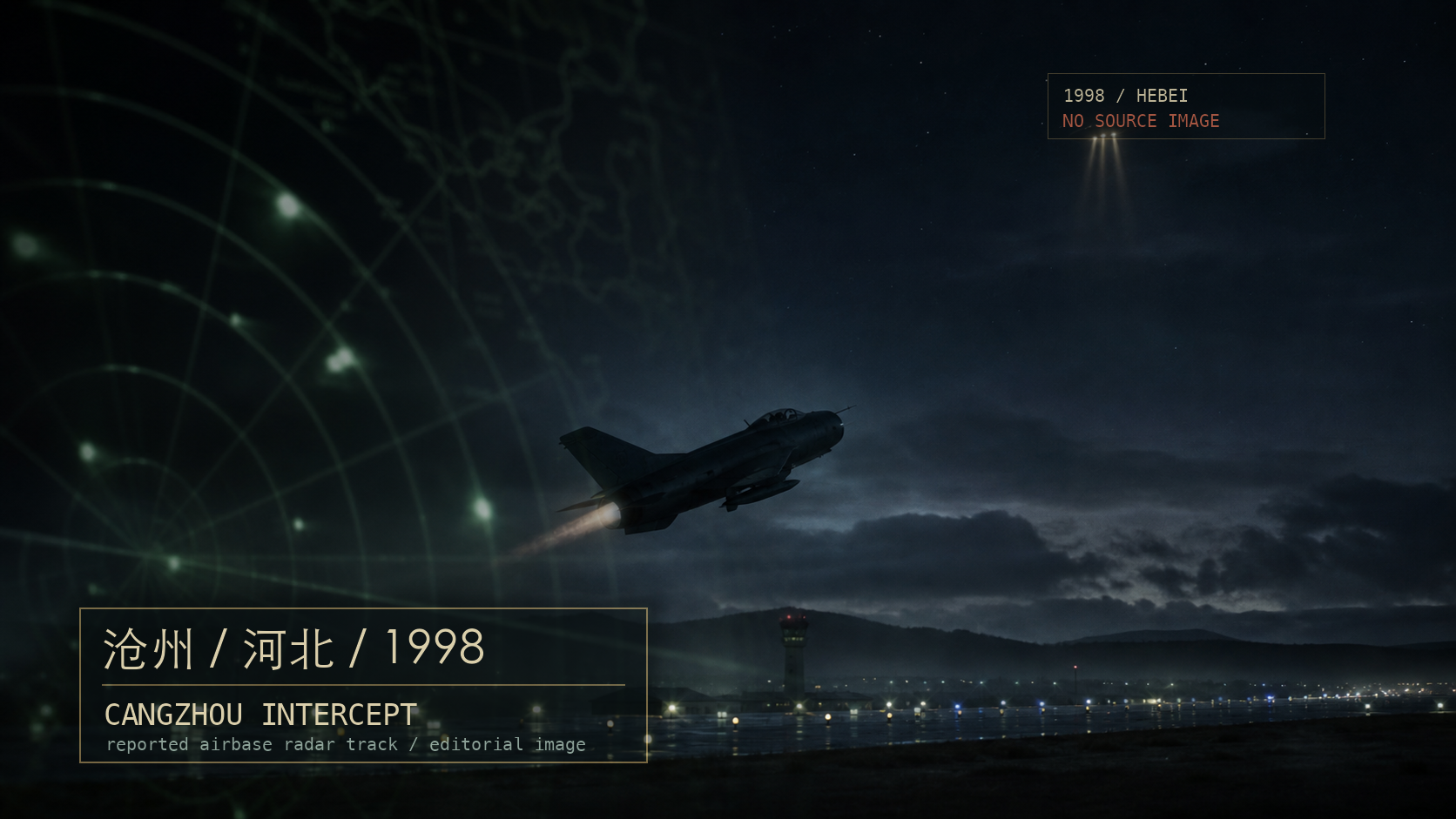
On the night of October 19, 1998, four radar stations at a flight unit near Cangzhou, Hebei, raised simultaneous alarms on an unknown track. The base commander, Li Suolin, ordered two JJ-6 trainer-interceptors into the air.
Ground observers saw a luminous object that grew from a starlike point into a "short-legged mushroom" with a beam of light shining downward. As the jets closed to within roughly four kilometers, the object climbed above 20,000 meters and disappeared from radar and visual contact.
Later reporting describes Cangzhou as China's only officially confirmed UFO sighting, and keeps using it as an anchor for the country's "unidentified air condition" system.
What the public record says
The case was first reported in Hebei Daily, the official newspaper of Hebei province, around the time of the incident. The original report is repeatedly cited in later accounts but isn't easily inspectable on the open web.
Retellings, including a 2021 South China Morning Post article by Stephen Chen and a 2025 arXiv paper on UAP science, describe the same core event: a low object over a military training area, radar alarms, an intercept order, and a target that outclimbed the pursuing jets.
The Sina version of the case, a December 2021 military-channel retelling that draws on the same provincial-paper trail, adds details the English-language coverage doesn't reach: the four-radar simultaneous alarm; the name of the base commander, Li Suolin; the pilots' titles, given as a deputy regimental commander Liu and a regimental commander Hu; the object's reported position over Qingxian county at about 1,500 meters altitude; and the visual transformation ground observers described — a single starlike point that split into two, came back together, and then became the "short-legged mushroom" shape with a beam of light shining downward.
The Sina version also gives the closest intercept distance: roughly four kilometers, at which point the object stepped upward and left the pursuing jets behind. Two more fighters were reportedly scrambling to continue the pursuit when the object vanished entirely.
Those Sina details aren't independently verifiable from the open record, but they are consistent with the English-language retellings and with the 2025 arXiv paper's account of the same incident.
Why Cangzhou still matters
A 2021 SCMP article described a Chinese military system for sorting "unidentified air condition" reports collected from radar stations, pilots, police, weather stations, and scientific observatories. Cangzhou was the older anchor case for that system: the incident used to show that China hadn't treated every unknown object as folklore.
The shape phrase has also survived translation. "Short-legged mushroom" is what Chinese retellings call the object, and it's the descriptor English-language coverage keeps coming back to.
What's still thin
The original Hebei Daily report is the load-bearing source, and it isn't easy to retrieve in full. The pilot names, cockpit details, and exact aircraft type are repeated in retellings but aren't in the primary record. The radar track, the intercept order, and any air-defense follow-up explanation haven't surfaced in public files.
Cangzhou sits in an unusual place: more concrete than a viral clip, less open than a modern release. For a case later reporting describes as China's only officially confirmed UFO sighting, the public file is thinner than the U.S. PURSUE drops, but more grounded than a witness-only sighting.
A real airbase, four simultaneous radar alarms, a named base commander, an intercept at four kilometers, and a mushroom-shaped light over Hebei that nobody has publicly closed out.
Related UAP Logbook notes
- How other governments handle UAP reports
- Japan's UAP timeline
- Japan's Cabinet Secretariat UAP proposal
- PURSUE Release 02 adds a 2025 orb narrative and old Sandia green-fireball files
Sources
- South China Morning Post: "China military uses AI to track rapidly increasing UFOs", Stephen Chen, June 4, 2021.
- Mirror of the SCMP article, useful for the Cangzhou passage if the original is unavailable.
- Sina military-channel retelling of the 1998 Hebei / Cangzhou UFO intercept account, December 17, 2021.
- Ifeng: "Cangzhou pilots chase UFO" retelling, October 15, 2013.
- Kevin H. Knuth et al.: "The New Science of Unidentified Aerospace-Undersea Phenomena (UAP)", arXiv:2502.06794, revised March 30, 2025.